
Add slabs to your wishlist so we can give you custom quote.
Add productions from our slab collection so we create a quote for your next project!
If you're unsure of what you're after please reach out via our contact page.

A Sydney Buyer's Guide to Dekton Benchtops
A Sydney Buyer's Guide to Dekton Benchtops
TL;DR Dekton is a sintered surface fired into a dense, non-porous slab. It resists stains, heat and UV, so it works indoors and out with no sealing. The trade-offs are at the edges: fewer profiles, and corners that need a little care. Choose 12mm for a slim, contemporary look and 20mm for a conventional benchtop, or a mitred edge for a thicker look. Check the edge of the exact colour before you commit.
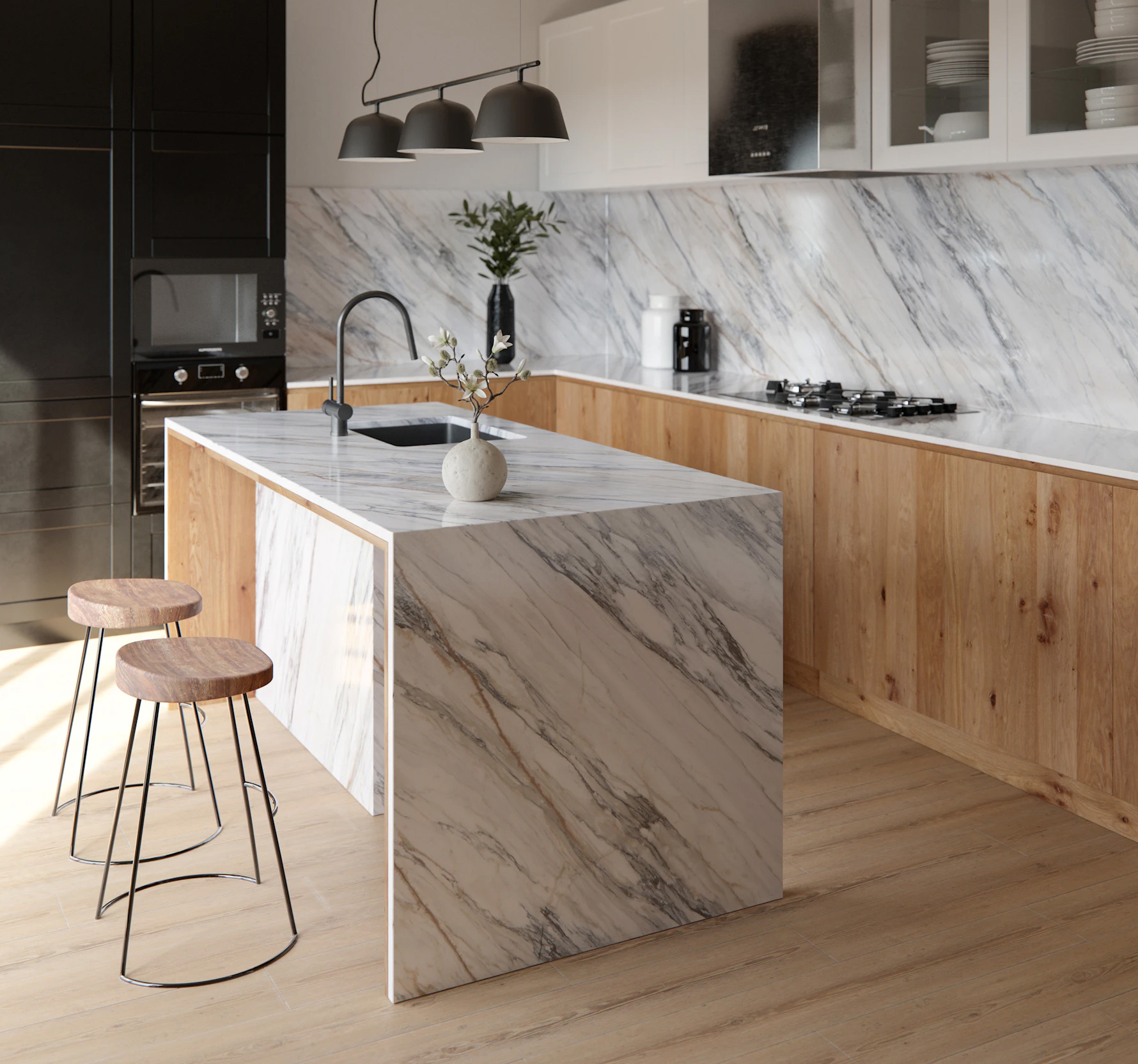
Dekton usually comes up when someone has had enough of worrying about their benchtop. A previous marble kitchen with etch marks. A plan for an outdoor kitchen. A family that cooks every night and cleans up whenever it can.
It's a good answer to all of those. It's also a different kind of material from stone, with its own rules, and most of the disappointment we hear about comes from people who didn't know those rules going in. Here's what's worth knowing before you choose it.
What is Dekton?
Dekton is a sintered surface, sometimes called ultracompact. It's made from a blend of minerals pressed under enormous pressure and fired at very high temperatures. The result is a dense, very hard slab with almost no porosity.
That low porosity is where most of its strengths come from. Liquids can't soak in, so it doesn't need sealing. It contains no resin, so heat and sunlight don't affect it the way they affect engineered stone.
It sits with porcelain in our range. If you want the wider picture, our porcelain and sintered stone range has the full set. If you're weighing Dekton against Neolith specifically, we've compared those two in a separate post.
What does Dekton do well?
Stains are the first win. Red wine, oil, turmeric and coffee wipe off rather than soak in. For a lot of families that alone settles it.
Heat is the second. Dekton handles hot pans far better than engineered stone and most natural stone. We still recommend a trivet or board under really hot pans and dishes, partly for the surface and partly because sudden heat in one spot is never a great idea for any benchtop.
Scratches are the third. It's very hard, so everyday knife slips won't mark it. Use a board anyway, mostly for the sake of your knives.
The fourth is the outdoors. Dekton is UV stable, so it won't fade or yellow in the sun, which makes it one of the few benchtop surfaces we're comfortable recommending for an exposed outdoor kitchen.
Where does Dekton need more care?


The edges and corners. Dekton is hard, and hard materials tend to be less forgiving of a sharp knock on an edge than softer stone is. A cast iron pot swung into the corner of a benchtop is the classic example. Be mindful at the edge, and choose an edge detail that suits how you use the kitchen.
Edge choice is also more limited. Natural stone can be shaped into a wide range of profiles. With Dekton, we keep to simpler, cleaner edges that suit the material. If you love a heavily shaped profile, natural stone is the better fit. Our guide to edge profiles walks through the options.
Then there's the body. On some Dekton colours, the pattern and colour you see on the surface aren't fully carried through the slab. On a slim square edge, that can read as a plainer band of colour. It varies a lot between colours, so always look at the edge of the exact colour you're choosing, not just the face.
Which thickness should you choose?
Dekton is made in several thicknesses, from very thin sheets for cladding up to heavier slabs. For benchtops, the real choice is between 12mm and 20mm.
12mm gives you that crisp, slim, very contemporary line. It suits minimal kitchens, floating vanities and furniture-style islands. It needs proper support underneath, and your joinery team should plan for that from the start.
20mm reads like a conventional benchtop. It's the safer choice for a family kitchen, and it pairs more naturally with traditional joinery.
If you want a thicker, more solid look, a mitred edge builds the front up so it reads as a heavier slab. On the right colour, a mitred edge also wraps the surface pattern around the front, which hides the body colour issue completely.
What finish should you choose?
Dekton comes in several finishes, from matte and soft-touch textures to high gloss. This is a decision to make by hand, in the showroom, rather than from a photo.
Matte and textured finishes reduce glare and feel more like honed stone. They suit natural light and calm, layered kitchens. Gloss reflects more light and makes colours look deeper, but it shows fingerprints and smudges more, especially on darker colours.
The colours we have in show the range well. Albarium comes in a matte finish, Nara in Velvet, a soft-touch texture, and Nebbia in a smooth matte. Put them side by side and you can feel how much the finish changes the same kind of surface. The full set is on our Dekton range page.
Darker matte surfaces can show greasy marks from hands more than lighter ones. They clean easily. It's just worth knowing that a black matte island will need a wipe more often than a pale one.
Is Dekton right for your kitchen?
Choose Dekton if you want a surface you can stop thinking about. Spill-heavy cooking, small kids, a rental, a holiday house or an outdoor kitchen are all good reasons. It also suits architects and designers who want a slim, consistent surface across benchtops, splashbacks and cladding.
Choose natural stone if the movement and one-of-a-kind character are why you're renovating. A quartzite gives you real veining and toughness. It needs sealing, but it has a depth no manufactured surface can copy.
Choose silica-free engineered stone if you want a calm, consistent surface indoors on a tighter budget. It's an indoor-only material, which rules it out for outdoor kitchens.
Can Dekton be used for splashbacks and cladding?
Yes, and this is where it shines in architectural work. The slabs are large, so a full-height splashback can run with very few joins, and the same surface can carry onto a rangehood, island end or wall.
A few things are worth settling early. Around windows, the splashback is usually joined, and sills and ledges are butt joined or mitred to it. The splashback thickness needs to be allowed for in sink, tap and cooktop clearances, following each appliance's install guidelines. And tell us which power points you're using at quote stage, because standard, flush and Zeta outlets each change how the slab is cut.
Site access matters too. Large pieces need a clear path through halls, stairs and side entries, and extra lifting for big pieces can add cost. We review the slab layout and count with you at quote stage, joins included.
What does Dekton cost?
Price depends on more than the slab. The colour, the thickness, how many slabs the layout needs, the edge detail, cut-outs and site access all change the number. A mitred edge, a large island or a full-height splashback can move it a lot.
The most useful thing you can do is get a quote on the actual layout. If you're undecided, ask us to quote Dekton next to a natural stone option, so the comparison is real rather than guessed.
Living with it
Day to day, Dekton asks very little. Warm water and a mild detergent handle most cleaning. No sealing, ever. Avoid abrasive pads on gloss finishes, and wipe greasy marks off matte ones.
The things to remember are small. Trivets under really hot pans. A board for chopping. A little care at the corners. That's the whole routine.
See it before you choose
Dekton colours look different at full size than on a small sample, and the finish changes everything. Come and see the range in our Strathfield South showroom, hold the samples in daylight and check the edges as well as the face.
If you're planning a kitchen around it, a design consultation is the fastest way to settle thickness, edges and layout before anything is cut.
Frequently asked questions
Does Dekton need sealing?
No. Dekton is non-porous, so liquids sit on the surface rather than soaking in. There's nothing to seal and no yearly maintenance. Warm water and a mild detergent handle everyday cleaning. That's one of the main reasons people choose it over natural stone.
Can you put hot pans on Dekton?
Dekton handles heat far better than engineered stone and most natural stone, so a hot pan set down briefly won't harm it. We still recommend a trivet or board under really hot pans and dishes. It's a good habit with any benchtop, and it protects against sudden heat in one spot.
Does Dekton chip?
It's very hard and scratch resistant, but hard materials are less forgiving of a sharp knock on an edge or corner. Be mindful at the edge, especially with heavy pots. Choosing a suitable edge detail and planning corners at design stage helps a lot.
Can Dekton be used outdoors?
Yes. Dekton is UV stable, so it won't fade or yellow in sunlight, and it handles heat and stains well. That makes it one of the best options for an outdoor kitchen in Sydney. Outdoors, we also recommend butt joins or shadowlines over mitres, because decks and ground can move. Keep an eye on salt air, dust and bird droppings, which still need cleaning off.
What thickness of Dekton is best for a kitchen benchtop?
20mm suits most kitchens and reads like a conventional benchtop. 12mm gives a slimmer, more contemporary line but needs good support underneath, so your joinery team should plan for it. For a heavier look, a mitred edge builds the front up and wraps the pattern around.
What edge profiles suit Dekton?
Simple, clean profiles. Dekton doesn't suit heavily shaped edges the way natural stone does. A softened square edge or a mitred edge are the usual choices. Check the edge of your exact colour first, because some colours show a plainer body colour on a slim edge.

Six Natural Stones Next to Their Look-Alikes
Six natural stones from Marble Hub's current slabs, each placed next to the engineered stone or porcelain that looks most like it. The pairs are Bianco Carrara and Lumira, Pink Patagonia and Khalo, Calacatta Picasso and Calacatta Luxe, Calacatta Monet and Arabescato Corchia, Esmeralda and Labradio, and Breccia Rose Botticelli and Dubai Drift. The guide shows what each copy gets right, where it differs, and how to choose.
Six Natural Stones Next to Their Look-Alikes
Taj Mahal Quartzite vs the Look-Alikes
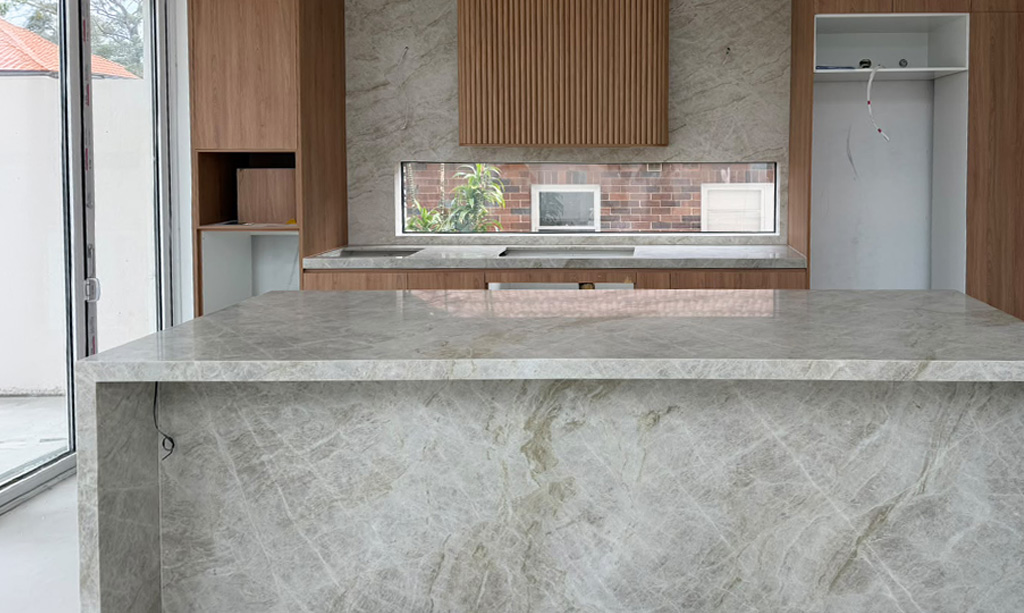
Taj Mahal quartzite is a natural Brazilian stone with a warm cream ground and soft gold movement. This guide compares it honestly with the silica-free engineered stone and porcelain look-alikes. It covers depth, repetition, edges, sealing, heat and resale, and gives a clear choose-this-if framework. It closes with joinery pairings and how to compare slabs at full size in the Strathfield South showroom.
Taj Mahal Quartzite vs the Look-Alikes

The Marble Look Without the Marble
Love the look of white marble but not the upkeep? This guide compares the two real marble look-alikes, silica-free engineered stone and porcelain or sintered stone. It covers what makes a copy convincing, where each one beats marble, and where the illusion stops. It also suggests natural stones that actually read like marble with fewer trade-offs, and how to mix real stone and look-alikes in one kitchen.
The Marble Look Without the Marble

If You're Sick of Taj Mahal, Try These Eight Stones
A light-hearted look at eight natural stones for people who love Taj Mahal's warm, neutral look but want something different. It covers three quartzites (White Cristallo Extra, Biancatto, Cristallo Oro) and five marbles (Hermes Gold, Gold Santorini, Athena Gold, Ceppo di Vagli Extra, Breccia Roma). And if none of them win you over, the answer is simple: go with Taj Mahal.
If You're Sick of Taj Mahal, Try These Eight Stones
Let’s Get Started on Your Dream Space
Whether it’s a kitchen, bathroom, or laundry, Kitchen Hub is here to bring your vision to life.
