
Add slabs to your wishlist so we can give you custom quote.
Add productions from our slab collection so we create a quote for your next project!
If you're unsure of what you're after please reach out via our contact page.

The Marble Look Without the Marble
The Marble Look Without the Marble
TL;DR If you love white marble but not the upkeep, the two real look-alikes are silica-free engineered stone and porcelain or sintered stone. Engineered stone is the calm, budget-friendly choice for indoor kitchens. Porcelain and sintered stone handle heat, stains and the outdoors. Neither fully matches real marble's depth, so judge them at full size. If you still want natural stone, a white veined quartzite is the closest tougher option.
Most people who ask for a marble look have already decided on the look. A white ground, grey or gold veining, that calm, slightly expensive feeling a marble kitchen has. What they haven't decided is the material.
Usually there's one thing about real marble holding them back. A friend's etched benchtop. Young kids. A rental they'll sell in a few years. An outdoor kitchen. The good news is that marble-look surfaces have come a long way, and some are very convincing. The trick is knowing what each one does well, and where the illusion stops.
Why not just use marble?
Real marble is still the benchmark. Calacatta and Carrara have a depth no factory can fully copy, and if you love it, buy it.
Marble also asks something of you. There's the upkeep, and for some people a low-level nervousness that comes with it every time the kitchen fills up. It costs more too. Some people simply feel more relaxed in a space where the bench gives them a little less to worry about.
If that sounds like you, it's a perfectly good reason to choose a look-alike. Here are your options.
What makes a marble look-alike convincing?
Before comparing brands, it helps to know what to look for. Four things decide whether a copy reads as marble or as a printed surface.
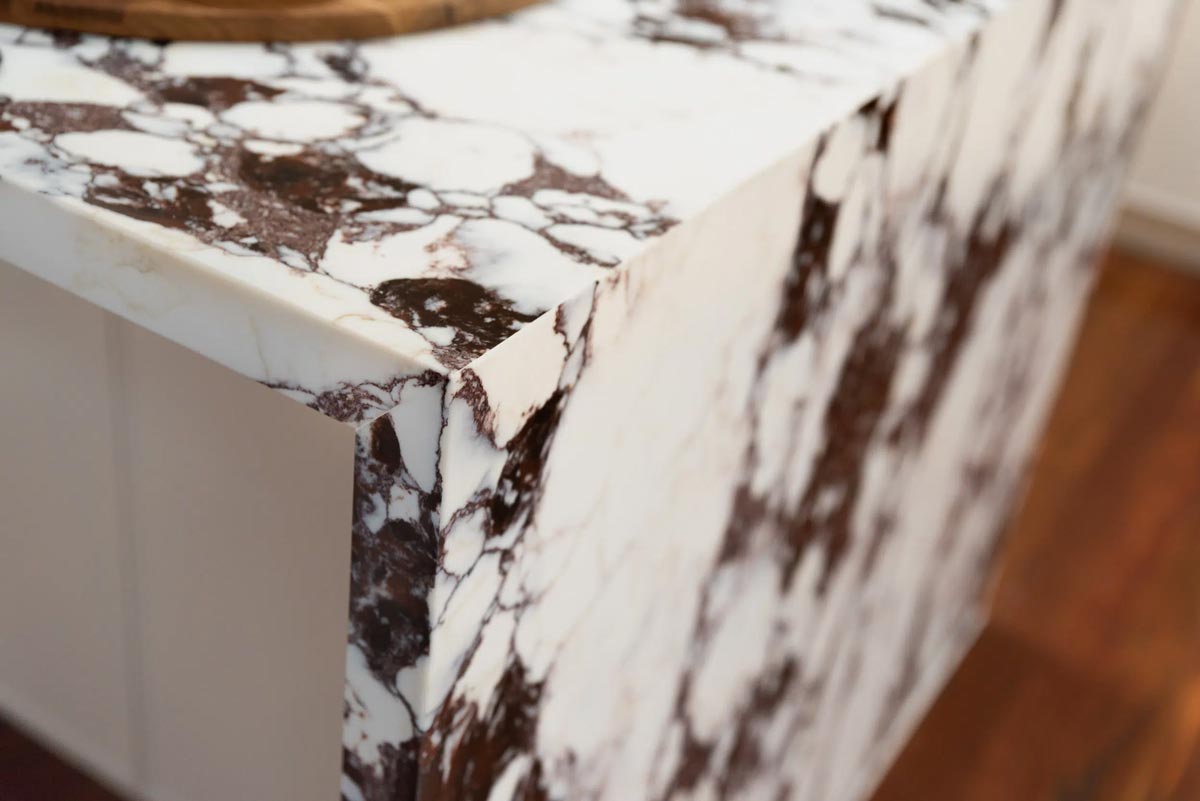
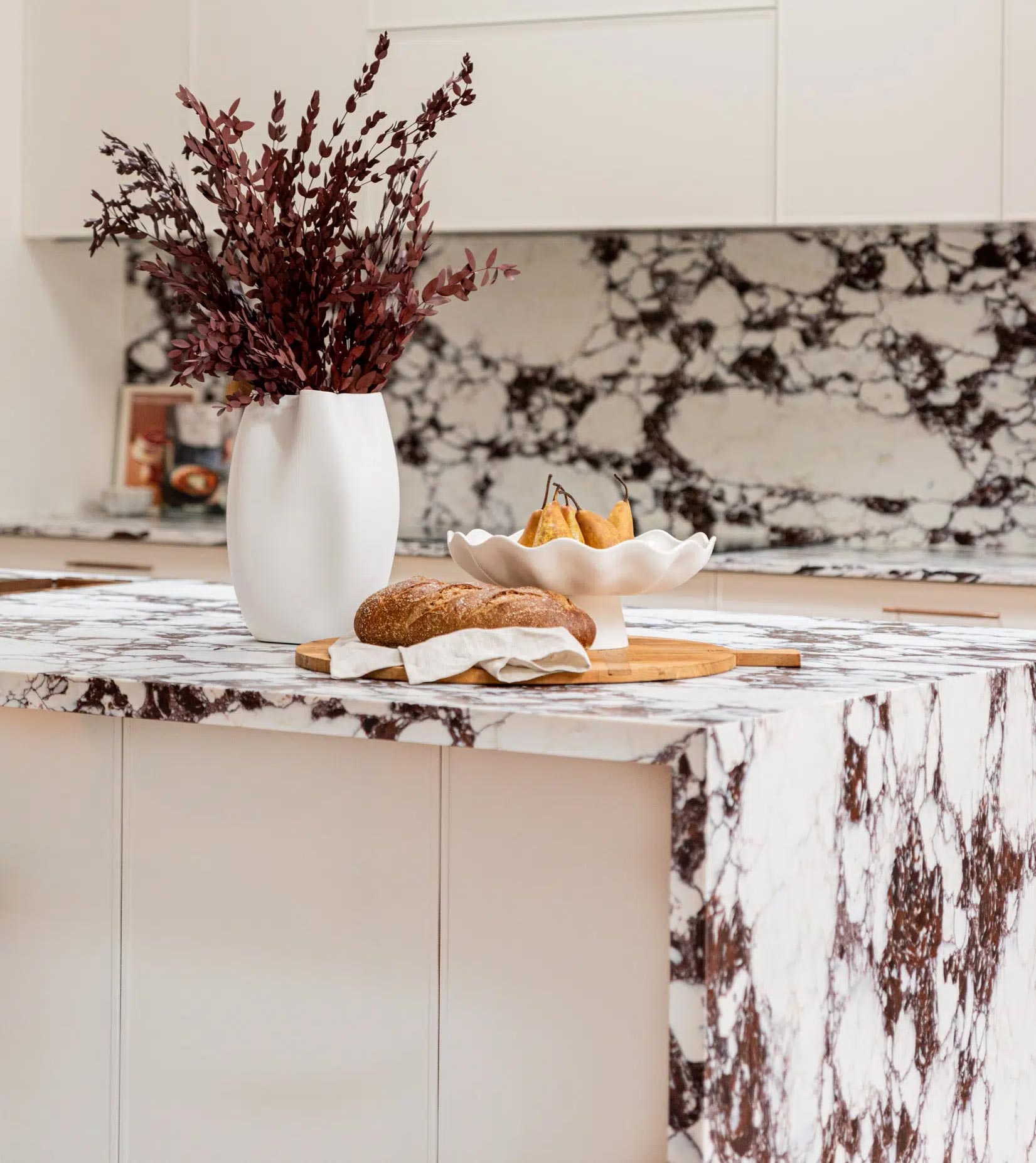
Scale of veining. Real Calacatta veins are big and confident, and they wander. Small, evenly spaced veins read as manufactured from across the room.
Depth. Real marble has a slight translucency, so the veining looks like it sits inside the stone. Better look-alikes get closer to this than they used to, but it's still the hardest thing to copy.
Repetition. A designed pattern can repeat across a long run. Once you spot the same vein twice, you can't unsee it.
The edge. On some designs the veining stops at the surface and the edge shows a plainer body colour. A mitred edge wraps the face around and fixes this. Our guide to edge profiles walks through the options.
Silica-free engineered stone
Engineered stone is a manufactured surface made from minerals bound with resin. The ranges we offer, including YDL, Talostone, Caesarstone and Quantum Zero, are crystalline-silica-free, so they're legal and safe to fabricate in Australia under the current rules.
Its marble-look designs are some of the most popular surfaces we sell. The softer Calacatta and Carrara interpretations are the most convincing, because gentle veining hides the manufactured feel better than bold drama does. Every slab matches the sample. No sealing. Very stain resistant. And it's usually the most budget-friendly way to get the look.
The limits are worth knowing. It's an indoor surface only, because UV affects the resin and outdoor use can void the manufacturer's warranty. It's less tolerant of direct heat than stone or porcelain, so trivets under hot pans are a must. And how far the veining runs through the slab varies between designs, so always look at the edge.
Choose engineered stone if budget is a real factor, the kitchen is indoors, and a consistent, calm surface matters more to you than one-of-a-kind movement.
Porcelain and sintered stone
Porcelain and sintered surfaces like Dekton, Neolith and Smartstone Sintered are fired at very high temperatures into dense, non-porous slabs. They're the most worry-free marble-look surfaces we sell.
They resist stains very well and handle heat better than any other option here, though we still recommend a trivet or board under really hot pans. They're UV stable, so they work outdoors. And because the pattern is printed at high resolution, some of the bold Calacatta designs are remarkably close to the real thing. The large slab sizes suit full-height splashbacks and wall cladding too.
The trade-offs sit at the edges. Edge profile choices are more limited, slim edges on many designs show a plainer body colour, and corners need a little care in use. A mitred edge carries the pattern around and looks far more like solid stone.
Choose porcelain or sintered stone if the benchtop needs to be practically maintenance-free, it's going outdoors, or you want a bold Calacatta look that engineered stone can't quite pull off.
Three real marbles and their closest look-alikes
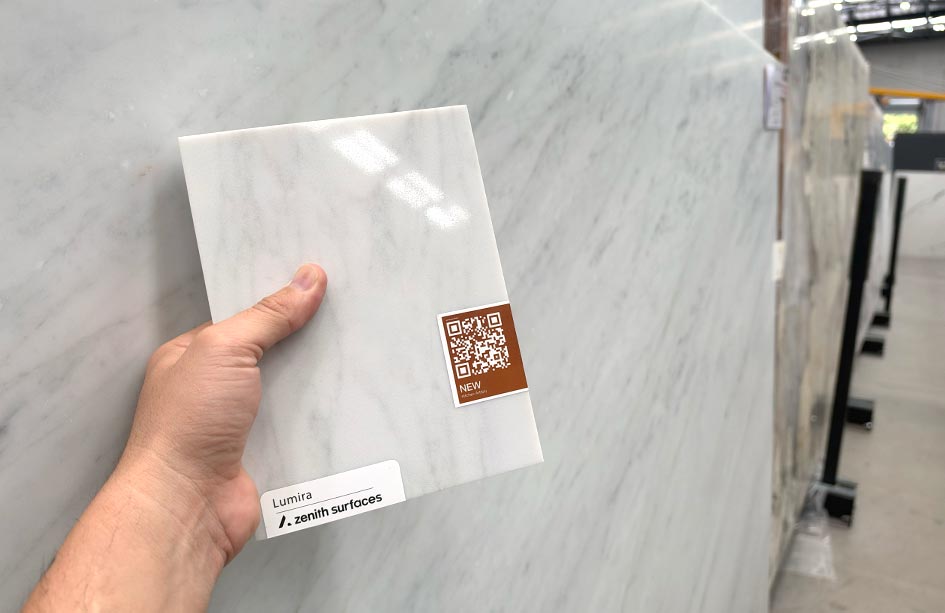
The easiest way to judge a look-alike is next to the stone it's copying. Three of our current pairs show the pattern well.
Bianco Carrara next to Lumira, a crystalline-silica-free engineered stone, shows how close engineered stone gets with soft grey veining. Calacatta Picasso next to Neolith's Calacatta Luxe shows porcelain carrying a bold Calacatta. Calacatta Monet next to Arabescato Corchia is a match in feel more than colour, with the porcelain reading cooler.
We've laid out all six of our natural and look-alike pairs, including quartzites and a breccia, in Six Natural Stones Next to Their Look-Alikes. You can also ask to see any pair side by side at our Strathfield South showroom.
Engineered stone or porcelain?
Work backwards from how you'll use the kitchen.
If budget leads and the kitchen is indoors, go engineered stone. If heat, stains or an outdoor kitchen lead, go porcelain or sintered stone. If you want soft, quiet veining, engineered stone tends to do it more naturally. If you want bold, dramatic Calacatta, porcelain usually does it better.
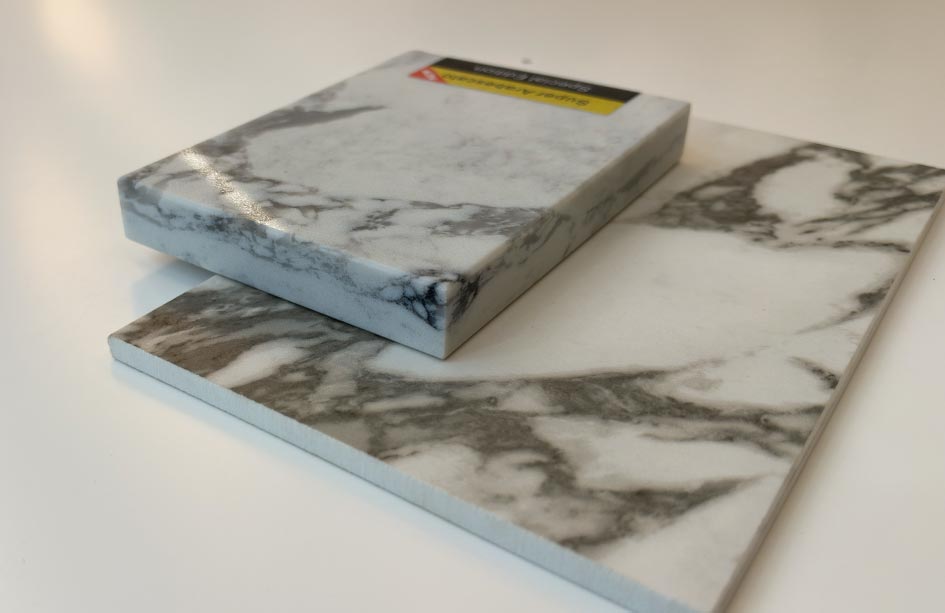
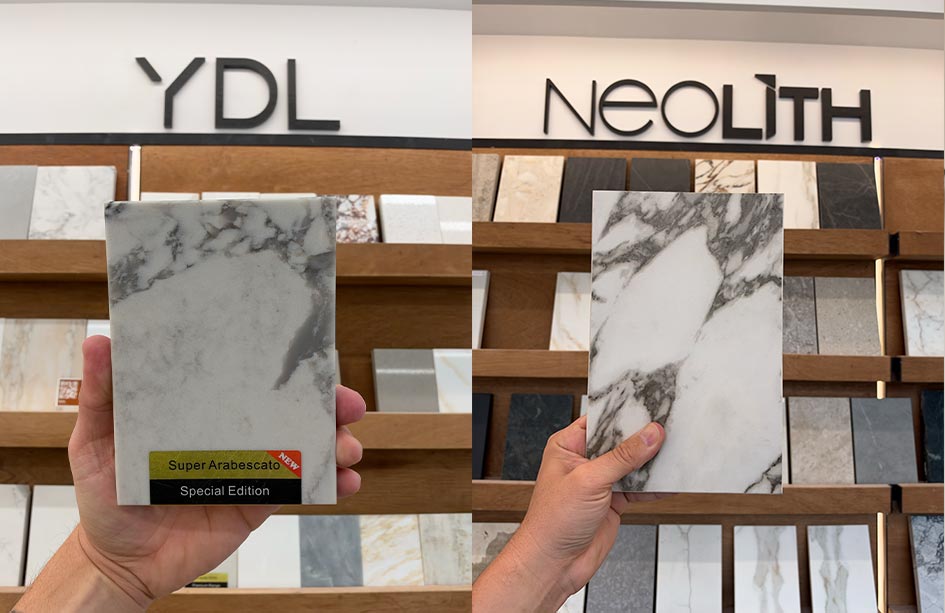
If you're torn, decide which matters more, the price or the performance. Most people find one is clearly bigger once they say it out loud. Our full engineered stone range and full porcelain range are both online if you want to shortlist first.
If you're still undecided, our sales team can price both options on your actual layout, so you're comparing real numbers. They can also talk you through the design details that suit one material better than the other. Edge profiles are the big one. Engineered stone takes a wider range of shaped edges, while porcelain usually looks best with a clean square or mitred edge. Waterfall ends, splashbacks and sink style can also tip the decision one way.
If you'd still rather have real stone
Some people read all this and realise it's the real thing they want, just with fewer trade-offs than marble. A small group of natural stones gives you a marble look with more toughness.
White veined quartzites are the closest. Calacatta Davinci Quartzite, for example, has a white ground and grey-green movement that reads like a marble but wears like a quartzite. Quartzite is harder than marble and far more resistant to etching and scratching, though it still needs sealing and no natural stone is mark-proof. Browse our quartzite range for the whiter, veined options, and our quartzite vs marble guide for the full comparison.
Super White is the other one. It's a dolomite with a cool grey ground and bold, smoky veining, more graphic than Carrara and more forgiving. It still etches slowly with acids, so treat it as a tougher marble rather than a quartzite. Our Super White guide covers it in detail.
Do you have to use one material everywhere?
No, and mixing is often the smartest move. The island is where people look. The perimeter is where people work.
A common approach that works well is real marble or quartzite on the island and a harder-working look-alike on the perimeter. The island carries the movement and character of natural stone, while porcelain or engineered stone takes the cooking, the kettle and the daily mess along the back wall.
The trick is to make the mix look intentional. Pick a perimeter surface that's calmer than the island, in a tone that picks up the island's ground colour. Keep the edge profile consistent across both so the rhythm of the room holds together. Done well, it reads as a design decision, never as a budget one.
Our guide to kitchen island design covers proportion and overhang if the island is going to be the feature.
What about resale?
If this is your forever kitchen, choose what makes you happy. You'll be the one living with it.
If you might sell, look at comparable homes in your price bracket. In the middle of the market, a good engineered or porcelain marble look is completely normal, and nobody will mark you down for it. At the upper end, natural stone is often expected.
Our honest view: silica-free engineered stone is a great budget option and can look just as good in the right room, but natural stone's extra visual depth and resale value are hard to pass by. Quote both and decide with real numbers.
How to compare them properly
Small samples flatter manufactured surfaces and undersell natural ones. A sample shows colour. It can't show scale, depth or how a pattern repeats across a three-metre island.
Shortlist two or three options, then see them at full size, side by side, in our Strathfield South showroom. Look at them in daylight and under warm light, and check the edges, not just the face. If real marble is still in the running, put a slab of it next to the look-alikes. That comparison settles it faster than anything else.
If you'd like a second opinion, book a design consultation. We'll talk through how you cook, what worries you about marble and what the room needs, and you'll leave knowing which surface fits.
Frequently asked questions
Which looks more like real marble, engineered stone or porcelain?
It depends on the marble you're copying. Soft, quiet Carrara-style veining usually looks more natural in engineered stone. Bold, dramatic Calacatta usually looks better in porcelain or sintered stone, because the pattern is printed at high resolution. Either way, see the full slab, not just a sample, and check the edge.
Is engineered stone still allowed in Australia?
Yes, if it's crystalline-silica-free. The 2024 ban applies to engineered stone containing 1% or more crystalline silica. The ranges we offer, including YDL, Talostone, Caesarstone and Quantum Zero, are silica-free, so they're legal to supply, fabricate and install.
Do marble-look benchtops need sealing?
Engineered stone and porcelain or sintered stone don't need sealing. They're non-porous, so warm water and a mild detergent handle everyday cleaning. Real marble, quartzite and dolomite all need sealing, usually about once a year depending on use.
Can a marble-look benchtop go outdoors?
Porcelain or sintered stone, yes. It's UV stable, handles heat and resists stains. Engineered stone is indoors only, because UV affects the resin and outdoor use can void the warranty. Light-coloured marble weathers quickly outside and struggles near a hot barbecue. Outdoors, we also recommend butt joins or shadowlines over mitres, because decks and ground can move.
Will the veining repeat on a look-alike benchtop?
It can. Manufactured designs are made from a set pattern, so on long runs or large islands the same vein can appear more than once. Larger slabs and bolder designs repeat less often. Ask to see a full slab, or a photo of one installed, before you commit.
What looks like marble but is natural stone?
White veined quartzites are the closest, such as Calacatta Davinci Quartzite. They have marble-like movement and are far more resistant to etching and scratching. Super White dolomite is another, with a cooler grey look. Both still need sealing, and no natural stone is completely mark-proof.

If You're Sick of Taj Mahal, Try These Eight Stones
A light-hearted look at eight natural stones for people who love Taj Mahal's warm, neutral look but want something different. It covers three quartzites (White Cristallo Extra, Biancatto, Cristallo Oro) and five marbles (Hermes Gold, Gold Santorini, Athena Gold, Ceppo di Vagli Extra, Breccia Roma). And if none of them win you over, the answer is simple: go with Taj Mahal.
If You're Sick of Taj Mahal, Try These Eight Stones

Honed, Polished or Leathered: How the Finish Changes the Way a Kitchen Feels
The same stone can look like three different materials depending on the finish. Polished deepens colour but shows etching on marble, honed is calm and hides etching better, and leathered hides fingerprints and suits quartzite and granite. This guide compares all three and explains how each changes light, colour and care. For most marble kitchens we recommend honed, and for granite we mainly recommend honed too.
Honed, Polished or Leathered: How the Finish Changes the Way a Kitchen Feels
How to Design a Calm Kitchen Around a Bold Stone
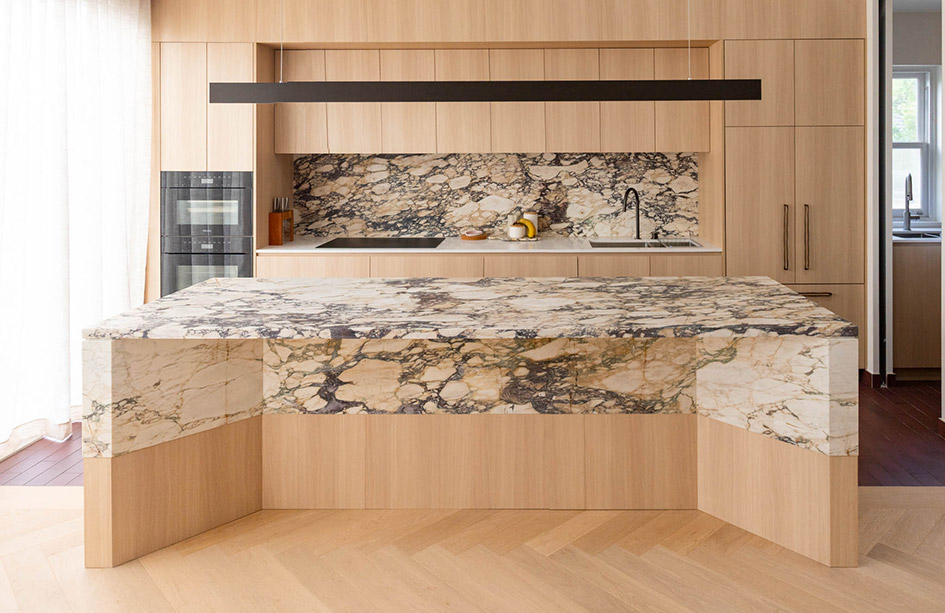
A bold stone like Calacatta Viola, Breccia, Patagonia or Negresco can carry a whole kitchen if everything else steps back. The rule is one hero: when the stone leads, the joinery, splashback, hardware and lighting support it. This guide covers where to put a bold stone, which joinery colours suit each of these four stones, how to manage visual weight, and why vein flow planning matters most with dramatic slabs.
How to Design a Calm Kitchen Around a Bold Stone
Stone Bathroom Walls and Showers: Full Slab, Porcelain or Tile
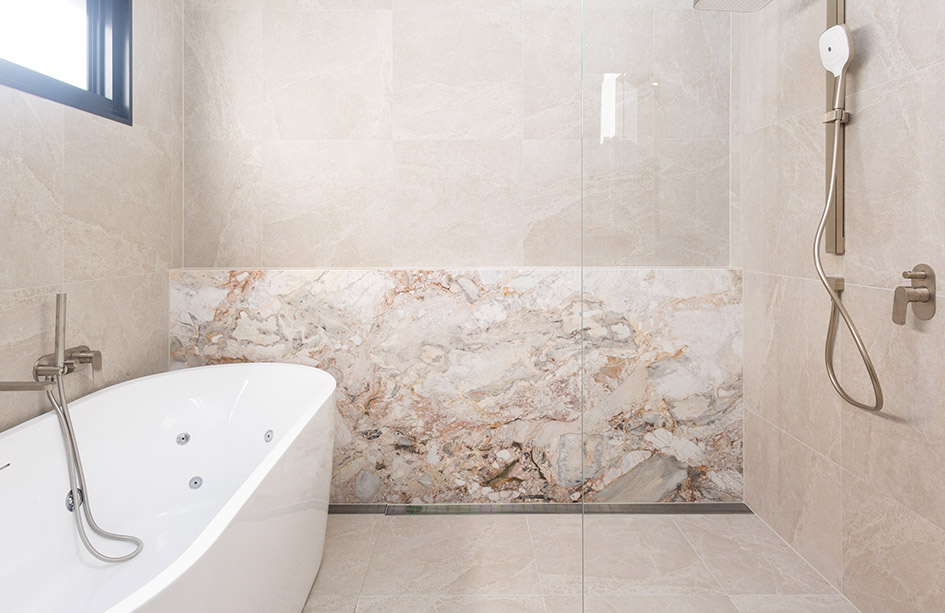
Stone on bathroom walls is what turns a tiled bathroom into a designed one. Full slab natural stone gives true vein flow and few joins, large-format porcelain is often the most practical choice inside a wet shower, and tile still suits complex shapes and tight budgets. Whatever you choose, stone is a finish, not waterproofing. This guide compares all three and covers marble in showers, joins, niches, floors and cost.
Stone Bathroom Walls and Showers: Full Slab, Porcelain or Tile
Let’s Get Started on Your Dream Space
Whether it’s a kitchen, bathroom, or laundry, Kitchen Hub is here to bring your vision to life.
