
Add slabs to your wishlist so we can give you custom quote.
Add productions from our slab collection so we create a quote for your next project!
If you're unsure of what you're after please reach out via our contact page.
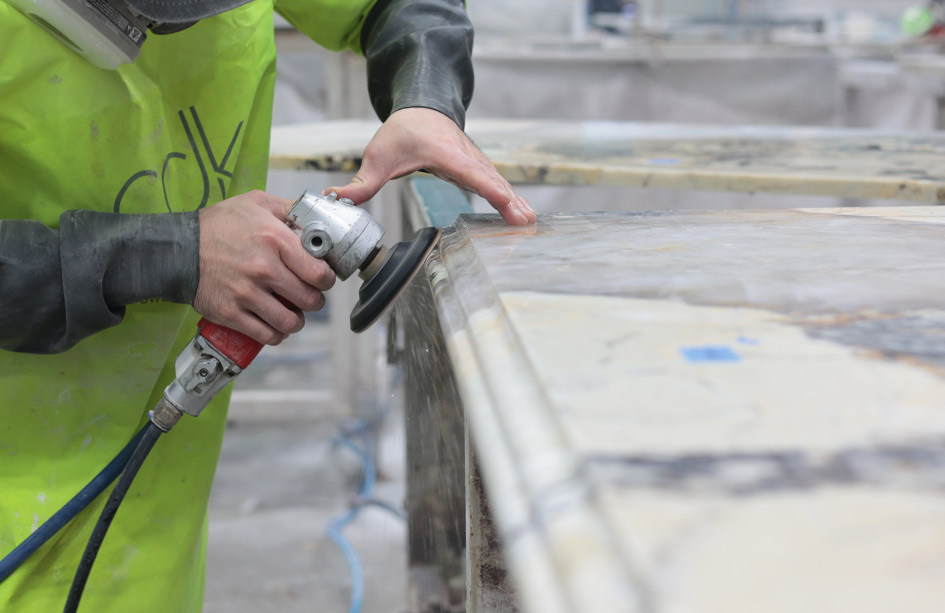
How an Ogee Edge Is Actually Made (And Why It Takes So Long)
How an Ogee Edge Is Actually Made (And Why It Takes So Long)
SHORT ANSWER
An Ogee edge takes longer than other profiles because the machine has to rout the curved profile in stages, using eight different tool heads, and it only works on one piece at a time. Every piece is honed and finished by hand before the next one goes in. It is not slow because of inefficiency. It is slow because that is what the profile, and the process, actually demand.

What actually happens when we fabricate an Ogee edge
Once a piece is cut to size, we apply a laminate to the edge, but only in the exact locations where an Ogee profile is required. It is a targeted step, not a blanket one, because it only needs to happen where that specific profile is going to be cut.

From there, every piece gets checked to make sure the mesh backing is removed from the back edge area specifically. That is a deliberate distinction. The rest of the mesh stays in place doing its job. Stripping it just from the edge means the machine has direct contact with the stone, with nothing to get caught in the tooling and nothing getting in the way of the cut.
Why does the machine need eight different tools?

An Ogee edge is not a single curve. It is a compound profile, a wave of concave and convex curves that has to read as one continuous, fluid line. To cut that shape, one piece runs through eight tool heads in sequence, and each one has a specific role.
One tool cuts the rough shape. Another grinds it down. A few stages handle polishing. Another hones the edge, refining the surface before the piece is ready to move on to finishing touches. Every pass is only refining what the last tool started, so rushing one stage compromises everything that follows.
We recently added two new tools to this set, specifically to reduce how much hand-finishing each edge needs. That is not about removing the human check. It is about giving the machine more of the fine work, so the finishing stage can focus only on what genuinely needs a person's eye and touch.
One piece at a time
There is a factor here that has nothing to do with the profile itself. The machine only works on one piece at a time. A single benchtop is a straightforward run through the process. A full kitchen, or a project spanning multiple rooms, means every individual piece queues through that same sequence in turn.

That is often the real reason a larger project takes longer. Not that any single edge is harder to cut, but that there are simply more pieces waiting their turn through the same eight-stage process, the same honing passes, and the same hand-finish.
Why does it still get finished by hand?
After the machine work, the edge is honed several times to smooth out the tool marks and even out the surface.

The next step once it comes off the machine is for our team to review each linear metre of edge to make sure it is up to our standard. The fabricator runs a hand over the entire Ogee edge, checking the profile against our own eye before it ever reaches yours. Machines are precise, but a compound curve like this has transition points where the profile shifts direction, and those points are exactly where a hand can catch what a camera or a quick pass might miss.
It is a genuine review, not a formality. We are checking that the edge is smooth, that the curve reads as one continuous line, and that the outcome meets our own standard, not just the standard we think you will accept. Those two things are not always the same, and this is the step that makes sure they line up.
This is the difference between an edge that looks right in a photo and one that still feels right against your hand every day for the next twenty years.

The real value: subtle detail versus bold statement
Most design details fall into one of two categories. There is the bold statement, the waterfall end, the dramatic veining, the thing you notice from across the room. Then there is the kind of detail you actually reach out and run your hand over while you are standing in the space. An Ogee edge belongs to the second category, and that is exactly why it works.
Think about the difference between a plain, square picture frame and one with proper moulding, the kind with steps and levels built into the profile. The moulded frame sets the tone for the room before you have even looked at what is inside it.
That is the difference an Ogee edge makes on a benchtop. It is not there to be the feature. It is there to set the level of the whole space. Bold details announce themselves once, on arrival. Subtle details keep working on you the whole time you are in the room, because your hand finds that edge every single time you lean on the bench.
That is the difference between a kitchen that photographs well and a kitchen that actually feels expensive to live in. The Ogee edge adds a layer of traditional, architectural language to a benchtop without ever competing with the stone itself. It does not shout. It supports.
Is an Ogee edge worth the extra time?
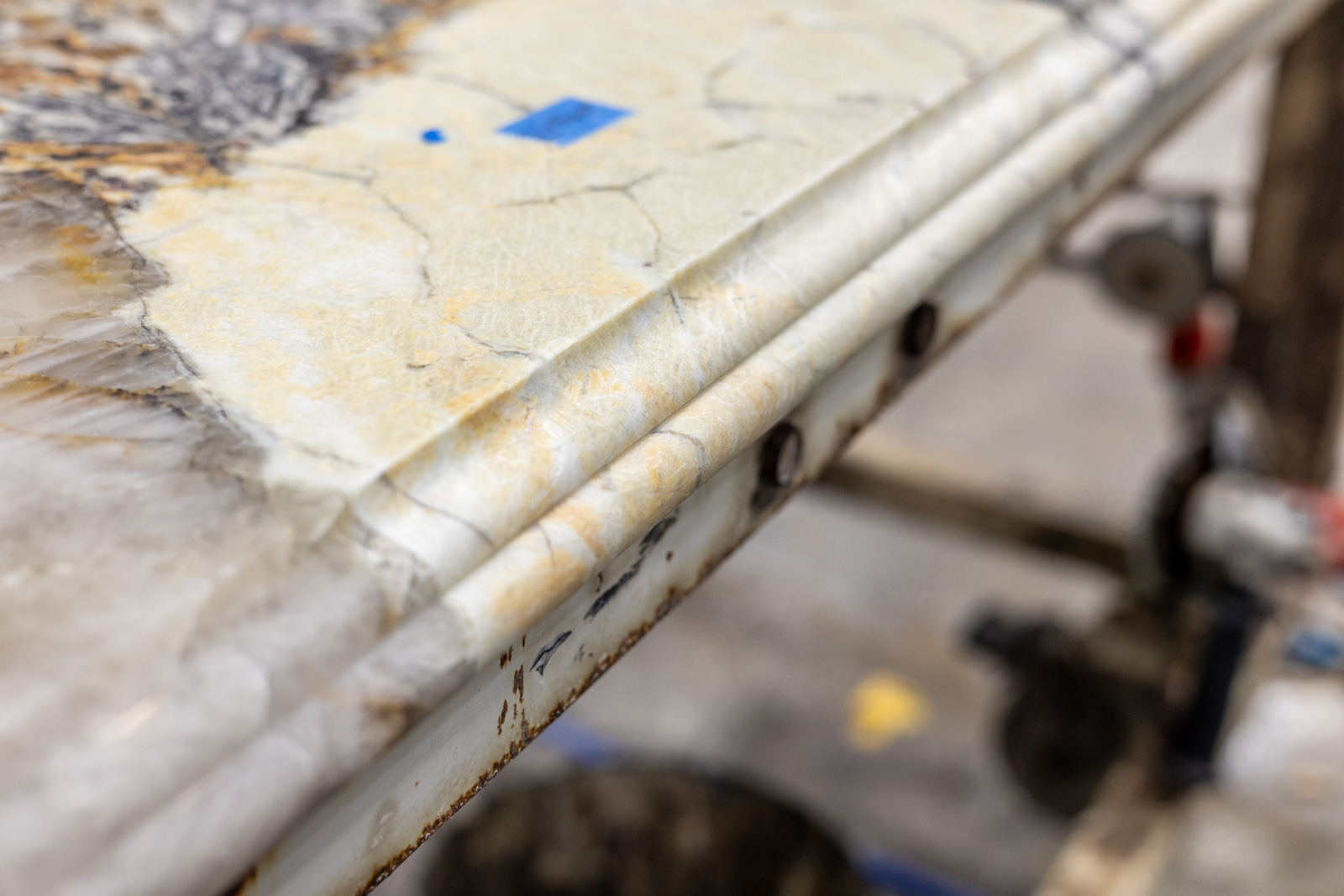
The finished Ogee profile. Eight tool changes, multiple honing passes, and a hand-finish.
Here is the honest trade-off. An Ogee edge costs more in fabrication time than a bullnose or mitred edge, and every bit of that time is doing something. What you are paying for is not a fancier-looking edge. It is a detail considered enough to lift the whole design without ever being the loudest thing in the room.
If your kitchen or vanity is leaning contemporary and minimal, an Ogee edge will likely fight the rest of the design. If the space leans classical or formal, or you want one considered detail rather than a bold one, this is where the extra time earns its place.
When Ogee earns its place

Choose Ogee if: your kitchen or bathroom leans classical or formal. You want a detail that supports the overall design rather than competing with it. You are comfortable with a longer fabrication timeline for a result that keeps adding to the space every time you notice it.
Choose a simpler profile if: your space is contemporary and pared back. You want the stone itself to be the feature rather than the edge. Your timeline does not suit a multi-stage tooling process.
Neither choice is wrong. It comes down to whether you want a detail that announces itself, or one that quietly does the work of making everything else look considered.
FAQ
How much longer does an Ogee edge take compared to a standard edge?
It varies by how many pieces are in your project and the stone itself. As a rule, expect it to take meaningfully longer than a single-pass profile like pencil round or arised, because of the eight-stage tooling process, and because the machine only works on one piece at a time. Ask for a specific timeline when you get your quote, since it depends on your project size.
Can any stone be cut with an Ogee edge?
Most natural stones can take an Ogee profile. Where a piece has mesh backing for structural support, that mesh is removed from the back edge area specifically before profiling, so the machine has direct contact with the stone. This is a normal part of fabrication, not a sign of a flawed slab.
Does an Ogee edge need more maintenance than a simpler profile?
No. Maintenance comes down to the stone itself (marble, quartzite, granite) rather than the edge profile. The Ogee does not add exposure or fragility once it is fabricated and installed correctly.
Is Ogee available on any benchtop thickness?
The profile changes character depending on the thickness. An Ogee cut into 20mm reads differently to one cut into 40mm or 60mm, and there are limitations at different thicknesses. That does not mean it cannot be done. It means we review the profile you want with you and work out how to build and tweak it so it works properly on the thickness you have chosen.
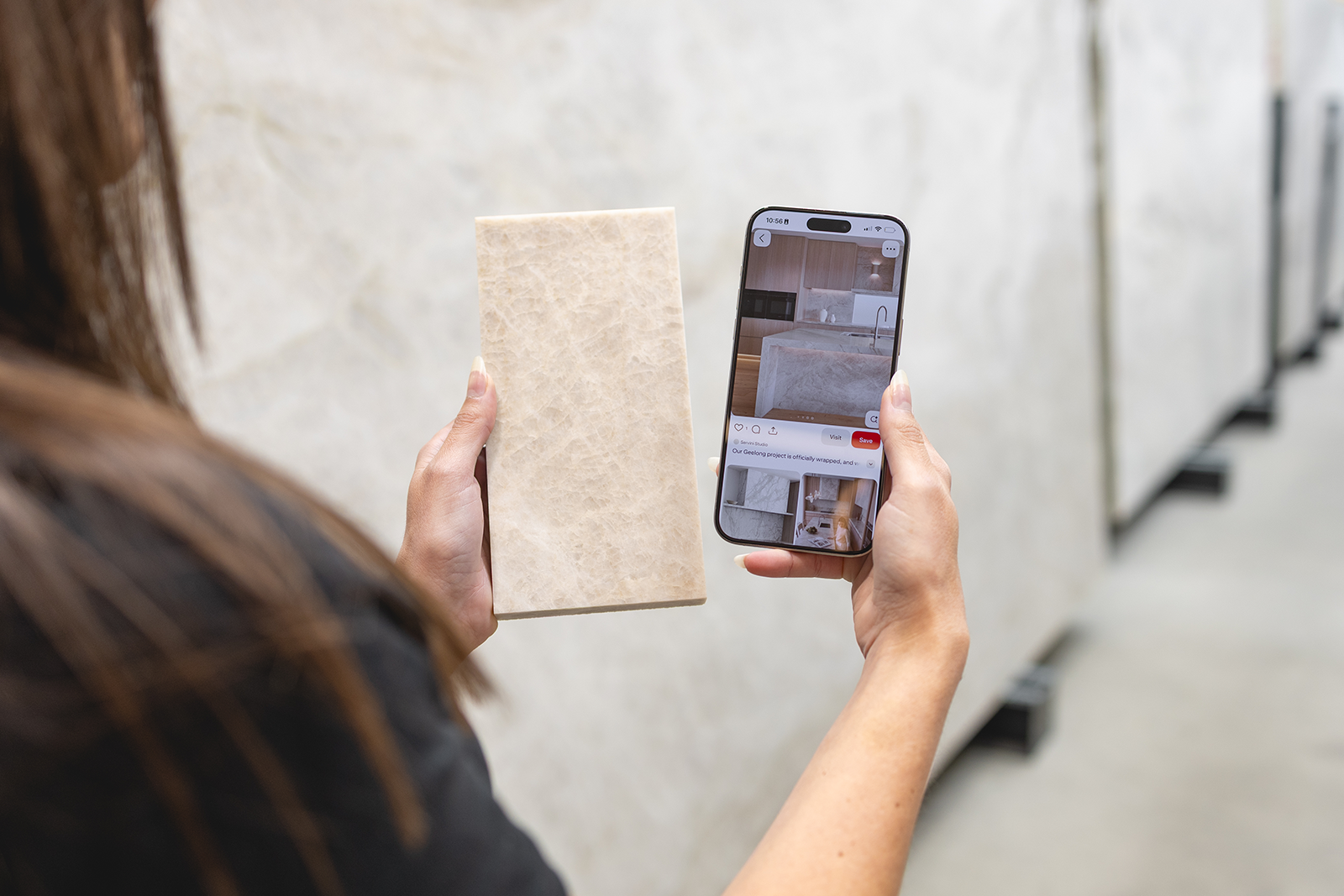
Where to Start When You Don't Know the Stone in Your Inspo Photos
For homeowners who don't know where to begin with stone. You don't need a stone name to start. Send your inspiration photos, tell us what you like and why you're drawn to it, and we'll identify the material and point you to the right slabs. Covers how your eye already picks matching tones, reading stone from a photo, which photos to trust online, and why picking stone is like picking art. Tags: how to choose stone, where to start, inspo photos, identify marble from photo, stone selection, Marble Hub Sydney.
Where to Start When You Don't Know the Stone in Your Inspo Photos
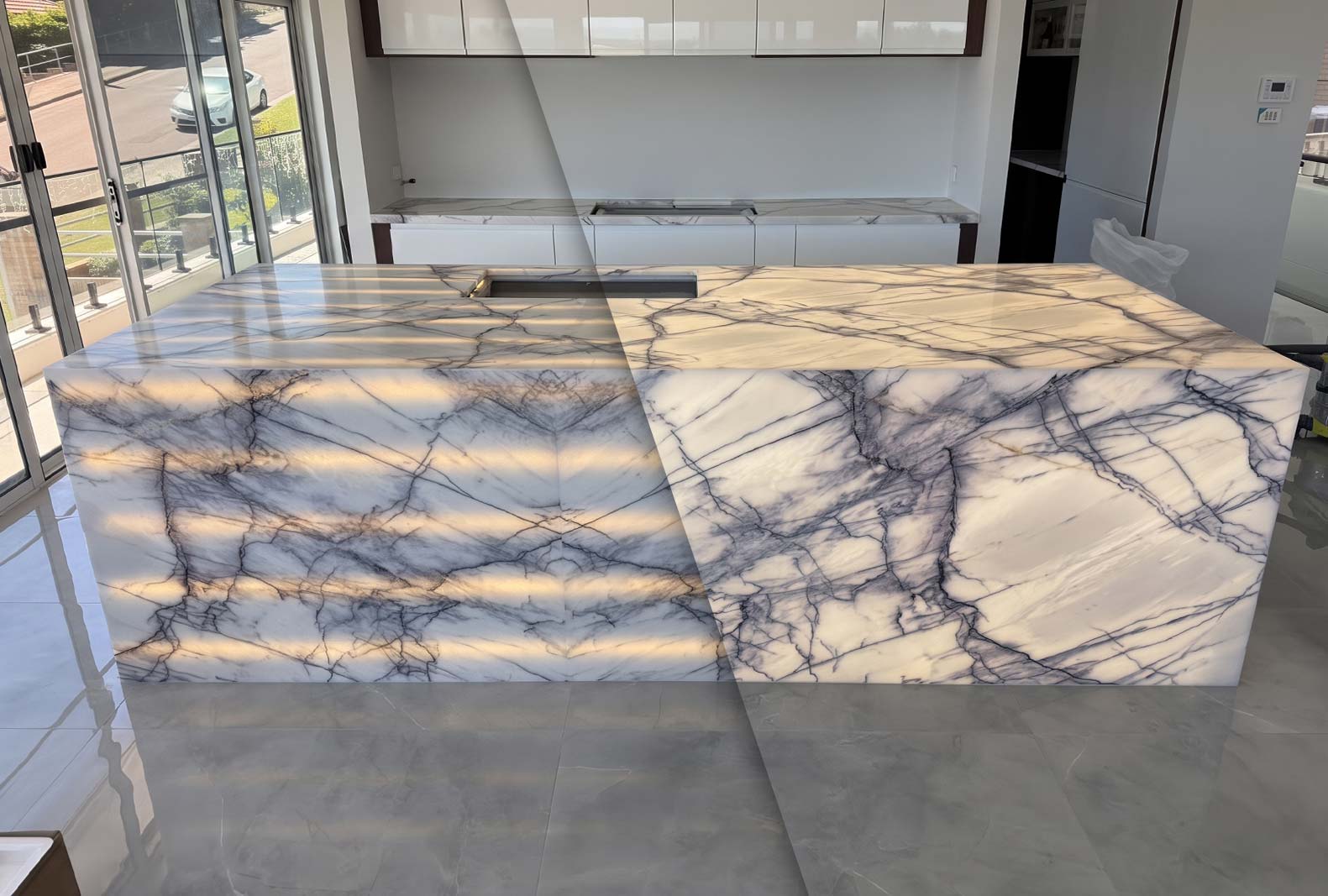
Backlit Stone and Why the LED You Choose Changes Everything
Backlit stone explained simply. The look changes a lot with the light behind the slab. LED strips give a striped, patterned glow; a full LED panel lights the whole slab evenly so it looks lit from within. Both are valid, so do what suits your budget, but plan it early with your electrician. Covers which stones are translucent and why the light install feeds into the check-measure. Tags: backlit stone, backlit marble, translucent stone, LED stone panel, backlit onyx, feature lighting, Marble Hub Sydney.
Backlit Stone and Why the LED You Choose Changes Everything
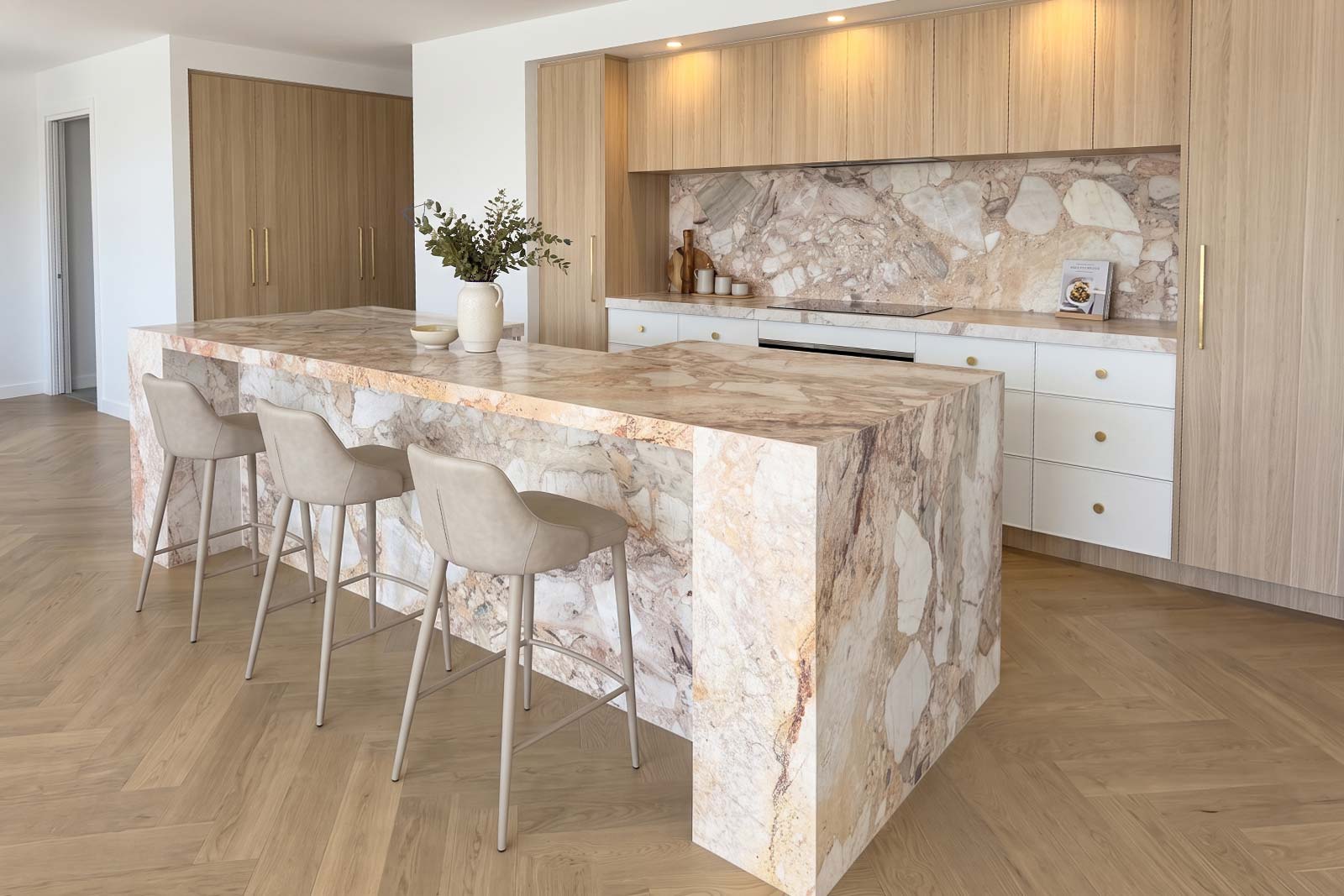
How We Plan Stone Across a Duplex Without Wasting a Slab
Planning stone across a duplex or dual-occupancy build. We work out real slab count, map every piece across the slabs, balance feature stone across both homes, and plan the stages so the check-measure and install land when each side is ready. Covers slab yield, offcut planning, mapping the cut to the stages, and getting every trade working to the same target dates. Tags: duplex stone benchtops, dual occupancy, slab count, stone yield, staged install, trade coordination, Marble Hub Strathfield South.
How We Plan Stone Across a Duplex Without Wasting a Slab
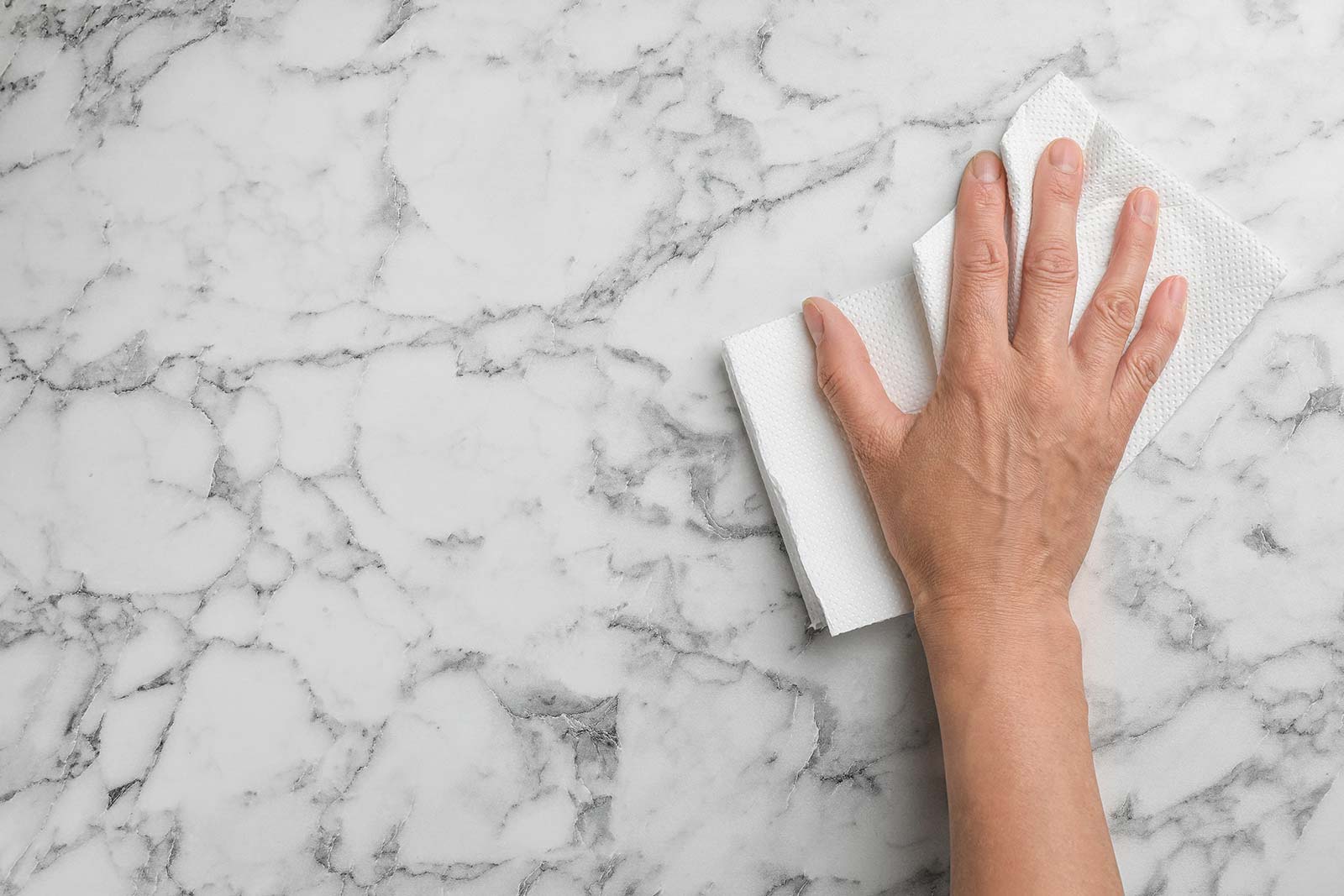
How to Clean and Care for a Marble Benchtop
How to clean and care for a marble benchtop, written for people who already own marble or are about to. Covers the daily routine, warm water and pH-neutral cleaner, wiping acidic spills fast, sealing with Lithofin MN Stain-Stop every 6 to 12 months, and the difference between a stain and an etch. Explains why heavy veining hides marks better than plain marble, and why a rehone and rebuff after 3 to 4 years brings a tired benchtop back. Honest about trade-offs. Marble is a relationship, not a set-and-forget surface. Written by Marble Hub, a Strathfield South stone factory and showroom.
How to Clean and Care for a Marble Benchtop
Let’s Get Started on Your Dream Space
Whether it’s a kitchen, bathroom, or laundry, Kitchen Hub is here to bring your vision to life.
