
Add slabs to your wishlist so we can give you custom quote.
Add productions from our slab collection so we create a quote for your next project!
If you're unsure of what you're after please reach out via our contact page.
How Much Does a Benchtop Cost? What Actually Drives the Price
How Much Does a Benchtop Cost? What Actually Drives the Price
A stone benchtop comes down to two costs, multiplied by how many slabs your kitchen needs. The first is the material, the price of the slab itself, which depends entirely on the stone you pick. The second is fabrication and install, the rough cost to cut, fabricate and install each slab. Add those two together and multiply by your slab count, and you have a very rough total for the whole job before anyone has measured a thing.
The material is the starting factor, because a silica-free engineered stone, a Carrara marble and a rare quartzite all sit at very different slab prices. As a starting point, engineered stone starts at around $2,000 plus GST per slab for fabrication and install, and natural stone starts at around $2,500 plus GST per slab for fabrication and install. So take the slab price of your chosen stone, add that fabrication and install figure, and multiply by the number of slabs your kitchen needs. That gives you a very rough starting total. From there, plenty of other factors play a part, so the figure rarely stays where it started.
This blog walks you through both halves: how to reach a starting figure, and what pushes it up from there. Fabrication climbs with your design, so every polished edge, cutout, waterfall and splashback moves the number. When you get a quote from us, you'll understand exactly what you're looking at.
Start With the Slab, Not the Benchtop
Cost begins with the slab, so that's where you should start too. The benchtop is what you end up with. The slab is what you're actually buying.
Your stone sets the starting point. A silica-free engineered stone benchtop, a Carrara marble benchtop, and a Taj Mahal quartzite benchtop sit at very different places before we've cut anything. That's the material talking. Rarer stones, bolder movement, and larger-format slabs all carry different slab prices, and that's before fabrication enters the picture.
This is also where the category matters. A marble benchtop, a quartzite benchtop, a granite benchtop, an engineered stone benchtop, and a porcelain benchtop all behave differently on price, on slab size, and on how they cut. So the first question isn't “what does a benchtop cost.” It's “which stone, and how much of it does my kitchen need.” Everything else builds from there.
Why Benchtops Aren't Priced Per Square Metre
A square metre price is only helpful when you're dealing with the slab itself. It works for the raw material, the stone before anyone touches it. It doesn't work for the finished benchtop, because any quote built purely on square metres is hiding more than it tells you.
Here's the problem. Two benchtops can have identical square metreage and cost very different amounts. One is a simple rectangle with a single sink cutout. The other is an island with all four sides polished, a waterfall end, and a stone splashback. Same surface area. Completely different amount of work. Square metres measure the flat top and ignore everything that actually takes time: the polished edges, the cutouts, the waterfalls, the fitting.
Per-square-metre pricing also ignores the number of slabs your kitchen needs, which is the real driver most people never hear about. A stone with strong veining that we won't rotate might need an extra slab to protect the look. That cost is real, and it never shows up in a per-metre figure.
Be mindful of any quote that prices the whole job on a single per-square-metre rate. The detail that actually drives cost, your edges, cutouts, waterfalls and the number of slabs your job takes, can't be captured in a figure like that. Per square metre has its place, but only as a material breakdown for the slab price itself, not for the finished job.
At Marble Hub we're quoting the whole job. The details, the way we know you want it to look, the type of stone, and any unique factors. You're getting a custom design quote, not just a rough number.
Why Some Kitchens Need More Slabs Than Others
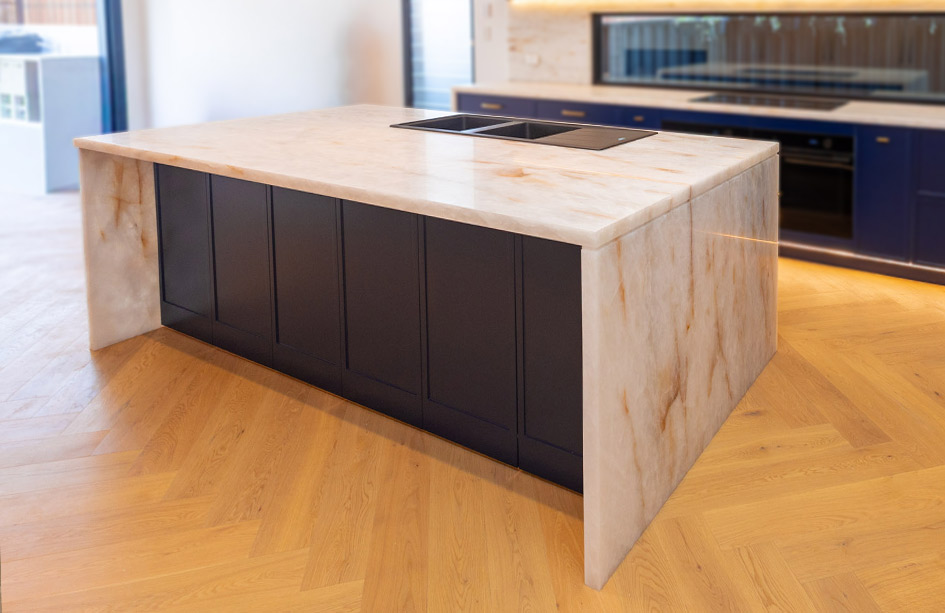
This is where two kitchens the same size can land in different places. Some kitchens need two slabs. Others need three or more. The number is set by your layout and your stone, not by how big your kitchen looks on paper.
How your pieces fit on the slab depends on the stone itself. Some stones have strong, directional veining. Think Calacatta Viola or a dramatic Taj Mahal. When the movement is the whole point of the stone, we hold the vein flow across your island, your run, and your waterfall ends so it reads as one continuous piece. Holding that flow means we can't rotate or reshuffle pieces to save material. We accept more offcut to protect the look. That can mean an extra slab.
Other stones have all-over movement rather than strong directional veins. Carrara and Biancatto are good examples. The movement is softer and reads evenly across the slab, so we have more freedom in how we lay your pieces out. That flexibility can mean fewer slabs for the same kitchen.
Here's the part that surprises people: natural stone slabs are often larger than engineered stone slabs. So a natural stone with a higher slab price might actually need fewer slabs than an engineered stone at a lower slab price. More expensive per slab, fewer slabs, and the totals can land closer than you'd think. The exception is a strong-veined natural stone where we hold the flow, because that protects the look but uses more material and can push the count back up. It depends entirely on your layout and your stone.
Engineered Stone vs Natural Stone: Which Costs More?
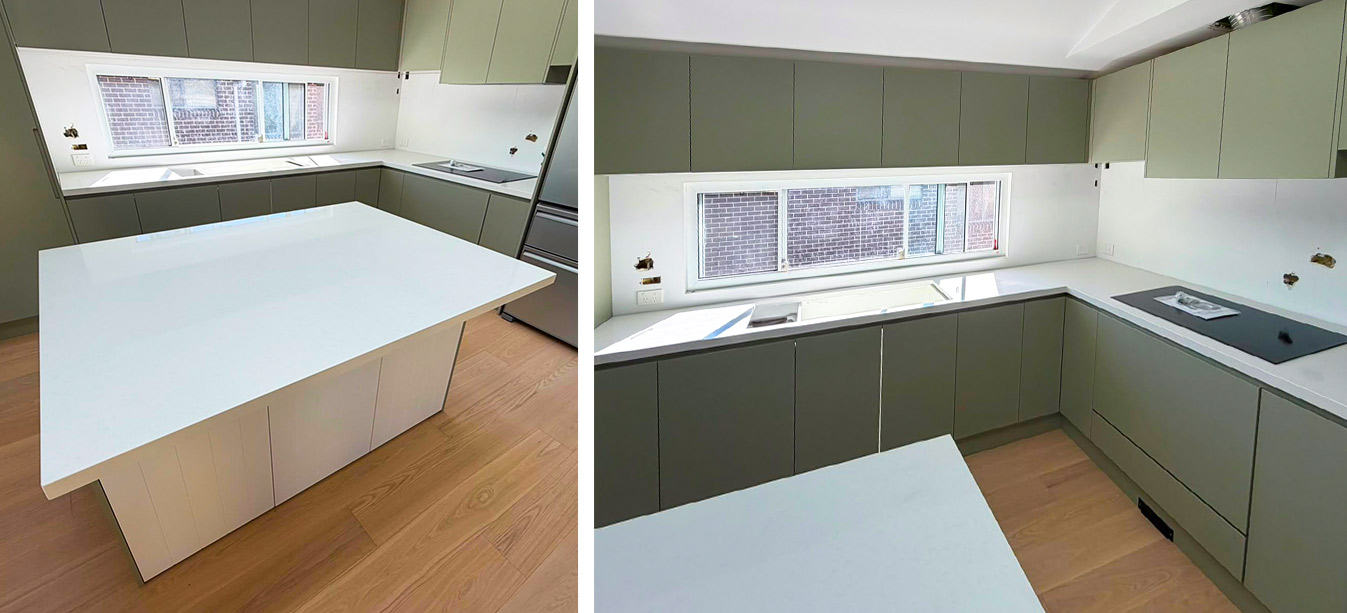
Most people assume natural stone costs more, and most of the time they're right. What surprises them is by how little. The gap is often smaller than expected, and in some cases the two land rather close. It's worth getting a quote before you rule natural stone out on price alone.
Here's why the gap narrows. Natural slabs are frequently larger, which changes the maths. A natural quartzite with a higher slab price can need fewer slabs than a silica-free engineered stone at a lower slab price, because more of your kitchen fits on each slab.
The fabrication work sits on top of both the same way. Edge profiles, cutouts, waterfalls, and splashbacks cost what they cost regardless of whether the stone is natural or engineered. So the gap between the two is often smaller than people expect once the whole job is quoted, and the right choice usually comes down to the look you want and how you live, not a simple cheaper-versus-dearer split.
Fabrication Is Where Your Design Decisions Show Up
Once the slab count is set, fabrication is where your choices start to add up. This is the honest part.
Edge profile.
A simple pencil round is one thing. A mitred edge that builds a deeper, more substantial profile is more work and more material. The profile you choose moves the price.
How many slabs we're cutting.
More slabs means more cutting, more handling, more fabrication time.
Cutouts.
Every sink, cooktop, and tap hole is a cut. The number and type matters. An undermount sink cutout is different work to a sit-on one.
Linear length of polished edges.
This is the one nobody expects, and it's often the biggest driver on a benchtop-only job. Every edge we polish is labour. A long island with all four sides polished, plus a long run of benchtop with a cooktop and a sink, is a lot of finished edge. It adds up fast. A modest galley with two short runs is a very different amount of edge work, even in the same stone.
If you're doing benchtops only, no splashback, the total metres of polished edge is the number that moves your quote most.
Waterfall Ends and Splashbacks: The Two Big Variables
These two decisions change your quote more than almost anything else, and both come down to how your pieces fit on the slab.
Waterfall ends.
A waterfall end is beautiful and it's more work. You're adding a full panel of stone that runs to the floor, more polished linear edges, and side returns where the stone wraps and meets. Each of those is finishing labour, and the panel itself needs slab space. A waterfall island in a strong-veined stone asks even more of the slab, because if you want the flow to carry down the waterfall, that panel has to come from the right part of the slab, which affects how everything else fits.
Splashbacks.
A full stone splashback is one of the biggest factors in how a job is quoted, which is exactly why we quote it both with and without so you can see the difference for yourself.
The height of your splashback matters more than people realise. A lower splashback height can sometimes fit neatly on the slab alongside your benchtop pieces, using space that might otherwise become offcut. A full-slab splashback that runs to the underside of your cabinets is more stone, and it can push you into territory where the pieces no longer fit together as efficiently. Splashbacks also add install work. More pieces, more fitting, more finishing on site.
None of this means don't do it. Waterfall ends and full splashbacks are some of the most beautiful things we make. It means you should see both versions quoted, so you're choosing with real information instead of guessing.
When the Job Isn't a Standard Benchtop
Everything above assumes a fairly typical kitchen: flat benchtops, straight runs, standard cutouts.
Custom curved radius ends, curved waterfalls, integrated stone vanities and kitchen sinks, stone fireplaces, plinths. These pieces don't follow the same set of factors as a standard benchtop. A curved end isn't a polished straight edge, it's shaping stone to a radius, which is different work entirely. An integrated sink made from the same stone as your benchtop is a different process again. Fireplaces and plinths are cut and installed differently to a benchtop too, they sit vertically or wrap a structure rather than lay flat, so the way the stone is measured, fabricated and fitted has little in common with pricing a run of benchtop.
So if your design includes any of these, the best move is to get a quote with and without those unique details, so you can see exactly what each one adds. Or let us know your wishlist items and we'll focus on those, and show you how they work with your budget. Send it through and we'll come back with a real cost for the actual job. That's a far better use of your time than trying to reason it out from a benchtop rate that was never built for curved or sculpted work.
Getting It There, and Getting It In
Two more factors, and they're practical rather than aesthetic.
Access for install.
A ground-floor kitchen with a clear path is straightforward. A benchtop that has to go up two flights, around a tight corner, or through a lift changes the install. Large single pieces of stone are heavy and unforgiving, and getting them in safely is part of the job.
Distance from our factory.
We're based in Strathfield South, and we fabricate everything in-house. For homes across the Inner West, a lot of our work sits in Balmain, Leichhardt and Rozelle, we're close. The same goes for the Eastern Suburbs around Bondi, Randwick and Bellevue Hill, and the Lower North Shore through Mosman and Cremorne. We also do a lot of work further out. Newport and Avalon on the Northern Beaches, and full projects well beyond the city in Newcastle, the Southern Highlands, and up the coast at Kingscliff. Distance affects transport and install logistics, so where your job sits relative to the factory is part of the quote.
The upside of doing everything under one roof is that design, fabrication, and install stay connected. Nothing gets handed off and lost in translation.
The Best Way to Actually Know Your Number
Here's our honest advice. Stop trying to price it in your head. Send us your plans, tell us the material you're dreaming about, and let us quote it.
The fastest way to get one is to come into our showroom. For most kitchens we can work on your quote then and there, with the slabs in front of you. For a more complex design we might need a little more time to get it right. Or send your plans over and we'll come back to you within 48 hours. Either way, that's us working out slab count, your edge profile, your cutouts, your splashback and waterfall decisions, and your install. It's the only way to give you a real number instead of a range that helps no one.
And if that first quote comes back higher than your budget, that's not the end of the conversation. Tell us, and we'll suggest a backup material or two that gives you a similar look for a different number. We'd rather quote a few options up front and help you choose than have you rule something out based on a guess. Choosing your benchtop is one of the bigger decisions in your whole project. It's worth getting real numbers before you commit.
The eight things that move a benchtop quote
— Your stone
— Number of slabs
— Edge profile
— Polished edge length
— Cutouts
— Waterfall ends
— Splashback
— Access and distance
Send us your plans and your dream material, and we'll quote a few options for you.
Frequently Asked Questions
How much does a benchtop cost in Sydney?
A stone benchtop comes down to two costs, multiplied by how many slabs your kitchen needs. The first is the material, the price of the slab itself, which depends entirely on the stone you pick. The second is fabrication and install, the rough cost to cut, fabricate and install each slab. As a starting point, engineered stone starts at around $2,000 plus GST per slab for fabrication and install, and natural stone starts at around $2,500 plus GST per slab for fabrication and install. So take the slab price of your chosen stone, add that fabrication and install figure, and multiply by the number of slabs you need. Most kitchens need two slabs or more. From there the figure moves with your edge profile, polished edge length, cutouts, waterfall ends and splashbacks. The most accurate way to know is to send us your plans and your chosen material for a quote.
Are benchtops priced per square metre?
Not in any way that's useful. Two benchtops with the same square metreage can cost very different amounts, because square metres ignore polished edge length, cutouts, waterfalls, splashbacks, and how your stone lays out on the slab. A tidy per-metre rate is the fastest way to compare two jobs that aren't the same. We quote the whole job instead.
Does natural stone cost more than engineered stone?
Usually yes, but by less than most people expect. Natural stone often has a higher slab price, but natural slabs are frequently larger, so your kitchen might need fewer of them. A silica-free engineered stone can sit at a lower slab price but need more slabs for the same layout. The fabrication work sits on top of both the same way, so the totals can land closer than you'd think, and in some cases rather close. It's worth getting a quote before ruling natural stone out on price.
Why do two kitchens the same size cost different amounts?
Mostly because of the stone and the finishing. A stone with strong directional veining needs us to hold the vein flow, which uses more material and can mean an extra slab. A layout with lots of polished edges, a waterfall end, or a full splashback carries more fabrication than a simple design in the same stone. Same footprint, different work.
How much does a waterfall end add?
A waterfall end adds a full panel of stone plus extra polished edges and side returns, all of which is fabrication labour, and the panel needs its own slab space. If your stone has strong veining and you want the flow to carry down the waterfall, that panel has to come from a specific part of the slab, which affects how the rest of your pieces fit. It's one of the bigger single decisions in a quote.
Should I include a stone splashback?
That's a design and budget call, which is why we quote it both ways. A full stone splashback is more material and more install work, and its height affects how neatly your pieces fit on the slab. Seeing the quote with and without lets you decide with real information. Some people love the continuous look of stone from benchtop to cabinet. Others put the money elsewhere. Both are fine.
Do curved or custom stone pieces cost the same as a benchtop?
No, and it's worth knowing upfront. Curved radius ends, curved waterfalls, integrated stone sinks and vanities, fireplaces and plinths are shaped and fabricated differently to a standard flat benchtop, so they're quoted differently. The factors that drive a benchtop quote don't map cleanly onto sculpted or curved work. Send the design through and our team will review it and come back with a real cost for the specific piece.
How long does a quote take?
If you come into our showroom, we can usually work on your quote then and there, though a complex design might need a little longer to get right. If you send your plans through, we'll come back to you within 48 hours. Either way, that's the time to work out slab count, edge profiles, cutouts, and your install so the number is real rather than a guess. If it comes back over budget, we'll talk through backup materials that give you a similar look for a different figure.
Where to Start When You Don't Know the Stone in Your Inspo Photos
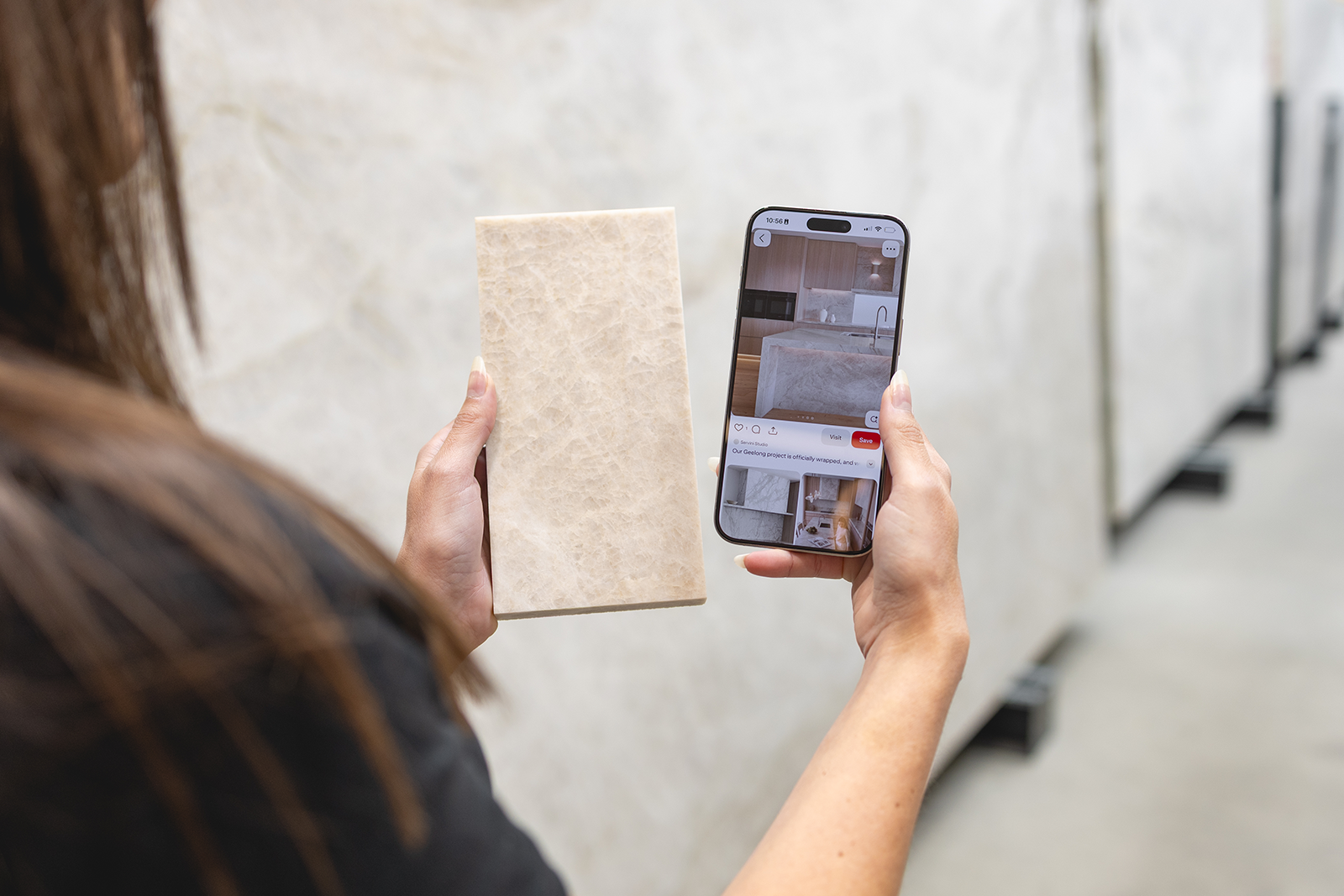
For homeowners who don't know where to begin with stone. You don't need a stone name to start. Send your inspiration photos, tell us what you like and why you're drawn to it, and we'll identify the material and point you to the right slabs. Covers how your eye already picks matching tones, reading stone from a photo, which photos to trust online, and why picking stone is like picking art. Tags: how to choose stone, where to start, inspo photos, identify marble from photo, stone selection, Marble Hub Sydney.
Where to Start When You Don't Know the Stone in Your Inspo Photos
Backlit Stone and Why the LED You Choose Changes Everything
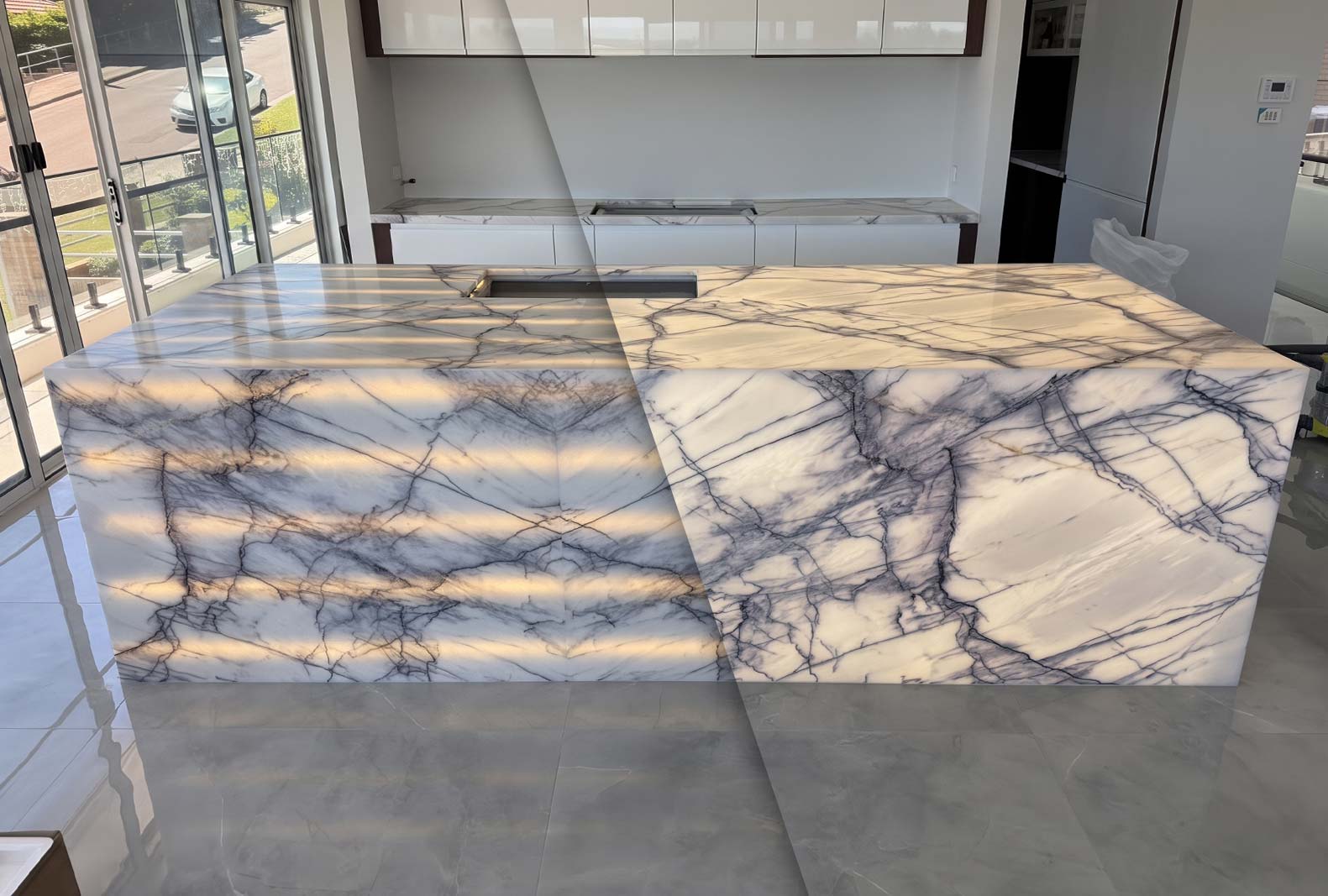
Backlit stone explained simply. The look changes a lot with the light behind the slab. LED strips give a striped, patterned glow; a full LED panel lights the whole slab evenly so it looks lit from within. Both are valid, so do what suits your budget, but plan it early with your electrician. Covers which stones are translucent and why the light install feeds into the check-measure. Tags: backlit stone, backlit marble, translucent stone, LED stone panel, backlit onyx, feature lighting, Marble Hub Sydney.
Backlit Stone and Why the LED You Choose Changes Everything
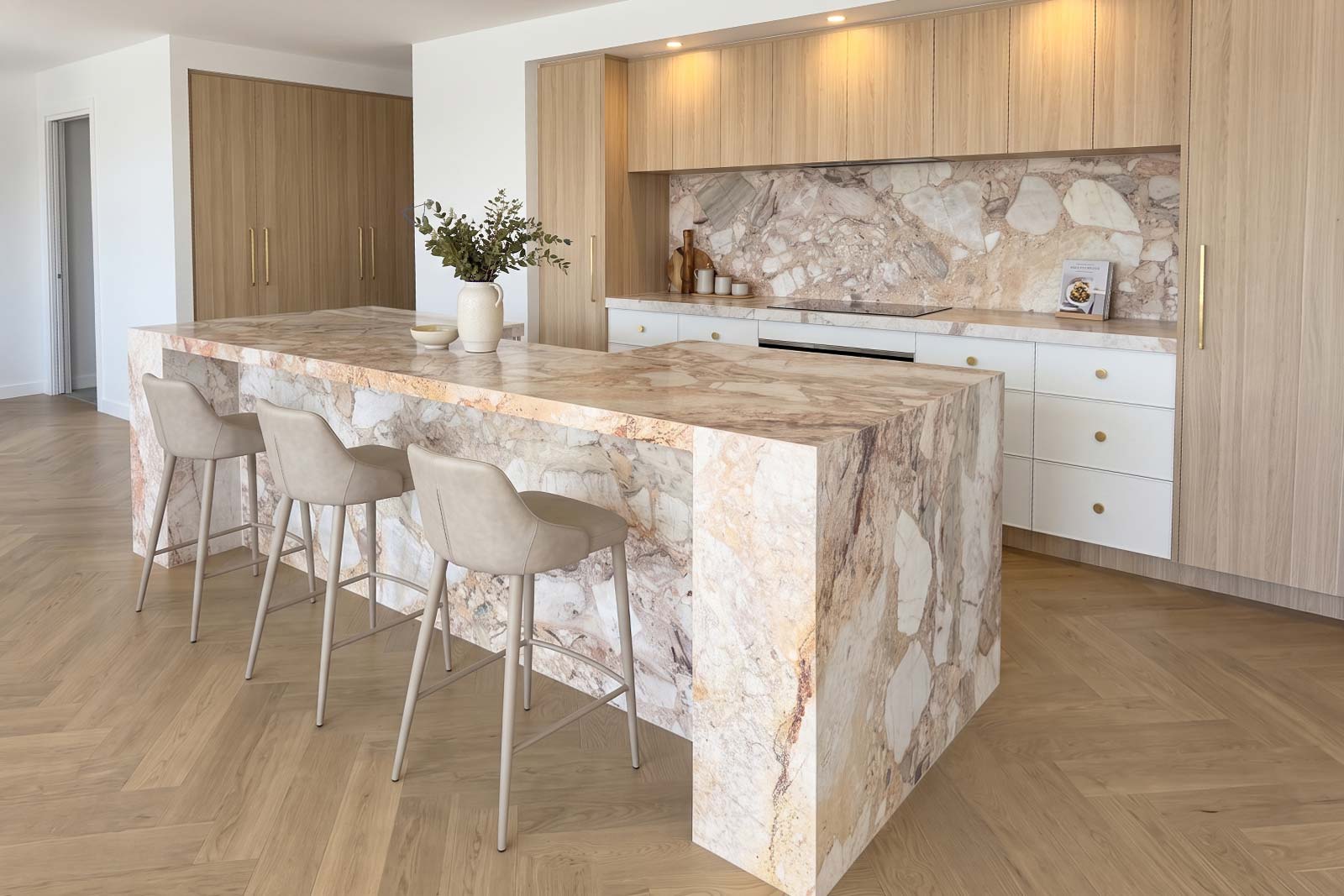
How We Plan Stone Across a Duplex Without Wasting a Slab
Planning stone across a duplex or dual-occupancy build. We work out real slab count, map every piece across the slabs, balance feature stone across both homes, and plan the stages so the check-measure and install land when each side is ready. Covers slab yield, offcut planning, mapping the cut to the stages, and getting every trade working to the same target dates. Tags: duplex stone benchtops, dual occupancy, slab count, stone yield, staged install, trade coordination, Marble Hub Strathfield South.
How We Plan Stone Across a Duplex Without Wasting a Slab
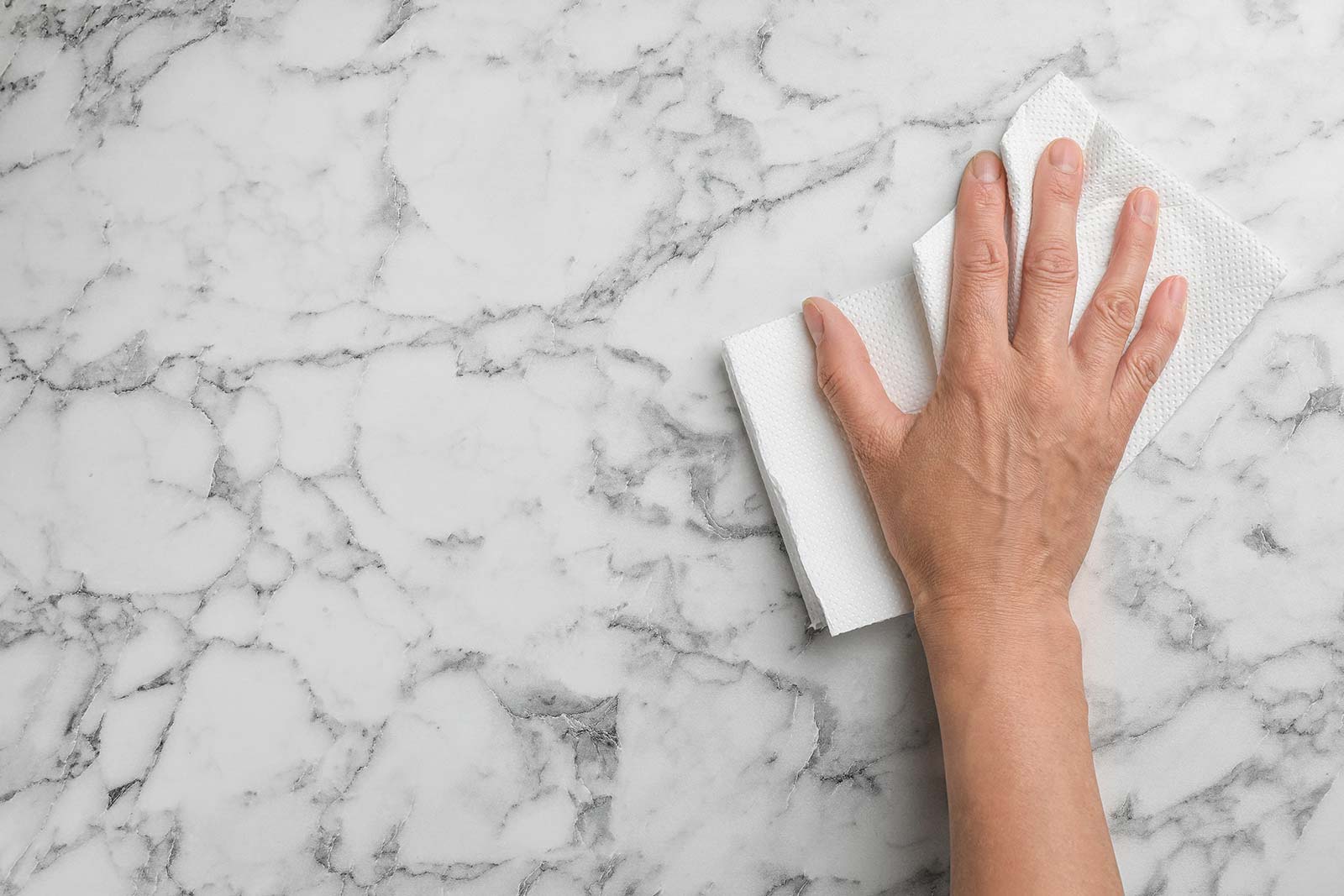
How to Clean and Care for a Marble Benchtop
How to clean and care for a marble benchtop, written for people who already own marble or are about to. Covers the daily routine, warm water and pH-neutral cleaner, wiping acidic spills fast, sealing with Lithofin MN Stain-Stop every 6 to 12 months, and the difference between a stain and an etch. Explains why heavy veining hides marks better than plain marble, and why a rehone and rebuff after 3 to 4 years brings a tired benchtop back. Honest about trade-offs. Marble is a relationship, not a set-and-forget surface. Written by Marble Hub, a Strathfield South stone factory and showroom.
How to Clean and Care for a Marble Benchtop
Let’s Get Started on Your Dream Space
Whether it’s a kitchen, bathroom, or laundry, Kitchen Hub is here to bring your vision to life.
