
Add slabs to your wishlist so we can give you custom quote.
Add productions from our slab collection so we create a quote for your next project!
If you're unsure of what you're after please reach out via our contact page.
Five Curved Islands, Designed to Gather Around
Five Curved Islands, Designed to Gather Around
TL;DR
The island is the heart of the home, so we design ours to be sat at. Five curved islands, each with a cantilevered overhang for seating, on a sculptural stone base. Four stand on a single column, one on twin stone plinths. Five different stones, five moods, one idea that keeps working.
The island is the heart of the home. Everyone knows it, even if they've never said it out loud. It's where people drift while dinner's being made, where kids do homework, where the second glass of wine happens. The kitchen might be the engine of the house. The island is where the living goes on.
So the real test of an island isn't how it looks in a photo. It's whether people want to be at it. The five islands here all pass that test, and they do it the same way. A curved top, cantilevered so stools tuck under, on a sculptural stone base. The curve makes them read as sculpture from across the room. The overhang makes them somewhere to sit, eat, work and talk. Five different stones, five moods, one idea that keeps working.
We'll start with the newest.
The Six Senses island
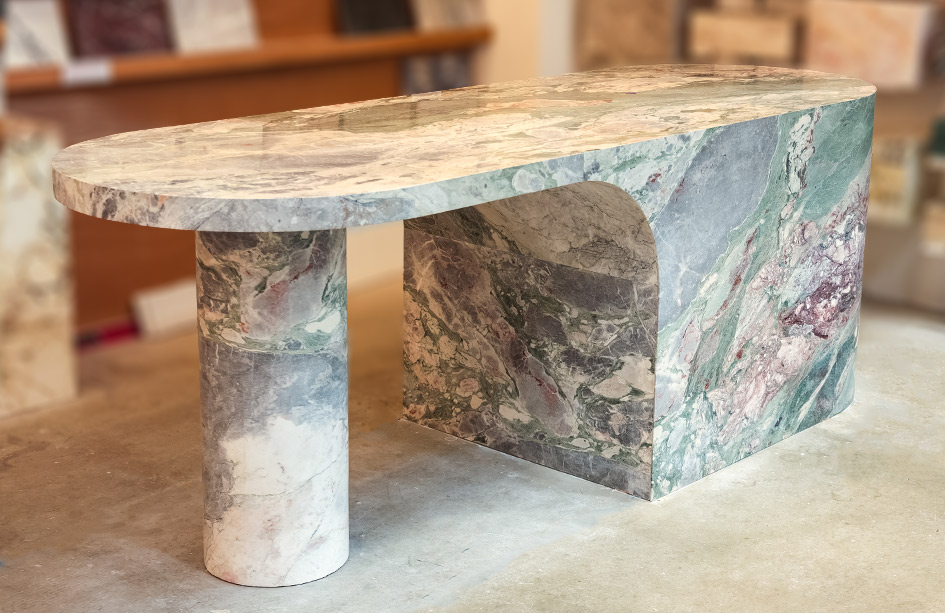
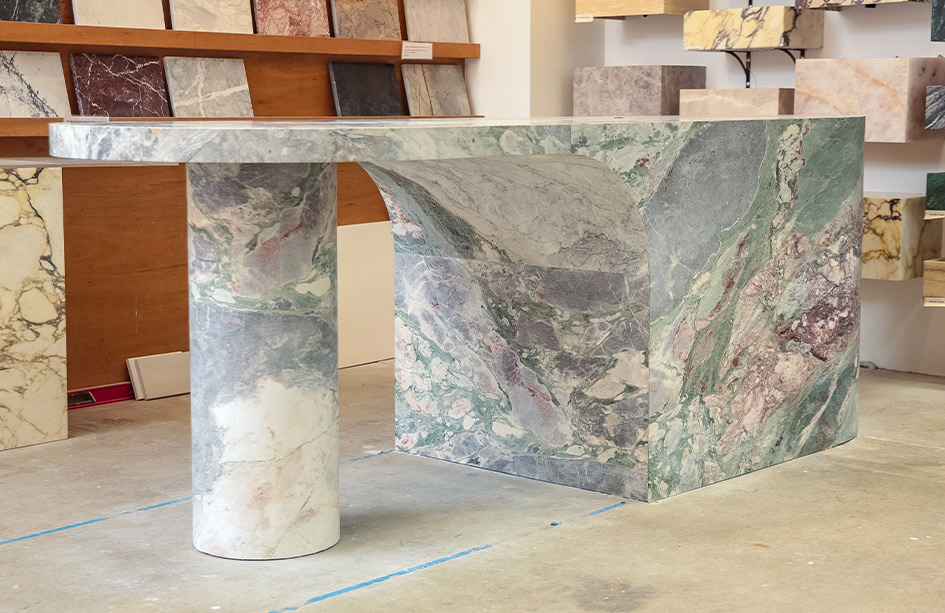
This one lives in our showroom, cut from Six Senses Marble, also sold as Four Season. It reads as a sage and grey-green ground with burgundy, rose and cream moving through it, softened by grey and crystalline white. A stone that sets the mood of a room before anyone stands at it. Here's what makes it work as a place to gather.
The curved end
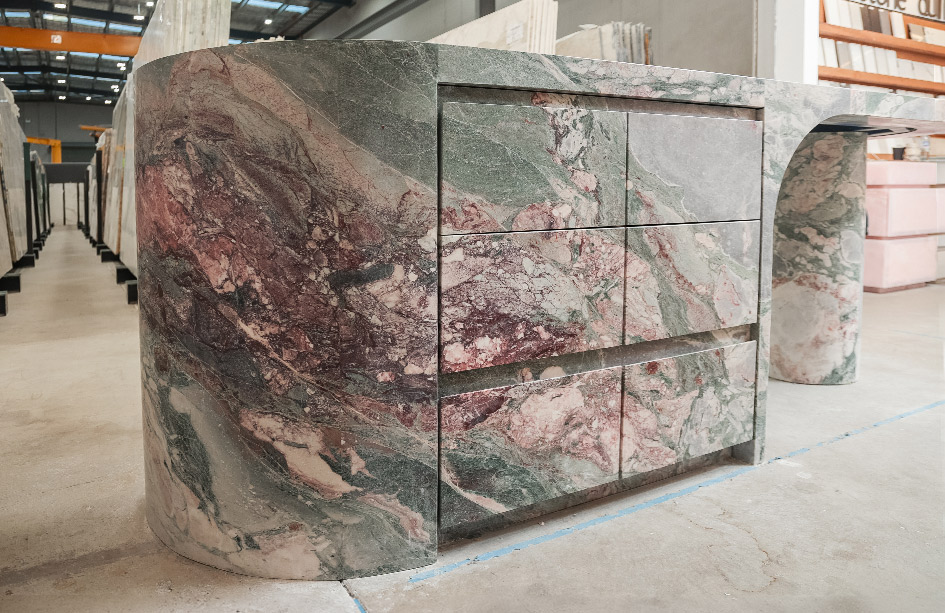
A hard mitred waterfall stops the eye with a corner. This end curves instead, sweeping from the benchtop to the floor in one move. On a stone with this much movement, the curve matters. It keeps the eye travelling rather than snagging. It also loses the sharp corner people walk into, and it reads as sculpture from across the room rather than as a benchtop with a panel on the side.
The overhang, and why you can sit at it
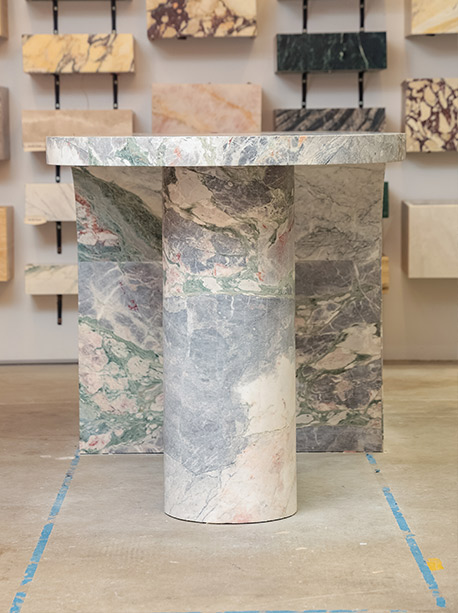
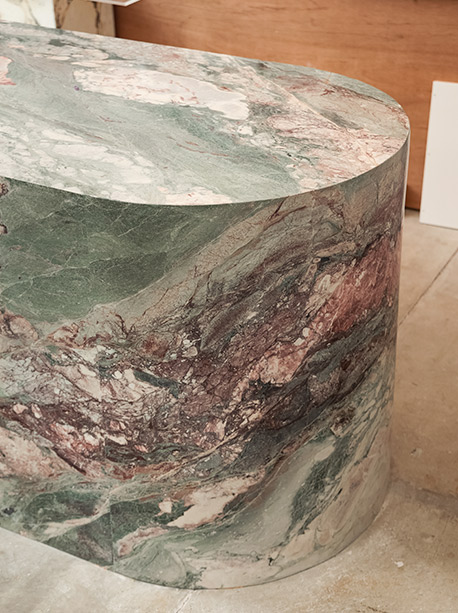
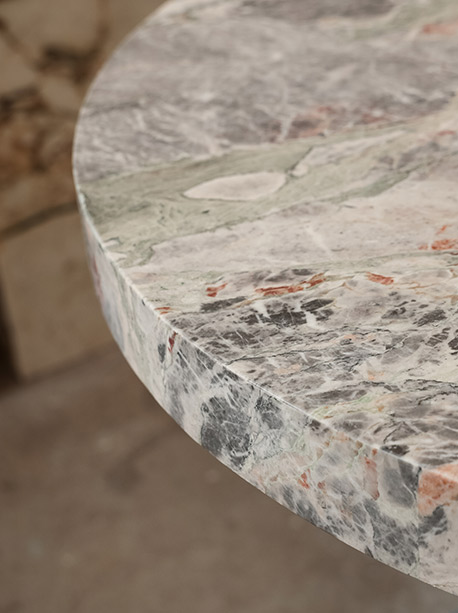
The overhang is the whole point of the seating side. The benchtop runs past the drawer base so stools tuck underneath and people can actually sit, knees under, the way you'd sit at a table. That's what turns a bench into the spot everyone ends up.
A run this generous needs support, so it stands on a single stone column. The column does two jobs. It carries the overhang, and it becomes a design feature in its own right, its curve answering the curve of the top. You could hide the support on a bracket and float a shorter overhang. We wanted the longer seating run and the sculptural leg, so the column stays in view.
Stone-clad drawers, no handles
The drawer fronts are clad in the same stone, and they open on a finger pull instead of a handle. A recess along the top edge your hand slips into.
Handles would interrupt the surface. On a stone this expressive, every handle would break the pattern and pull your eye to hardware instead of material. Without them, the face reads as one continuous run of stone. That unbroken look is a large part of why the island feels architectural rather than fitted. The luxury is in what you don't see.
The movement runs right across
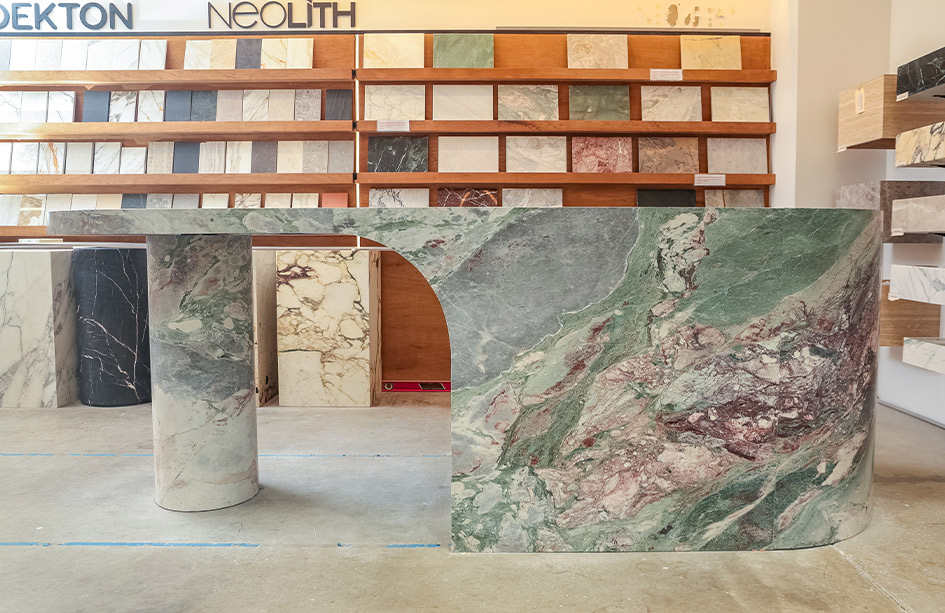
Look along the drawer bank and the veining runs straight across the joins, drawer to drawer, then continues around onto the curved end. The stone reads as one piece with drawers cut into it, rather than separate fronts sitting side by side. On a busy natural marble, holding that flow across a whole run is what separates a composed island from one that's merely installed.
See the stone properly

You can't judge a stone like this from a sample. A hand-sized offcut shows you colour and nothing else. Six Senses reads completely differently at full scale, where the movement that looks busy in a small piece resolves into flow. That's why we ask people to view the full slab, in the light it will live under, before committing. On a statement stone, where the drama lands on your island is a design decision, not a coincidence.
You can see this slab on the Six Senses Marble slab page, and more in the Four Season collection.
A form we keep coming back to
The Six Senses island isn't a one-off. This curved shape, cantilevered for seating on a sculptural stone base, is a form we return to because it keeps earning its place as the heart of the room. We've made it five times now, in five stones. Same idea underneath. A different mood on top.
The Taj Mahal Quartzite island
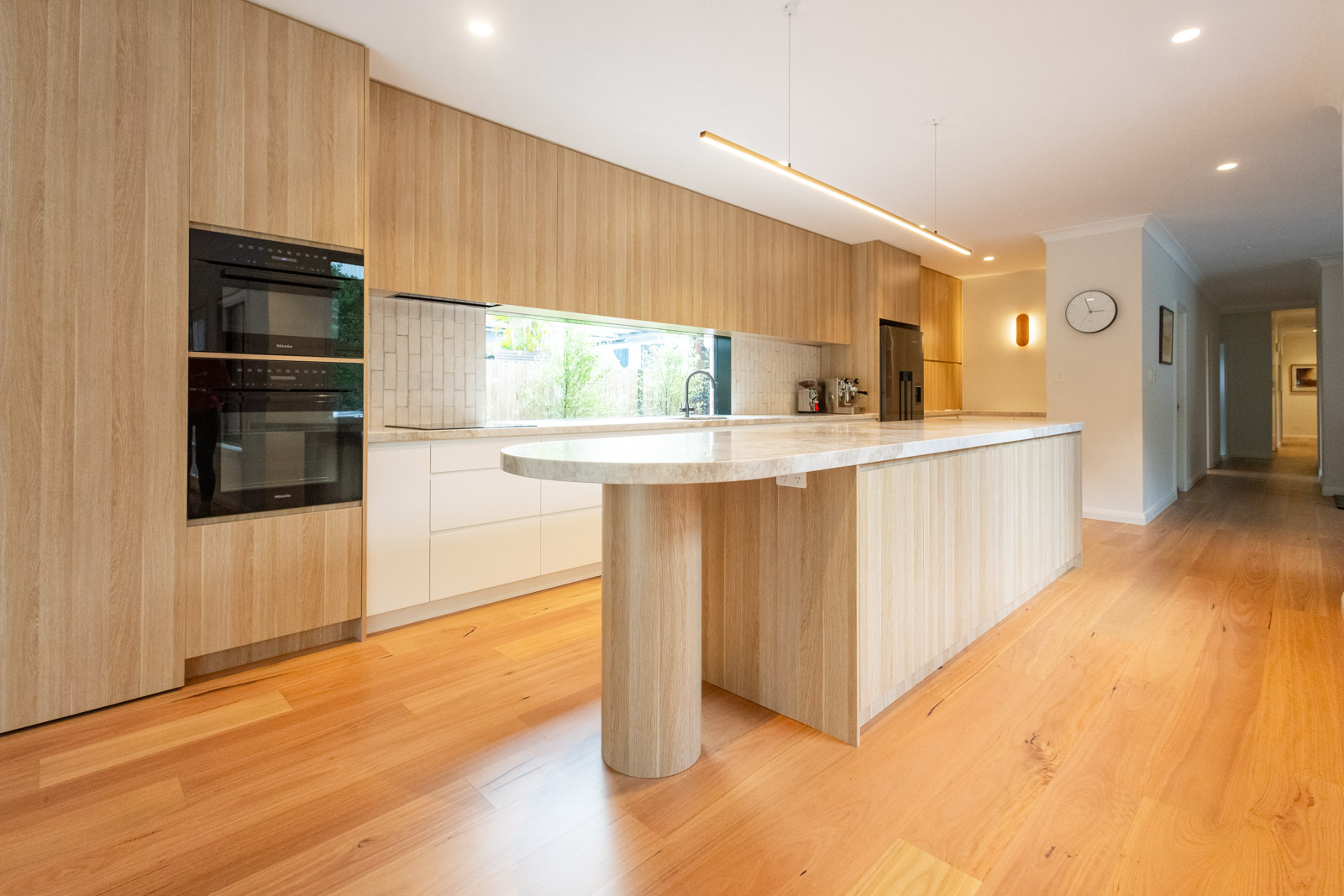
Taj Mahal Quartzite. Warm creamy whites and soft beiges with subtle gold movement. Soft and flowing rather than sharp, which keeps the room calm. Being a quartzite, it's harder-wearing than a marble too, which suits a family kitchen. The column here is timber, wrapped to match the joinery, so the stone top reads as a floating slab resting on warm oak. This is the version for people who want the sculptural shape and the seating without the drama.
The Calacatta Viola island
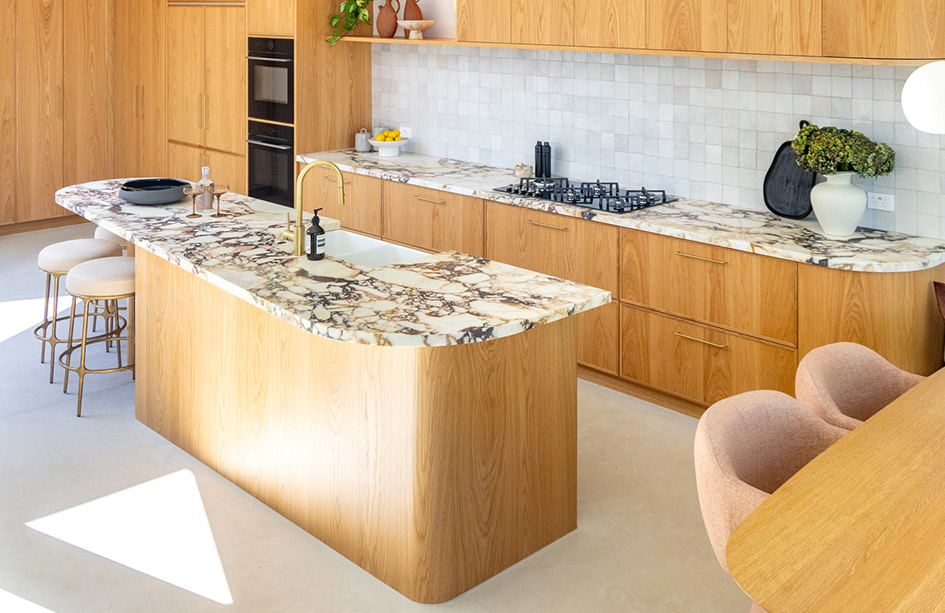
Calacatta Viola. White ground, burgundy and plum veining, paired with warm oak, gold stools and a soft white splashback. The veining does the talking. The timber column keeps the base grounded so the top can be expressive. Drama, but warm rather than cold.
The Calacatta Monet island
Calacatta Monet. A white marble with soft grey and gold veining. Cooler and more architectural, set against a herringbone floor and darker joinery. Like the Six Senses island, it stands on a stone column, so the whole piece reads as one carved mass.
The Breccia Rose Botticelli island
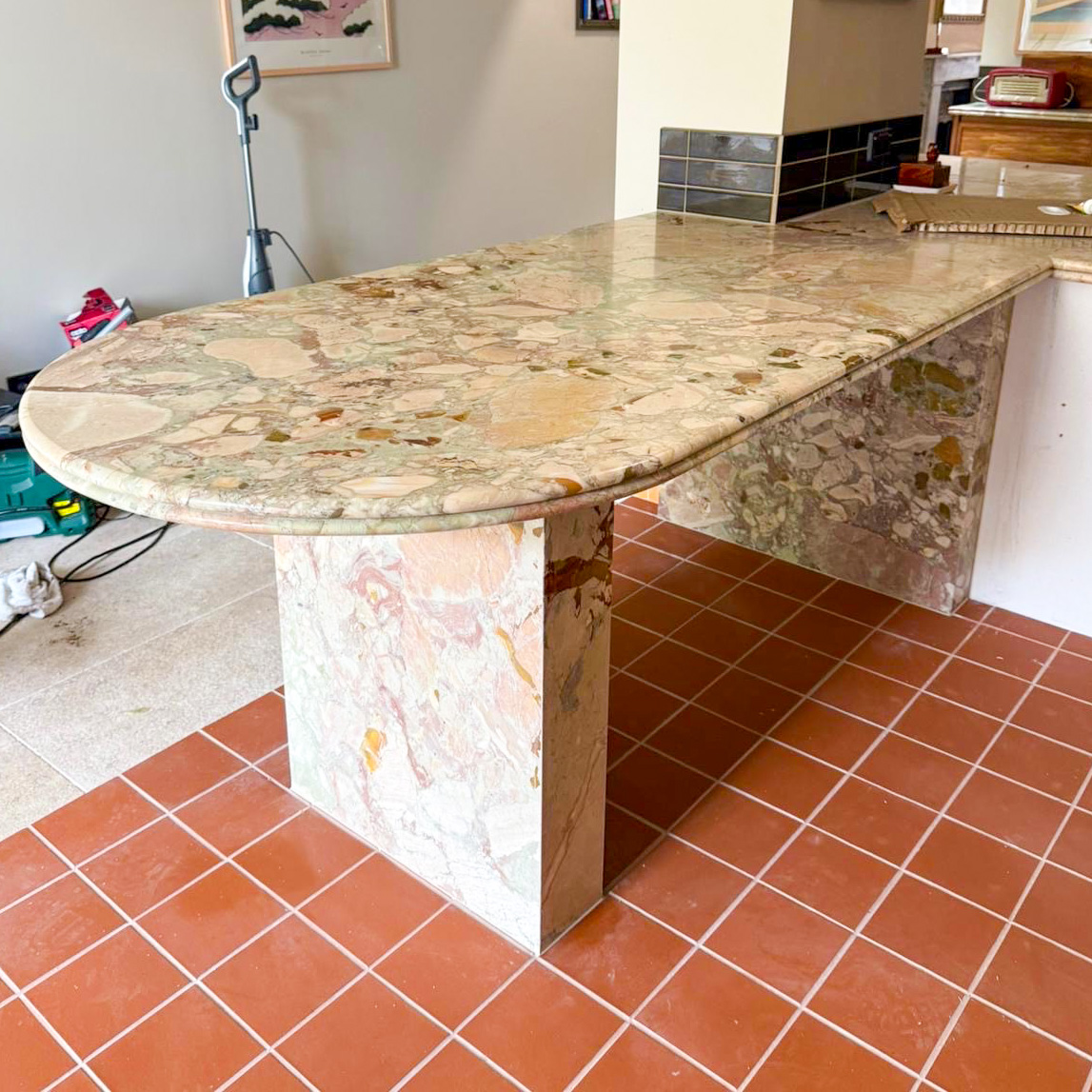
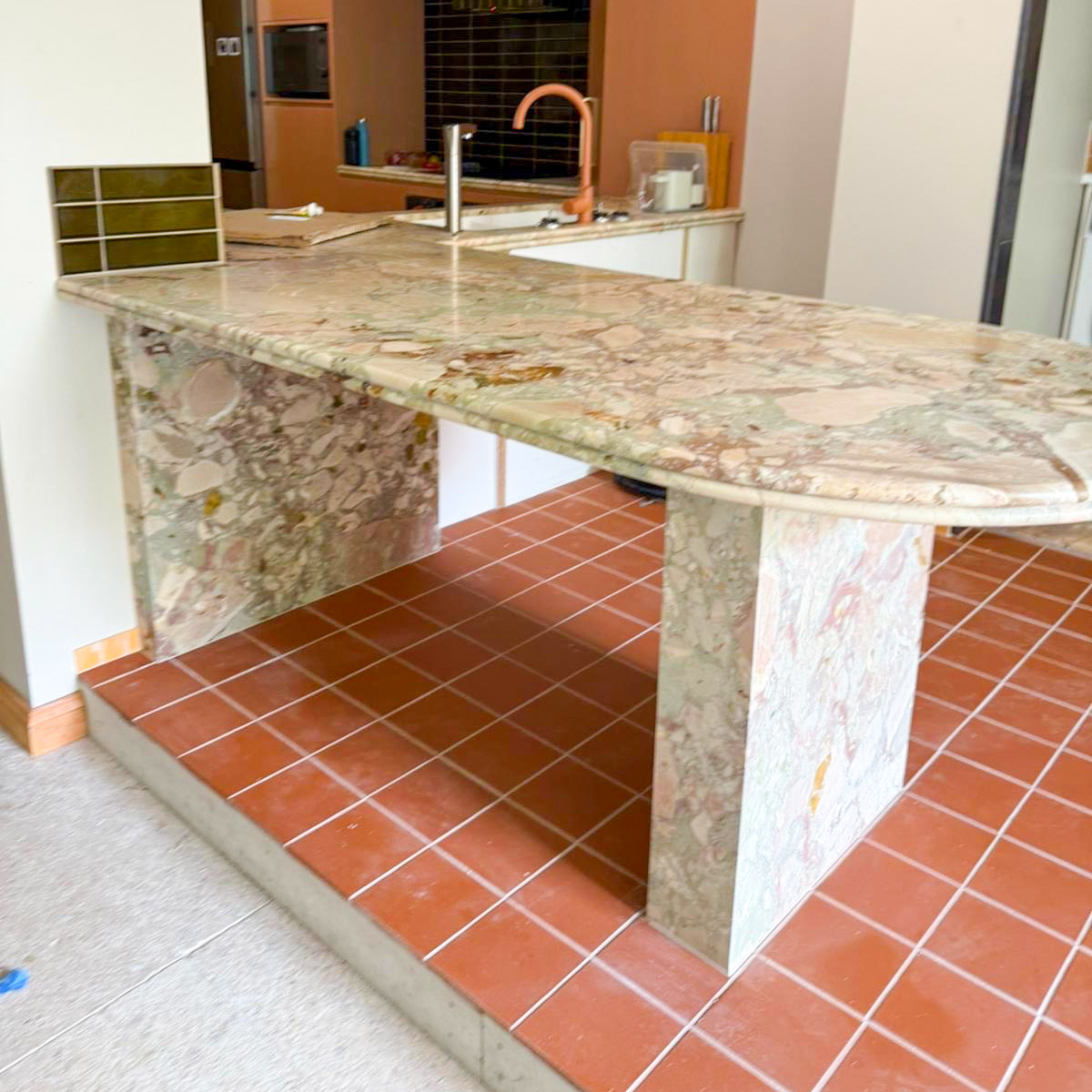
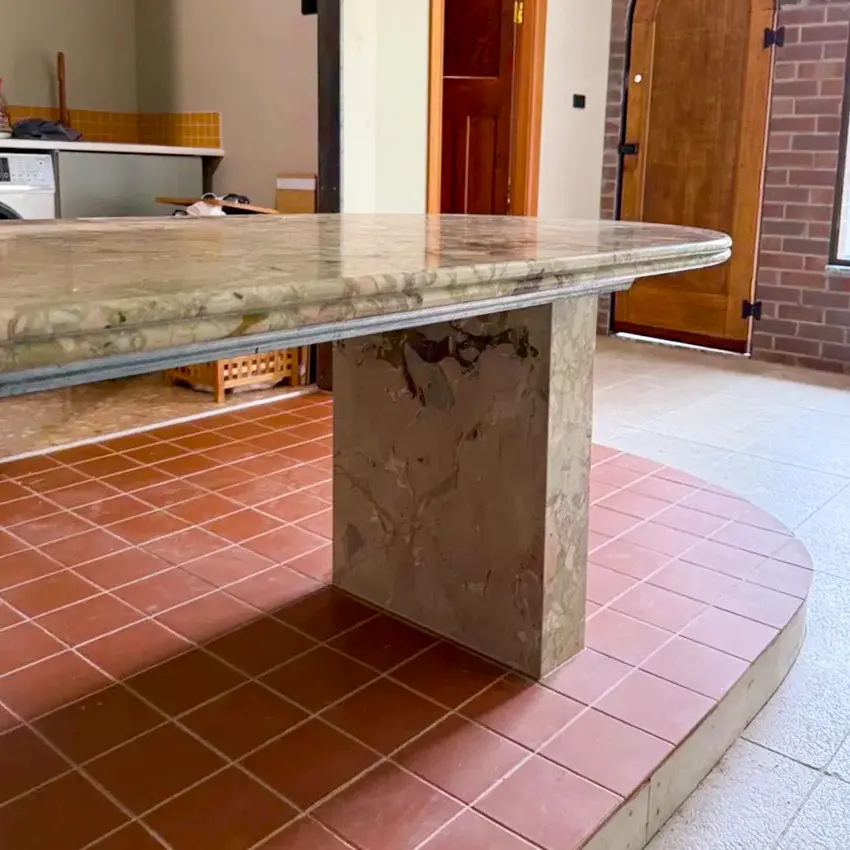
Breccia Rose Botticelli. Warmer and more traditional, a fruity breccia moving through cream, green, rose and terracotta. This one sits on twin stone plinths rather than a single column, which gives it a more grounded, solid presence. It's the version that shows the form doesn't only belong in a minimal modern kitchen. It works in a warmer, more characterful home too.
The base: column, plinth or timber?
This is the choice that changes the whole character of the island, and it's worth understanding before you fall for a photo.
A single stone column makes the island read as one carved object, with maximum stone presence. It's the boldest option. The Six Senses and the Calacatta Monet islands went this way.
A timber column lets the stone top feel like it's floating, and brings warmth from timber into the mix. It ties the base into your joinery so the room feels connected rather than dominated by stone. The Taj Mahal and the Viola islands went this way.
Twin stone plinths give a more grounded, solid feel, and they carry a long or heavy top comfortably. They suit a warmer or more traditional room, where a single slim column might feel too minimal. The Breccia Rose Botticelli island went this way.
None is more correct. It comes down to how much stone presence you want, how the top is proportioned, and whether the room leans modern or traditional.
What makes them timeless
Curves are having a moment, and statement stone is having a moment, so it's fair to ask whether this dates. The form is what protects it. A curve is a shape, not a trend detail. Hidden hardware is restraint, and restraint ages well.
Trends usually date because they add. These islands hold up because most of their decisions were about taking things away. No hard corners, no visible handles. The stone will always be a talking point. The reason each one still feels intentional in five years is that everything around the stone was kept calm, and the island still does the one job that matters. It's the place everyone gathers.
Start with the shape, then the stone
If you want an island that becomes the heart of your home, the shape and the seating are where to start, then the stone. Our Strathfield South showroom has full slabs and finished stonework under the light they're meant to live in. A design consultation is where we work through the form, the seating, and the stone that suits how you live. If you're weighing the bigger island decisions first, start with our guide to the four decisions that shape any island.
FAQ
What is Six Senses Marble?
Six Senses, also sold as Four Season Marble, is a natural marble with bold, high-movement patterning. In a honed finish it reads as a sage and grey-green ground with burgundy, rose and cream moving through it, softened by grey and crystalline white. It's a statement stone, best used where its movement has room to be seen. Every slab is individual, so slab selection matters more here than with a calmer stone.
Does a dramatic stone work across a whole island?
It can, with the right form and restraint everywhere else. A stone this expressive wants to lead, so the joinery, hardware and finishes around it should stay quiet. On these islands the curved form and hidden finger pulls all pull back so the stone can be the one loud thing in the room. If everything competes, the space feels chaotic.
What is a finger pull, and why use it on stone drawers?
A finger pull is a recess you open the drawer with, instead of a handle. On stone-clad fronts it keeps the surface unbroken, so the veining runs continuously and the joinery reads as one form rather than a bank of cabinets with knobs on them.
Should the island base be a column, timber, or stone plinths?
All three work, and they do different things. A single stone column makes the island read as one carved mass, with maximum stone presence. A timber column lets the stone top float and brings warmth from timber. Twin stone plinths give a grounded, solid feel that suits a warmer or more traditional room. It comes down to how much stone you want, how the top is proportioned, and whether the room leans modern or traditional.
Why put seating at the island?
Because the island is where people naturally gather, and a cantilevered overhang gives you the knee room to actually sit rather than just lean. A curved end softens the approach and loses the sharp corner. Together they turn the island from a work surface into the social centre of the kitchen.
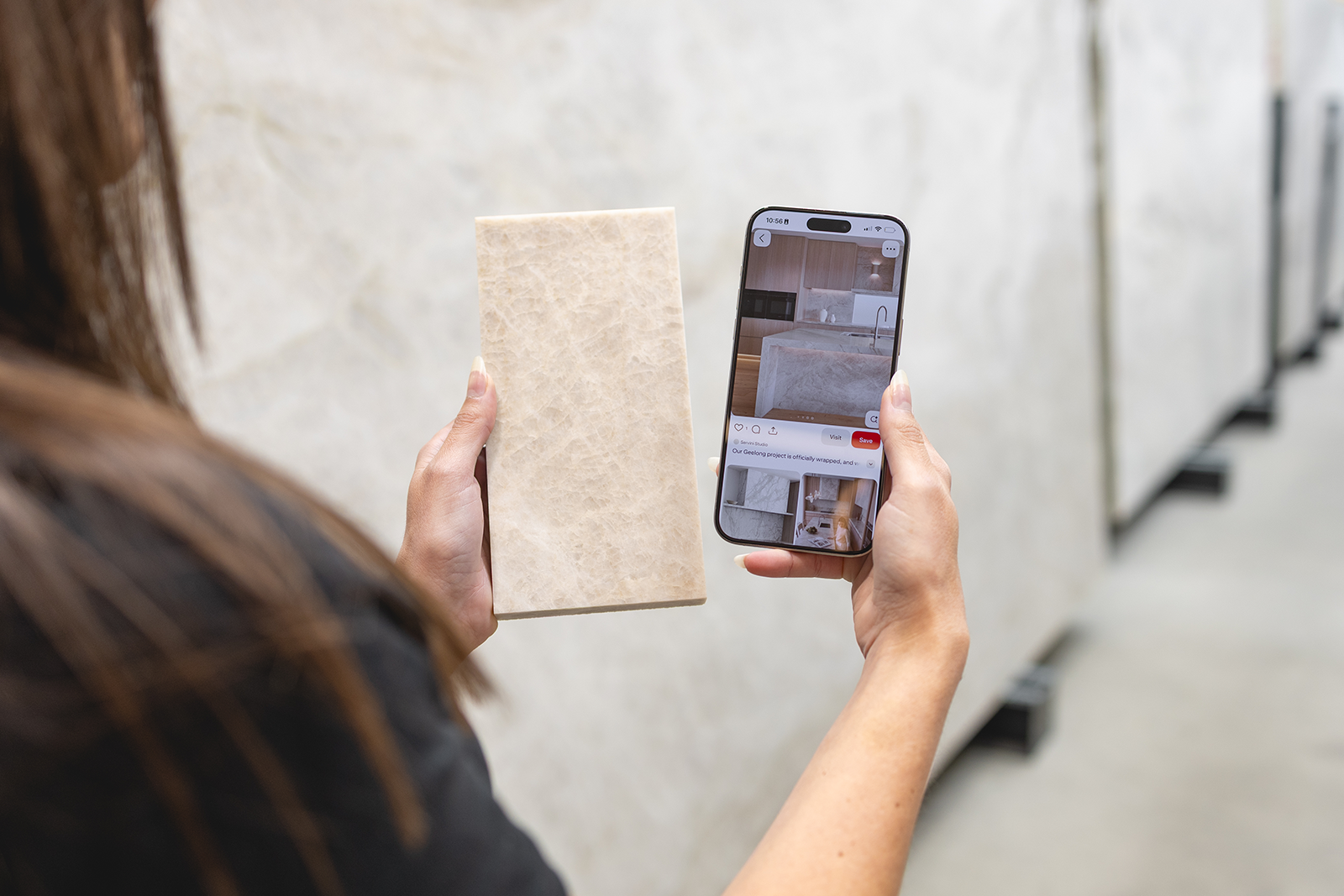
Where to Start When You Don't Know the Stone in Your Inspo Photos
For homeowners who don't know where to begin with stone. You don't need a stone name to start. Send your inspiration photos, tell us what you like and why you're drawn to it, and we'll identify the material and point you to the right slabs. Covers how your eye already picks matching tones, reading stone from a photo, which photos to trust online, and why picking stone is like picking art. Tags: how to choose stone, where to start, inspo photos, identify marble from photo, stone selection, Marble Hub Sydney.
Where to Start When You Don't Know the Stone in Your Inspo Photos
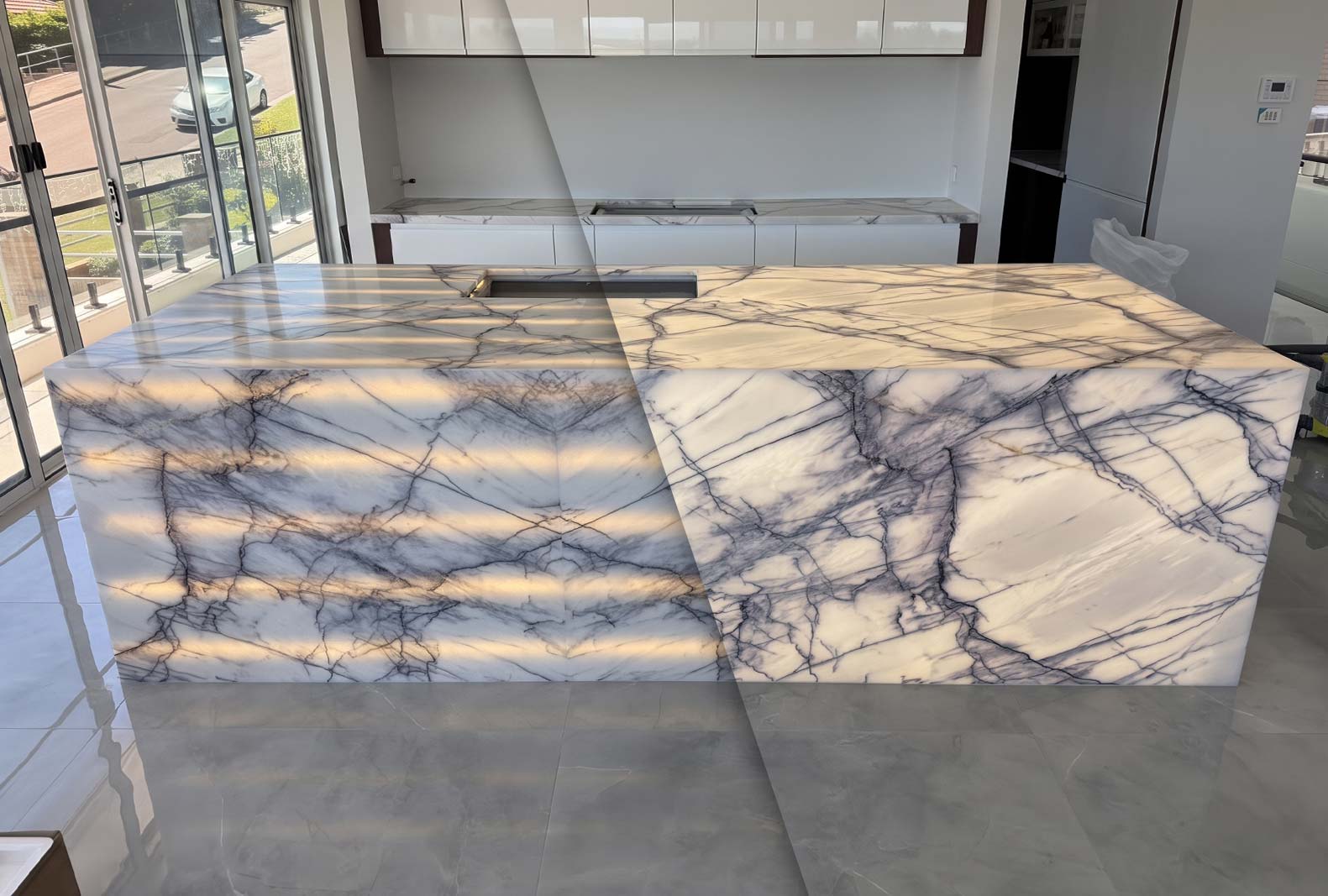
Backlit Stone and Why the LED You Choose Changes Everything
Backlit stone explained simply. The look changes a lot with the light behind the slab. LED strips give a striped, patterned glow; a full LED panel lights the whole slab evenly so it looks lit from within. Both are valid, so do what suits your budget, but plan it early with your electrician. Covers which stones are translucent and why the light install feeds into the check-measure. Tags: backlit stone, backlit marble, translucent stone, LED stone panel, backlit onyx, feature lighting, Marble Hub Sydney.
Backlit Stone and Why the LED You Choose Changes Everything
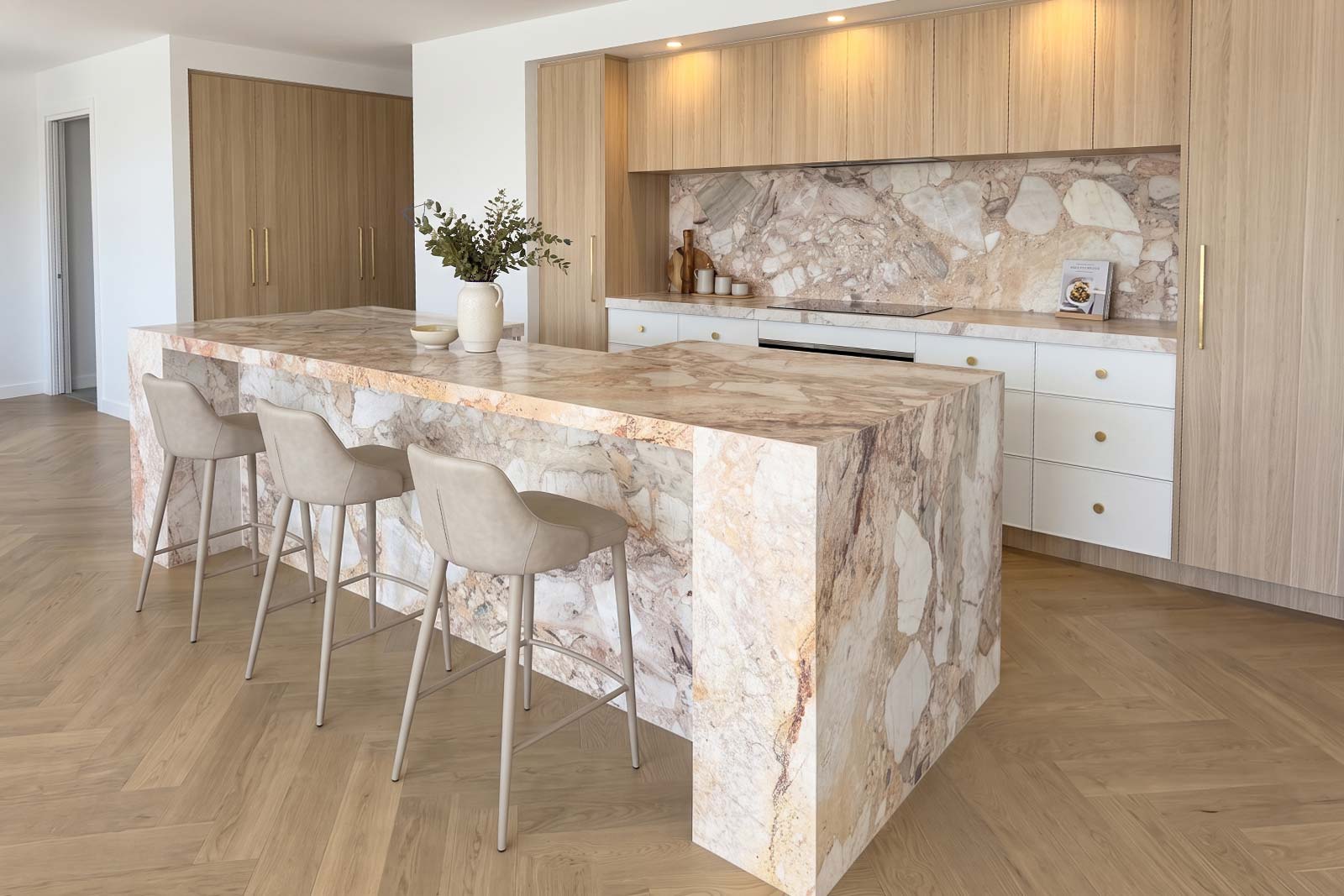
How We Plan Stone Across a Duplex Without Wasting a Slab
Planning stone across a duplex or dual-occupancy build. We work out real slab count, map every piece across the slabs, balance feature stone across both homes, and plan the stages so the check-measure and install land when each side is ready. Covers slab yield, offcut planning, mapping the cut to the stages, and getting every trade working to the same target dates. Tags: duplex stone benchtops, dual occupancy, slab count, stone yield, staged install, trade coordination, Marble Hub Strathfield South.
How We Plan Stone Across a Duplex Without Wasting a Slab
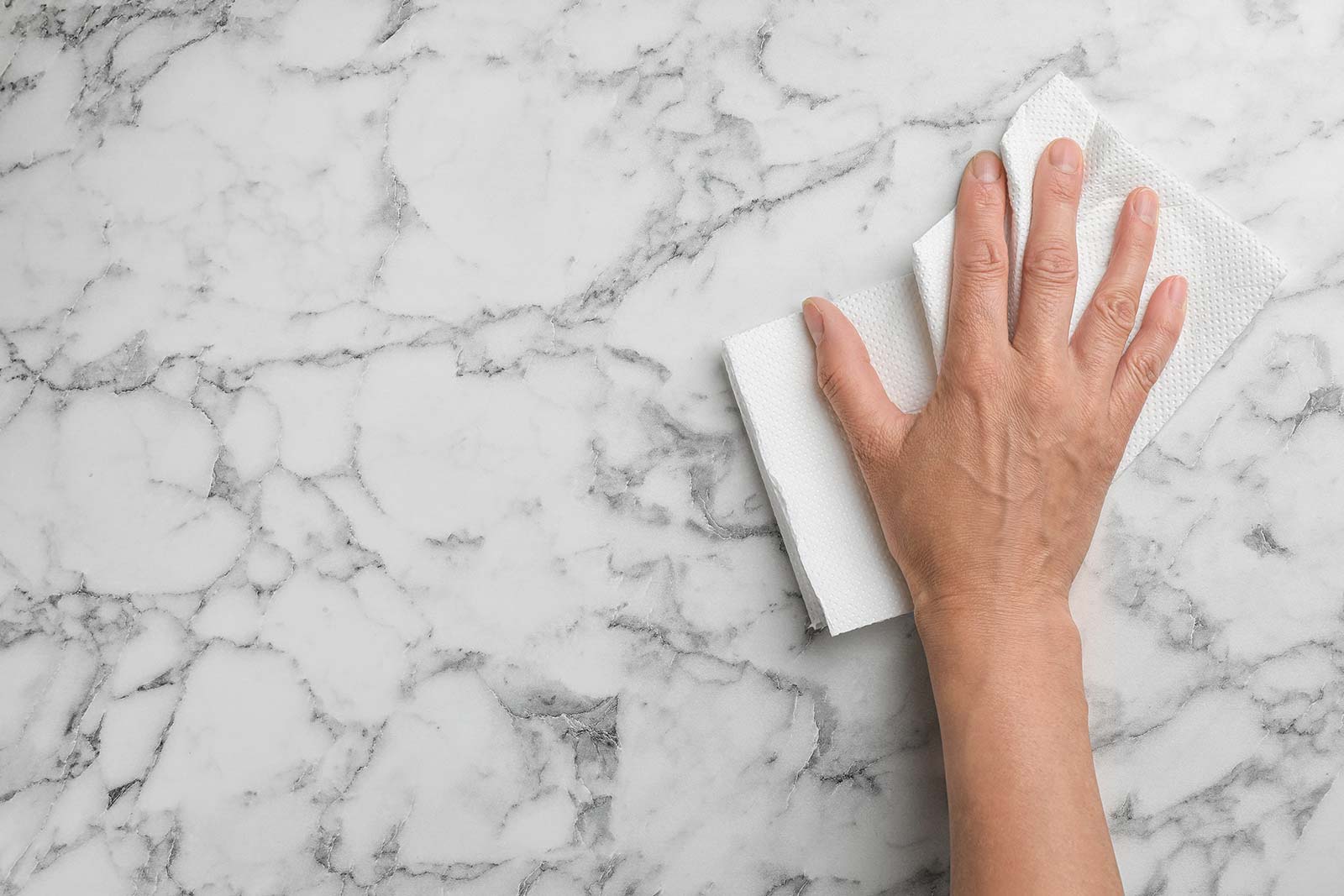
How to Clean and Care for a Marble Benchtop
How to clean and care for a marble benchtop, written for people who already own marble or are about to. Covers the daily routine, warm water and pH-neutral cleaner, wiping acidic spills fast, sealing with Lithofin MN Stain-Stop every 6 to 12 months, and the difference between a stain and an etch. Explains why heavy veining hides marks better than plain marble, and why a rehone and rebuff after 3 to 4 years brings a tired benchtop back. Honest about trade-offs. Marble is a relationship, not a set-and-forget surface. Written by Marble Hub, a Strathfield South stone factory and showroom.
How to Clean and Care for a Marble Benchtop
Let’s Get Started on Your Dream Space
Whether it’s a kitchen, bathroom, or laundry, Kitchen Hub is here to bring your vision to life.
