
Add slabs to your wishlist so we can give you custom quote.
Add productions from our slab collection so we create a quote for your next project!
If you're unsure of what you're after please reach out via our contact page.
Can You Use Marble in a Vanity? Yes, and It Might Be the Best Room for It
Can You Use Marble in a Vanity? Yes, and It Might Be the Best Room for It
TL;DR: Marble works beautifully in a bathroom vanity. A bathroom is actually kinder to marble than a kitchen, with no lemon juice, no olive oil, no hot pans, and a fraction of the traffic. Seal it a couple of times a year, wipe up cosmetics and toothpaste when you see them, and a marble vanity top will look considered for decades. The bigger decisions are which marble, and how you detail the front.
People ask us this all the time, and they usually ask it half-expecting a no, like they've already fallen for marble and they're waiting for us to talk them out of it. We won't. A bathroom vanity is one of the best places in the home to use marble, and here's the thinking behind that.
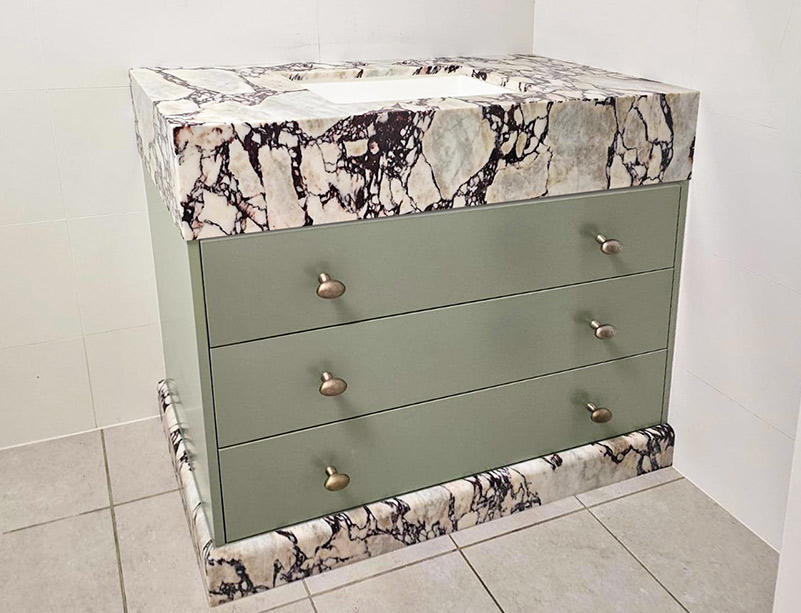
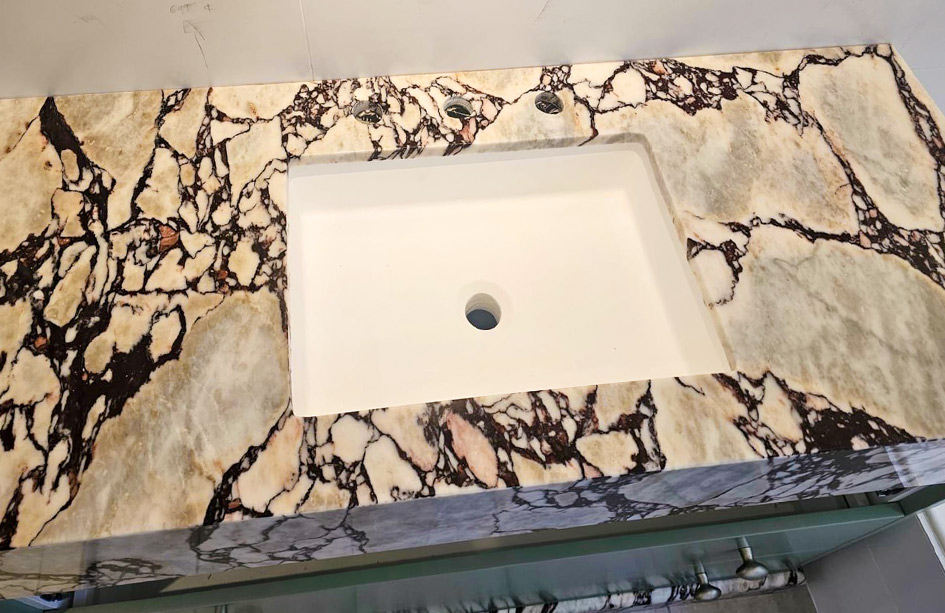
Start with Calacatta Viola. The violet and burgundy veining is about as strong as marble gets, so you'd expect a stone like this to box you into one very particular scheme. It doesn't. Those tones are earthy rather than saturated, so Viola reads as a bold neutral and sits happily against almost any joinery colour, sage green, warm timber, off-white, dark cabinetry, brass. That's why designers keep reaching for it, and why it stays timeless rather than reading as a moment. A strong stone that goes with everything is a rare find.
A stone this bold needs the right weight under it. On a slim edge, a strong marble can look thin, almost like a printed panel laid on top of a cabinet. Give it a proper mitred apron and the weight matches the drama of the veining, so the vanity looks as solid as the stone actually is. That apron is the detail that separates a marble vanity that looks designed from one that looks like a slab dropped on joinery, and it's worth understanding how it's done.
The detail that makes marble look architectural: the apron
The front edge of the top can be mitred to look like a solid block of stone. We call it an apron. A mitred join folds the face down from the top so the vanity reads as one thick piece of marble, when it's actually a benchtop-thickness top with a returned front. Done well, you can't see the trick. The eye registers weight and solidity, and the vanity looks sculptural.
You've got room to play with how thick it reads. A small edge keeps things light and modern. Around 100mm gives you a confident, substantial look. Push it to 350mm or 450mm and the apron becomes the feature of the room, a proper block of stone with real presence. Some sit on joinery, some are wall-mounted and float. That heavier apron is where marble stops looking like a benchtop and starts looking like furniture.
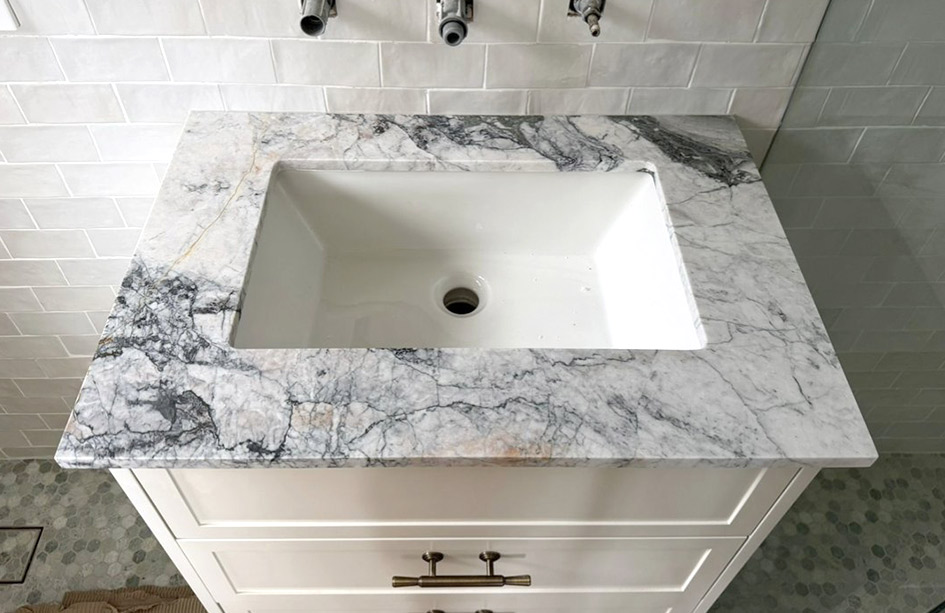
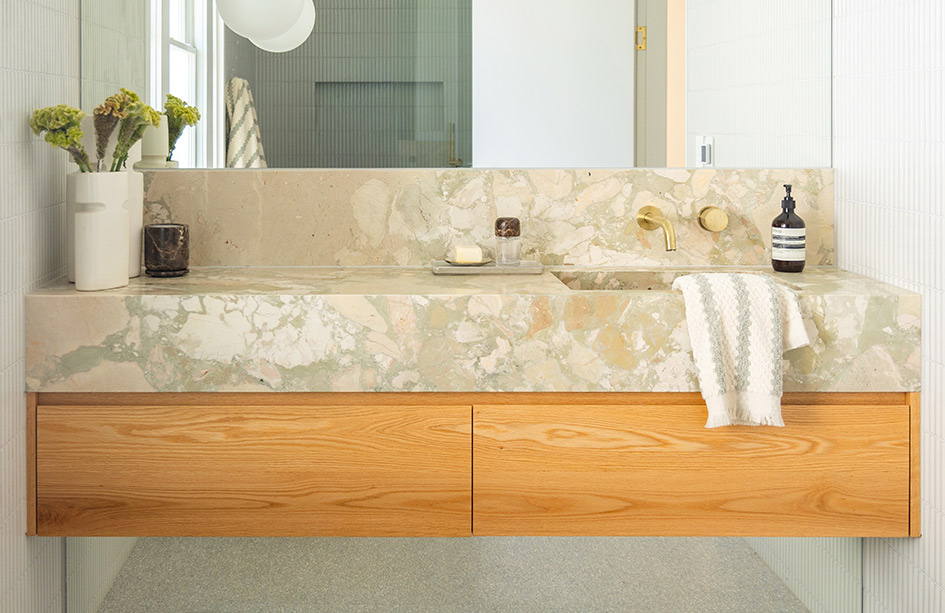
This one is Calacatta Monet Extra. Two things are working together. The mitred front gives it that solid-block weight, and the taps are wall-mounted rather than sitting on the bench. Wall-mounted tapware is worth the extra plumbing for one simple reason: it clears the top. Nothing interrupts the run of stone, so you see more marble and the veining reads uninterrupted. Put a marble splashback behind the taps and the whole back wall becomes part of the feature.
Why a bathroom actually suits marble
Most of what people fear about marble comes from the kitchen. Acidic food marks it. Oil sits in it. A dropped pan chips the edge. All true, and all reasons a marble kitchen benchtop is a genuine commitment.
A bathroom asks almost none of that. The main things that touch a marble vanity top are water, hands, and the occasional splash of something with a bit of acid in it, like a face toner or a perfume. Compared to a kitchen, that's a gentle life. The stone spends most of its day doing nothing but looking good.
This is the part most guides skip. They copy the kitchen warnings across to the bathroom and scare people off a material that suits the room. If you've been nervous about a marble bathroom vanity because of what you read about marble benchtops, the risk is smaller than you think.
Why marble reads timeless, not trendy
Think about the last high-end hotel you stayed in. The penthouse, the suite with the view, the room they photograph for the website. The bathroom was almost certainly marble.
That's no accident. Marble signals that a room was considered. The veining is organic movement, and organic movement doesn't date the way a trend colour or a patterned tile does. A sage-green vanity will feel like 2024 in ten years. A Calacatta vanity top will feel like a good decision.
There's a design principle worth borrowing from those hotels. They use one hero material and let it carry the room. The marble does the work, so everything else stays quiet: simple joinery, restrained tapware, good light. When the stone is the feature, you don't need much else, and restraint is what makes a small room feel expensive.
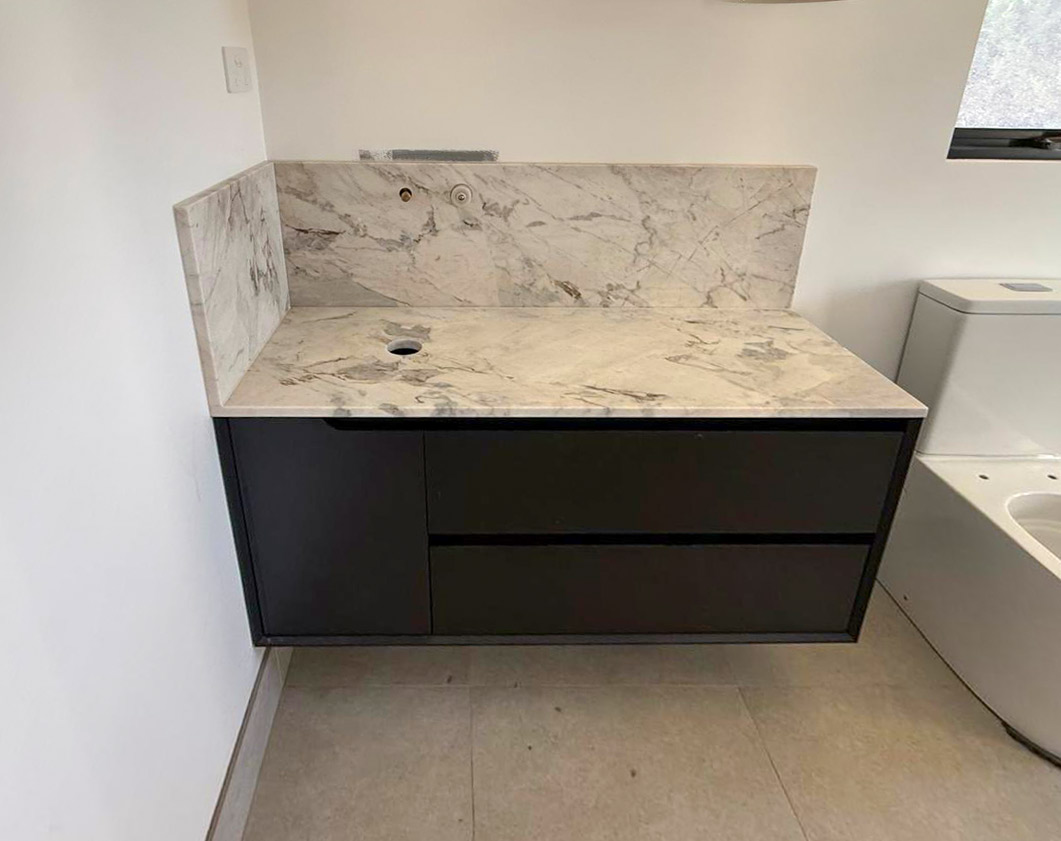
That's Lord White above. Bold grey veining on a soft white ground, a thick mitred top, floating on dark timber joinery with a full-height marble splashback running up behind. One material, doing everything. The dark cabinet grounds it so the stone reads as the hero rather than fighting for attention.
Use the whole slab: the smartest way to get marble into your bathroom
Here's something worth knowing before you price anything.
A vanity top is small. If you're already putting marble somewhere else in the home, a kitchen island, a benchtop, a full-slab splashback, there's often enough material in the same slab to get your vanity out of it too. When we quote a kitchen or a living area, we can check whether your marble vanity tops fit into the same slab at the same time.
Do that, and two good things happen. You make full use of a slab you're already paying for, and the same vein family runs through your home. The marble in your kitchen and the marble in your ensuite come from the same block, so the house feels connected rather than assembled from separate decisions. That continuity is the kind of thing people can't quite name when they walk in, but they feel it.
It also adds a feature to your bathroom that lifts the whole home. We've written more about letting one stone follow you through the house, which is worth a read if you like the idea.
Put your boldest stone in your smallest room
The powder room is the best gamble in the house. It's small, guests use it, and nobody lives with it every day. That makes it the room to be brave. A stone that could be too much across ten metres of kitchen can be perfect across a two-metre powder room. Viola is a natural fit here for the reasons above. If you want to push even further, natural stone has louder options still.
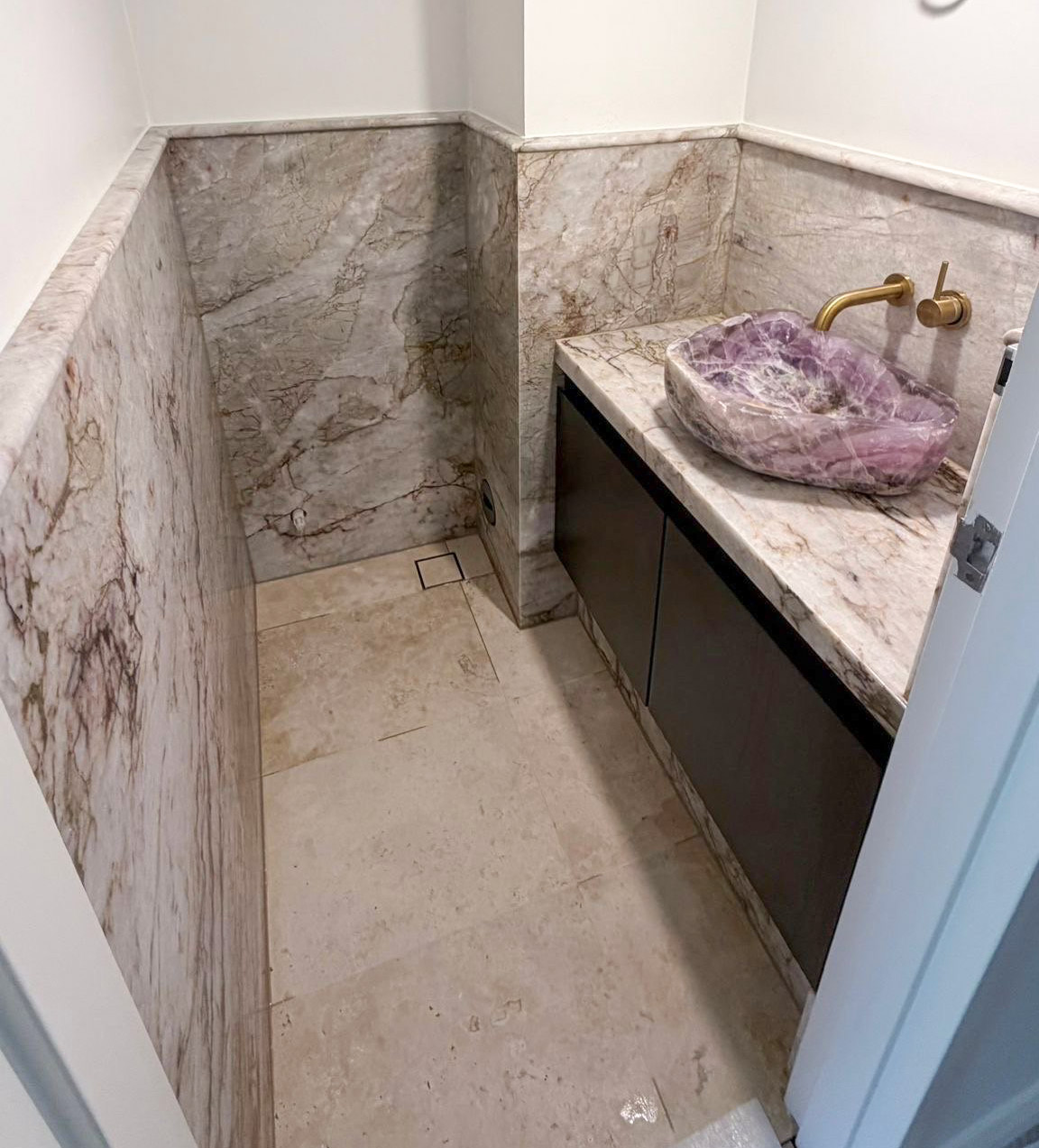
This one is Cristallo Oro, a quartzite rather than a marble, so it sits here as the statement-stone idea rather than a marble example. The stone wraps the walls and the vanity, a brass tap comes off the wall, and the basin is a carved crystal vessel. Bold, and it works because the room is small enough to carry it. If you're weighing marble against quartzite for something like this, we've written about how the two differ and when each one earns its place.
The honest part: living with marble
Every good material asks for something in return. Marble asks for a little care, and it's less than you'd expect in a bathroom.
Seal it around twice a year. Sealing takes a few minutes and it's the thing that buys you peace of mind. Wipe up cosmetics, toothpaste, and anything acidic when you notice them, rather than letting them sit overnight. That's most of the job, and our stone care guide covers the specifics.
The one honest trade-off is etching, which is different from staining. Something acidic can leave a dull mark where it takes the shine off, and this shows more on polished marble than honed. A honed finish is the safer choice in a bathroom for exactly this reason. It's matte, so the odd mark blends in and the surface feels grounded rather than glassy. Polished marble is beautiful, and if you love the reflectivity, that's a fair trade to make with your eyes open.
Some people come to like the way marble ages, the faint softening that says the stone has been lived with. Others want it kept pristine and are happy to do the upkeep. Both are fine. The only wrong move is choosing marble expecting it to behave like an engineered surface, then feeling let down when it behaves like marble. Go in knowing the deal, and you'll love it.
Choose marble for your vanity if...
You want a bathroom that feels considered and timeless, you like the idea of one hero material carrying the room, and a little seasonal care doesn't bother you. This is your forever bathroom and you want to walk in every morning and like it. Follow that instinct. It's almost always right.
Think twice if...
You want a surface you never have to think about, or the bathroom is a hard-working family space where nobody's going to wipe anything up. In that case a silica-free engineered stone or a quartzite gives you a marble-like look with less maintenance, and there's no shame in choosing the easier life.
Either way, the smartest first step is seeing the slabs in person. Marble is impossible to judge from a sample the size of a phone. The vein you fall for is the one you see full-scale, under light, standing in front of it.
Frequently Asked Questions
Can you use marble for a bathroom vanity top?
Yes, and a bathroom is one of the better places for it. Without the acids, oils, and heat of a kitchen, a marble vanity top lives a gentle life. Seal it twice a year and wipe up anything acidic when you see it, and it will look considered for decades.
Does a marble vanity stain?
It can mark, but staining and etching are different things. A stain is something coloured soaking in, which sealing largely prevents. Etching is a dull spot where something acidic takes the shine off, and it shows more on polished than honed marble. In a bathroom, both are manageable and far less common than in a kitchen.
Carrara or Calacatta for a marble vanity top?
Carrara is softer and greyer, with fine, feathery veining, and it's the more understated, classic choice. Calacatta has a whiter ground and bolder, more defined veins, so it reads as the statement. For a vanity you want calm, lean Carrara. For a vanity you want people to notice, Calacatta earns its place.
How thick should a marble vanity top look?
That's a design choice, not a fixed rule. A slim edge feels light and modern, around 100mm feels substantial, and a mitred apron at 350mm to 450mm becomes the feature of the room. The thickness is created with a mitred front, so the top reads as a solid block of stone whatever depth you choose.
Marble or quartzite for a bathroom?
Marble for timeless calm and softness, quartzite when you want a bolder or harder-wearing natural stone. Quartzite resists etching better, which suits a busier bathroom. Marble has a softness quartzite rarely matches. Both are natural stone, so both want sealing and a little care.
Should I match my bathroom marble to my kitchen?
If you can, yes. When we quote a kitchen we can check whether your vanities fit into the same slab. Running one vein family through the home makes the whole house feel connected, and it makes full use of stone you're already buying.

Outdoor Stone Benchtops That Survive a Sydney Summer
An outdoor benchtop in Sydney has to handle sun, heat, salt air, dust, rain and BBQ fat on the same surface. Porcelain and sintered stone are our first pick, granite is the best natural stone outdoors, and quartzite works with regular sealing. Light-coloured marble is best avoided outside, and engineered stone belongs indoors only, as UV affects it and outdoor use voids the manufacturer's warranty. This guide also covers joins, BBQ heat and why butt joins or shadowlines often outlast mitres outdoors.
Outdoor Stone Benchtops That Survive a Sydney Summer

Engineered Stone vs Natural Stone Benchtops: Honest Comparison | Marble Hub
Natural stone is one of a kind, handles heat well and can be restored for decades, but it needs sealing. Crystalline-silica-free engineered stone is consistent and needs no sealing, but it can scorch and can't be rehoned the same way. We cut both every week and compare them honestly on looks, care, heat, repair and price. We recommend natural stone first, and engineered stone where consistency or easy care matters most.
Engineered Stone vs Natural Stone Benchtops: Honest Comparison | Marble Hub

Pink Cristallo Quartzite for a Northmead Kitchen
A Federation home in Northmead with a new-wing kitchen by designer Vagn Madsen, built by Dan Kitchens Australia, with a Pink Cristallo Quartzite island benchtop and splashback from our Strathfield South showroom. This piece looks at why a pink stone works: subtle white shaker joinery that steps in and out around the rangehood, a soft stone that adds warmth without competing, a curved island with a softened, stepped double bullnose edge, and stone used in just two places. It also covers choosing slabs in person, living with pink quartzite in a family kitchen, and Pink versus White Cristallo.
Pink Cristallo Quartzite for a Northmead Kitchen
Undermount vs Flush Mount vs Drop-In Sink for Stone Benchtops | Marble Hub
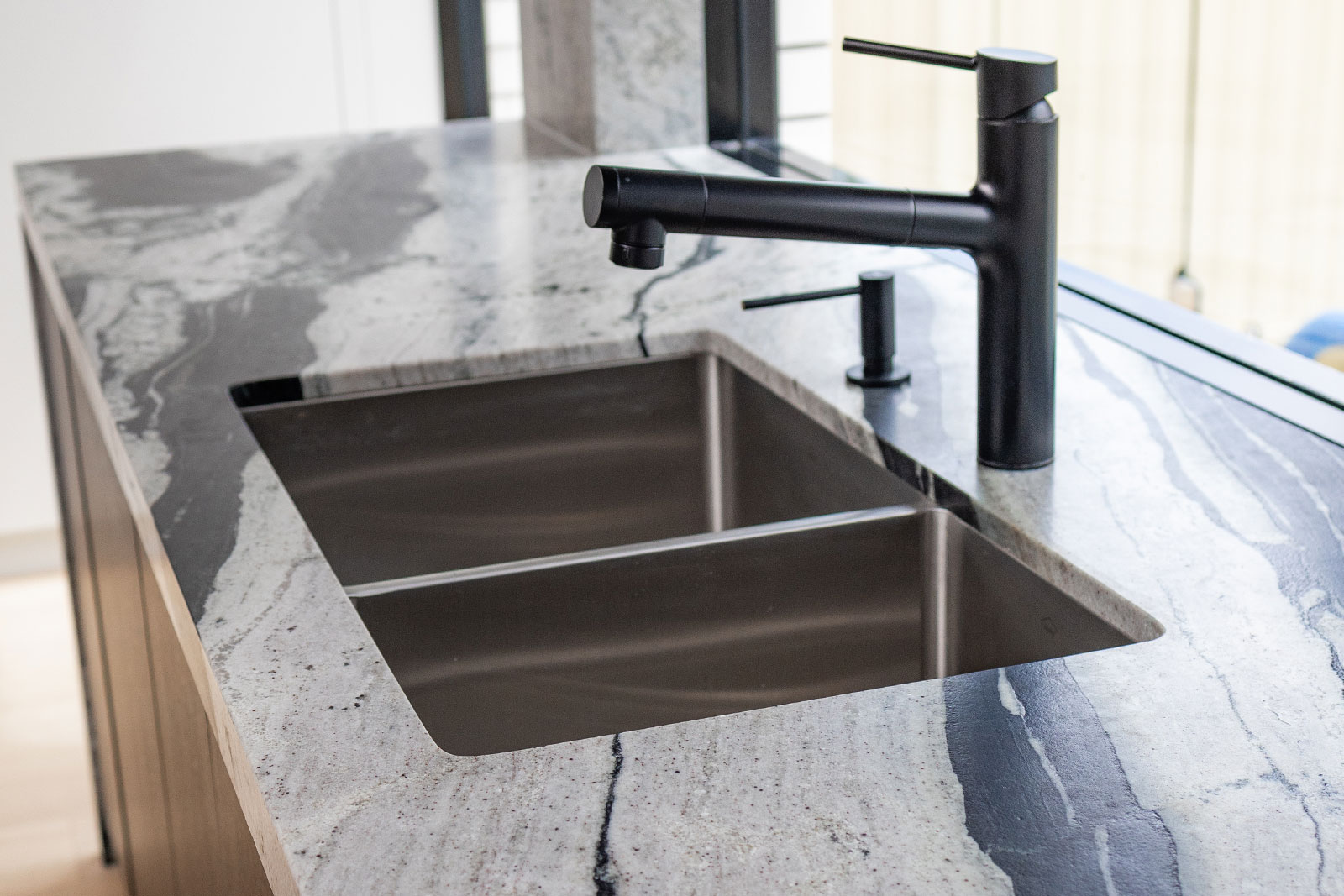
There's no wrong sink style for a stone benchtop, only the right one for how you'll use it. This guide explains the look, cost and maintenance of undermount, flush mount, drop-in and integrated stone sinks from a fabricator's point of view. Drop-in sinks work hard in busy kitchens, butler's pantries and utility laundries, while flush mount gives the sharpest look and needs the most planning. It also explains how Marble Hub reviews and supports every flush mount sink at the factory. Tags: undermount sink, flush mount sink, drop in sink, top mount sink, integrated stone sink, butler's pantry sink, laundry sink, sink cut-out, stone benchtop sink, kitchen sink styles, Sydney stone fabricator, Marble Hub
Undermount vs Flush Mount vs Drop-In Sink for Stone Benchtops | Marble Hub
Let’s Get Started on Your Dream Space
Whether it’s a kitchen, bathroom, or laundry, Kitchen Hub is here to bring your vision to life.
