
Add slabs to your wishlist so we can give you custom quote.
Add productions from our slab collection so we create a quote for your next project!
If you're unsure of what you're after please reach out via our contact page.

Waterfall Benchtops: Where They Add the Most to Your Kitchen
Waterfall Benchtops: Where They Add the Most to Your Kitchen
A waterfall benchtop is worth it when the island is the centrepiece of the room and the stone deserves to be seen from the side. There's never too many waterfall ends. The real question is where they'll add the most to your design. The corner can be mitred, butt joined or finished with a shadowline, and on timber floors we always suggest a shadowline.
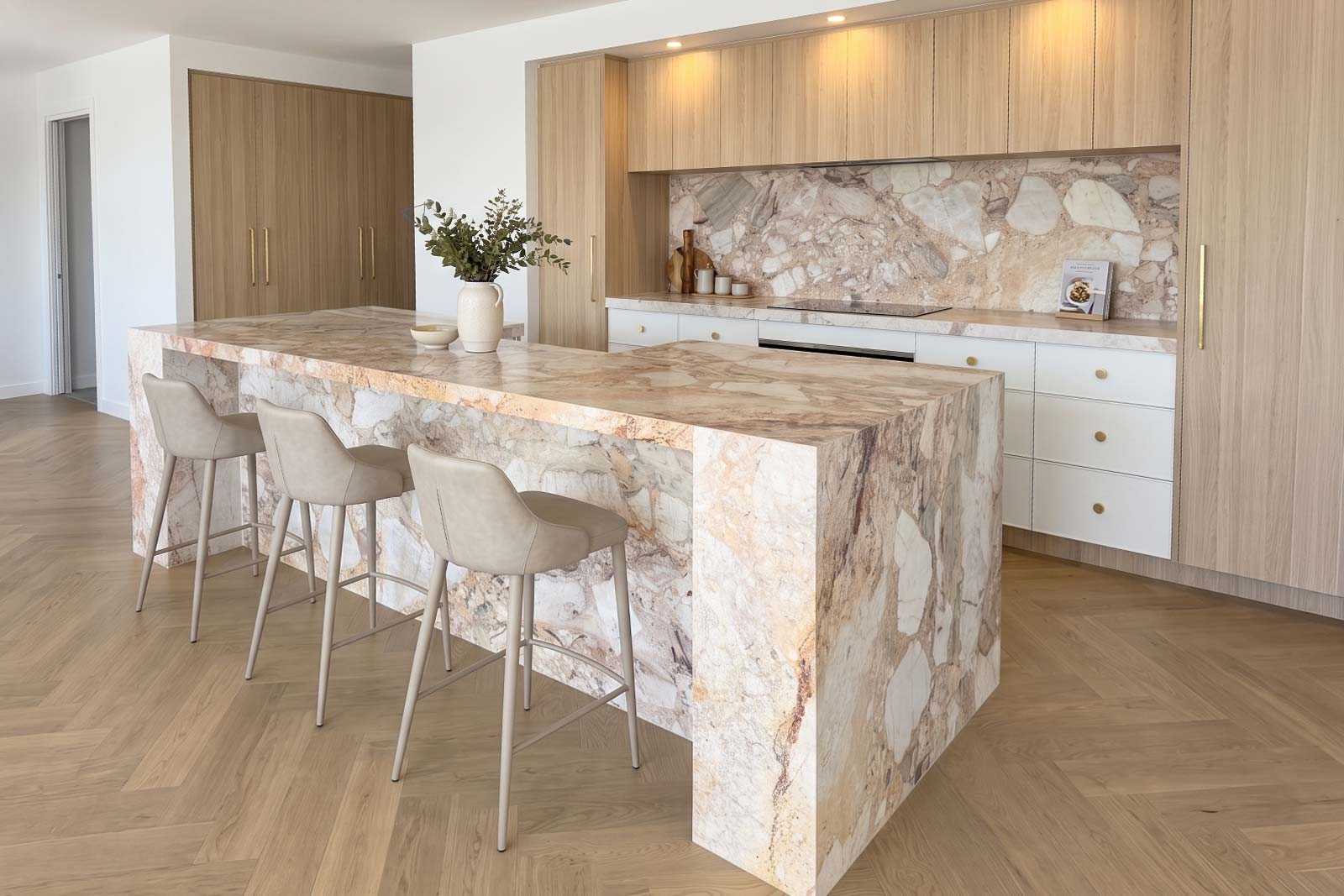
A waterfall end takes the benchtop stone down the side of the island to the floor. From across the room, the island stops reading as a cabinet with a top on it and starts reading as a solid piece of stone.
It's one of the most requested details we make, and one of the simplest ways to give a kitchen a sense of permanence. If you're still working through the bigger island questions, start with our guide to kitchen island design.
What does a waterfall add to a kitchen island?

A waterfall changes the visual weight of the island. With stone only on top, the island reads as joinery. Take the stone down the side and it reads as architecture. It feels heavier, calmer and more deliberate.
That weight anchors an open plan room. Where the kitchen, dining and living areas run together, a waterfall island gives the eye a fixed point. It marks where the kitchen begins without needing a wall.
It also creates continuity. The same stone carries from the top down to the floor, so the island looks like one considered object rather than a collection of parts. It's the same principle behind a full slab splashback: fewer interruptions make a room feel calmer.
And it's practical. A waterfall at the seating end gives stools a clean edge to sit beside, and it protects the end of the cabinetry from chair legs, mops and the dog doing laps of the kitchen.
Waterfall end or a standard island end?
A standard end stops the stone at the top, with an edge profile, and finishes the side in a joinery panel. A waterfall carries the stone to the floor. Both are good design. They just put a different material in charge.
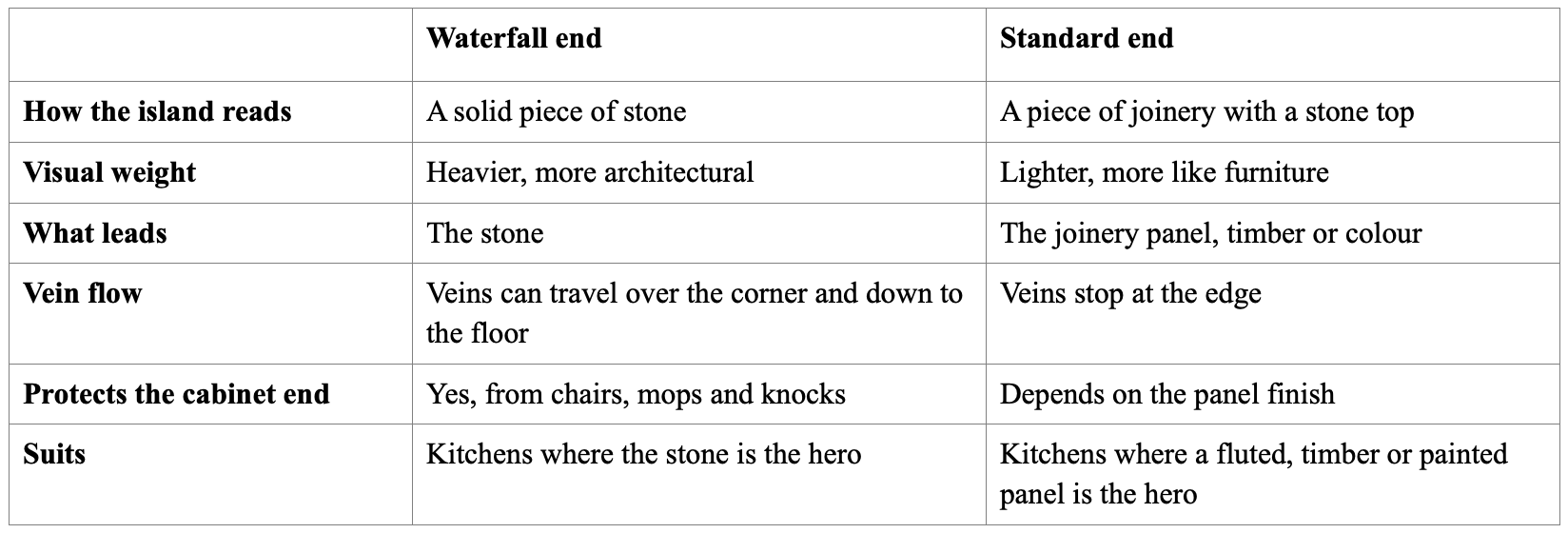
If your joinery has a feature end panel, such as fluted timber or a strong colour, a standard end lets it lead. If the stone is the reason you're doing the kitchen, give it the waterfall.
How many waterfall ends should a kitchen have?
There's never too many waterfall ends. Every waterfall adds weight, continuity and a sense of permanence, whether it's on one end of the island, both ends, or carried onto the perimeter benchtops as well. What matters is the order you add them in.
One waterfall
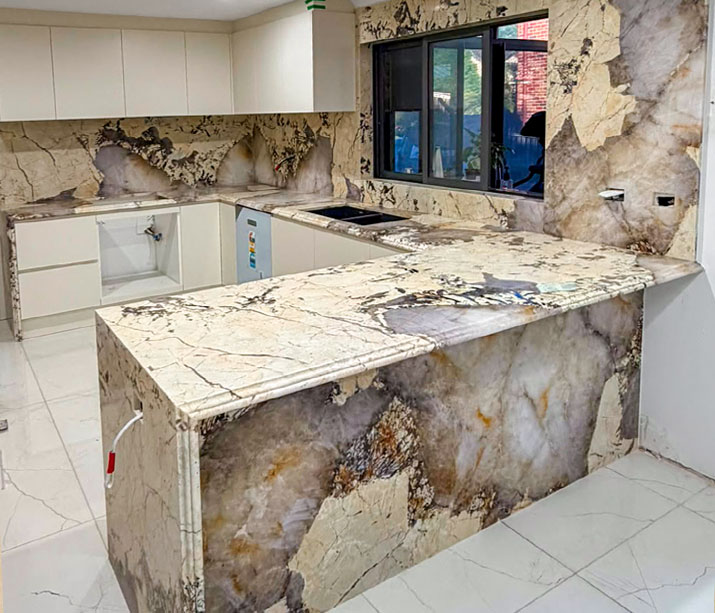
One waterfall suits islands where one end faces the living area or entry, and the other faces the cooking zone or a wall of tall cabinetry. You put the stone where people see it first. In the Patagonia kitchen, the client chose a single waterfall. The stone was dramatic enough already, and the island still reads as solid.
Two waterfalls
Two waterfalls suit freestanding islands that are seen from both ends. The island reads as a single block, almost like a piece of furniture carved from one slab. It's the stronger statement, and in a large open plan room it's usually the right one.
Waterfalls beyond the island
Waterfalls aren't only for islands. A waterfall at the open end of a perimeter benchtop, beside a doorway or at the end of a run, finishes the kitchen neatly and makes it look resolved from the living area. Where a benchtop ends against a fridge or tall cabinet, a waterfall usually isn't needed, because nobody sees that end.
Our view: start with the end people see first, then look at what each extra waterfall adds. Our design team can review which spots will look best in your kitchen, including whether it's worth taking waterfalls beyond the island.
Mitred, butt join or shadowline: which waterfall corner?
The corner where the top meets the waterfall is the detail people notice most. There are three ways to finish it.
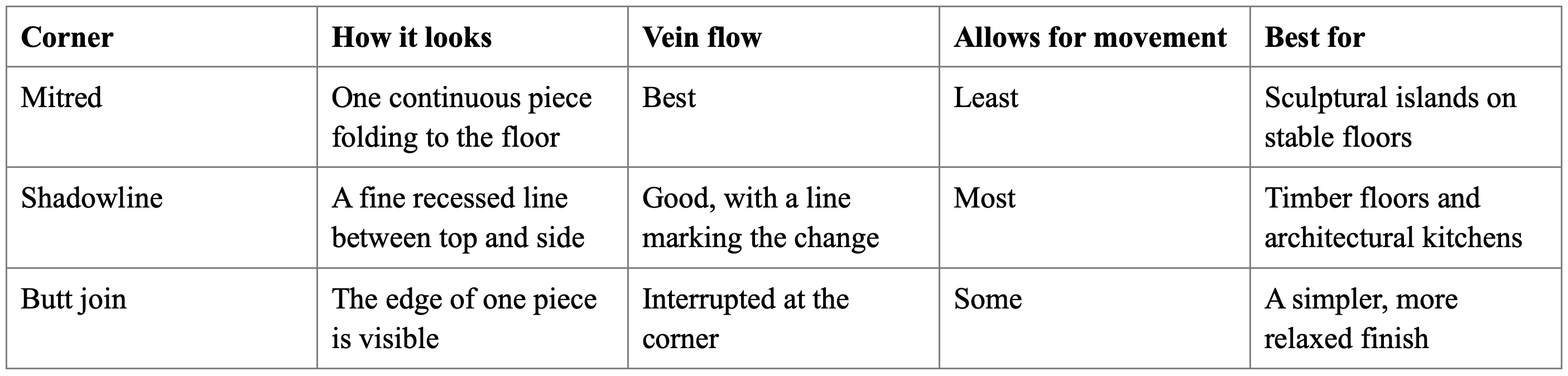
Mitred. The top and the side meet at a clean folded corner, so the stone looks like one piece bending down to the floor. It's the most sculptural option, and it lets the veining wrap around the corner.
Shadowline. A fine, deliberate recessed line separates the top from the waterfall. It looks intentional, a little like a reveal in good joinery, and it gives the two pieces room for small movement. That makes it the most forgiving option over the long term.
Butt join. One piece sits against the other and its edge is visible. It reads more relaxed and suits kitchens where the waterfall is a practical finish rather than the hero. Our edge profile guide shows how these corners sit alongside the rest of your benchtop edges.
Can you have a mitred waterfall on a timber floor?
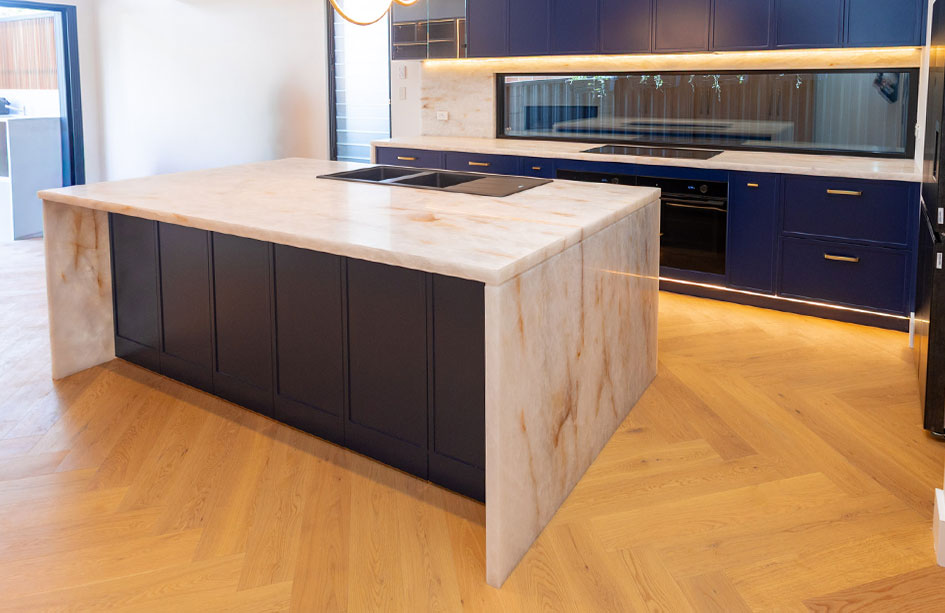
You can, but we're always mindful with it. Timber floors move. They expand and contract with the seasons and humidity, and that movement continues for the life of the floor.
A mitred waterfall is a tight, precise corner, and it doesn't like movement beneath it. Over time, a floor that rises and settles can put pressure on that corner.
On timber floors we always suggest a shadowline. It keeps the clean, architectural look of a waterfall and gives the island room to live with the floor rather than fight it. Tell us your flooring early, before the detail is drawn.
How do you get the veins to flow down a waterfall?
The best waterfalls look like the stone has been folded. The veins travel across the top and continue down the side, as if the slab bent at the corner.
That only happens when the waterfall piece is cut from the same slab, right next to the top, and planned before cutting. We lay the templates over the actual slab and decide where the fold will sit, so the strongest movement lands where it reads best. It's the same thinking behind the island in our Taj Mahal quartzite kitchen, where stone placement was decided before a single cut.
Softer, cloudier stones are forgiving. With strongly directional veining, planning is the difference between a good waterfall and a great one. A mitred corner shows vein flow best. A shadowline still carries the stone down the side, with a fine line marking the change.
What adds to the cost of a waterfall benchtop?
A waterfall costs more than a standard end. How much more depends on a handful of variables, and it's worth knowing them before you compare quotes.
More stone. Each waterfall is roughly a benchtop's height of stone, about 900mm, across the full depth of the island. On a large island, two waterfalls can tip the job into an extra slab.
The corner. A mitred corner takes the most fabrication time, because the two faces have to meet precisely and be finished as one. A shadowline and a butt join take less.
Vein flow. Planning for continuity means choosing pieces for how they look together, rather than for how efficiently they fit on the slab. Sometimes that uses more stone. We think it's worth it, and we'll tell you when it isn't.
Handling and installation. Waterfall panels are large and heavy, and they need careful support and a level floor. Our guide to what drives benchtop pricing explains how these variables add up, and our quote guide covers what to ask so you're comparing like with like.
A simple decision framework
Choose one waterfall if one end of the island is clearly the visible end.
Choose two waterfalls if the island is freestanding and seen from both ends.
Choose waterfalls beyond the island, on the open ends of the perimeter benchtops, if you want the whole kitchen to feel resolved.
Choose a mitred corner for the most sculptural look and the best vein flow, on floors that stay stable.
Choose a shadowline on timber floors, or anywhere you want a crisp architectural detail that allows for movement.
Choose a butt join for a simpler, more relaxed finish.
When you request a quote, tell us how many waterfalls you're considering, the corner finish you like, and what flooring is going down. We'll talk you through what suits your space.
Frequently Asked Questions
Is a waterfall benchtop worth it?
Yes, when the island is the centrepiece of the room and the stone deserves to be seen from the side. A waterfall makes the island read as solid stone, anchors an open plan room and protects the cabinet end. Our design team can review which spots will look best in your kitchen.
Should I have one or two waterfall ends?
There's never too many waterfall ends. Start with the end people see first. Two suit freestanding islands seen from both ends, and you can carry waterfalls onto the open ends of perimeter benchtops too. Our design team can review the best spots for your layout.
What is the difference between a mitred, butt join and shadowline waterfall?
A mitred corner looks like one continuous piece of stone folding to the floor and shows vein flow best. A shadowline uses a fine recessed line between the top and the side, which looks architectural and allows for small movement. A butt join shows the edge of one piece and reads more relaxed.
Can I have a mitred waterfall on a timber floor?
We're always mindful with mitred waterfalls on timber floors, because timber moves over time and a mitred corner doesn't like movement beneath it. On timber floors, we always suggest a shadowline instead.
How much more does a waterfall benchtop cost?
It depends on the extra stone, the corner finish and how much planning the vein flow needs. Each waterfall adds roughly 900mm of stone across the depth of the island, and a mitred corner takes the most fabrication time. Ask for waterfalls to be itemised in your quote so you can compare like with like.
Can you have a waterfall with porcelain or engineered stone?
Yes. With porcelain, the pattern sits mostly on the face, so a mitred corner matters more to keep the look continuous. With crystalline-silica-free engineered stone, the consistent pattern makes continuity straightforward, although the effect is less dramatic than natural stone.
Does a waterfall work on a small island?
Yes. A waterfall on the visible end gives a smaller island more presence and makes it read as a deliberate piece rather than a bench. Keep the island in proportion with the room, and let the stone do the work.

Granite Benchtops Are Back, and They Look Nothing Like the 90s
Granite sits mostly in darker and medium tones with a unique flowing pattern, and its dated reputation comes from what it was paired with in the 1990s, not the stone. With today's joinery, flooring and a honed finish, granite benchtops look timeless. It's hard, forgiving, resists etching and suits busy kitchens, outdoor areas and bathrooms. This guide covers pairing, finishes, real Marble Hub projects, granite vs quartzite, marble and dolomite, and how to choose a slab.
Granite Benchtops Are Back, and They Look Nothing Like the 90s

Outdoor Stone Benchtops That Survive a Sydney Summer
An outdoor benchtop in Sydney has to handle sun, heat, salt air, dust, rain and BBQ fat on the same surface. Porcelain and sintered stone are our first pick, granite is the best natural stone outdoors, and quartzite works with regular sealing. Light-coloured marble is best avoided outside, and engineered stone belongs indoors only, as UV affects it and outdoor use voids the manufacturer's warranty. This guide also covers joins, BBQ heat and why butt joins or shadowlines often outlast mitres outdoors.
Outdoor Stone Benchtops That Survive a Sydney Summer

Engineered Stone vs Natural Stone Benchtops: Honest Comparison | Marble Hub
Natural stone is one of a kind, handles heat well and can be restored for decades, but it needs sealing. Crystalline-silica-free engineered stone is consistent and needs no sealing, but it can scorch and can't be rehoned the same way. We cut both every week and compare them honestly on looks, care, heat, repair and price. We recommend natural stone first, and engineered stone where consistency or easy care matters most.
Engineered Stone vs Natural Stone Benchtops: Honest Comparison | Marble Hub

Pink Cristallo Quartzite for a Northmead Kitchen
A Federation home in Northmead with a new-wing kitchen by designer Vagn Madsen, built by Dan Kitchens Australia, with a Pink Cristallo Quartzite island benchtop and splashback from our Strathfield South showroom. This piece looks at why a pink stone works: subtle white shaker joinery that steps in and out around the rangehood, a soft stone that adds warmth without competing, a curved island with a softened, stepped double bullnose edge, and stone used in just two places. It also covers choosing slabs in person, living with pink quartzite in a family kitchen, and Pink versus White Cristallo.
Pink Cristallo Quartzite for a Northmead Kitchen
Let’s Get Started on Your Dream Space
Whether it’s a kitchen, bathroom, or laundry, Kitchen Hub is here to bring your vision to life.
