
Add slabs to your wishlist so we can give you custom quote.
Add productions from our slab collection so we create a quote for your next project!
If you're unsure of what you're after please reach out via our contact page.
Stone Bathroom Walls and Showers: Full Slab, Porcelain or Tile
Stone Bathroom Walls and Showers: Full Slab, Porcelain or Tile
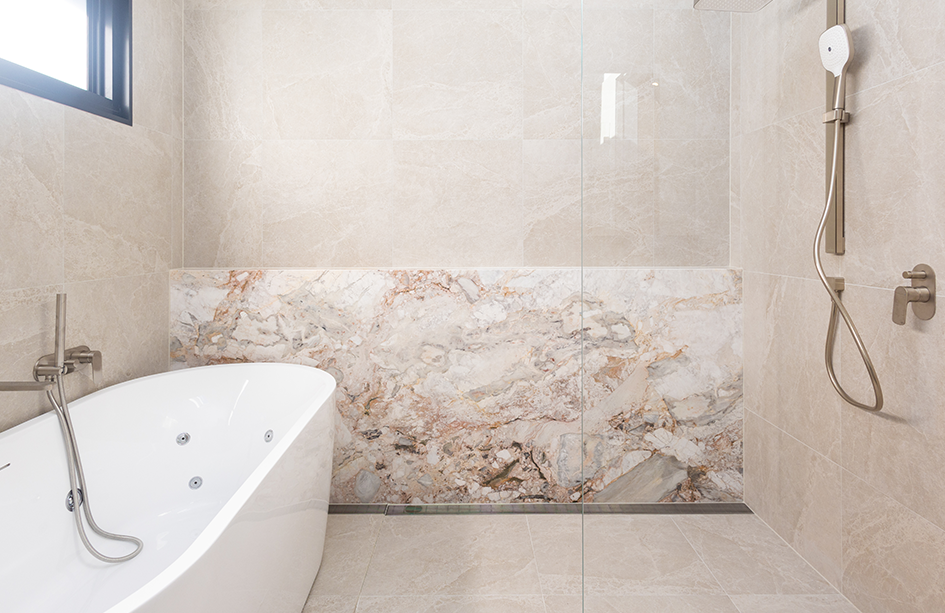
For bathroom walls outside the shower, full slab natural stone gives the most beautiful result. Inside a wet shower, large-format porcelain is often the most practical choice. Tile still makes sense for complex shapes, tight budgets and lots of niches. Whichever you choose, stone is a finish, not waterproofing. The membrane behind it does that job.
Stone on the walls is where a bathroom stops looking tiled and starts looking designed. We started exploring this with the undermount bath wrapped in stone. This guide goes further, into the walls and the shower itself.
Why put stone on bathroom walls?
A bathroom is a small room with a lot of hard surfaces. Tile grids, grout lines and several materials competing can make it feel busy.
Stone walls calm that down. Large surfaces with few joins make a small room feel larger. When the vanity, bath and walls share one material, the room reads as a single idea rather than a collection of finishes. We cover this whole-home approach in beyond the benchtop.
Full slab, porcelain or tile: how do they compare?

Full slab natural stone

Full slab marble or quartzite gives you continuous veining across the wall. The veins can carry from the vanity to the wall, around a niche and into the shower. It's the most dramatic way to use stone in a bathroom.
It's also heavy. Full slab walls need a structurally sound wall and an appropriate fixing system, planned with your builder before the walls are closed. Bathroom walls are often taller and wider than a single slab, so we plan where the joins fall and how the veins carry across them, using templates laid over the actual slabs.
Large-format porcelain
Large-format porcelain panels come in big sizes and thin profiles. They're much lighter than natural stone, very hard to stain, and never need sealing. Inside a wet shower, that combination is hard to beat. Soap, shampoo and hard water have little effect, and cleaning is simple.
Porcelain marble-looks are convincing, especially in large panels with few joins. Up close, natural stone has more depth and variation. Our guide to porcelain and sintered stone explains the differences.
Tile
Tile is still a good choice. It's cost-effective, flexible, and handles curves and multiple niches easily. A handmade tile beside a stone vanity can also add texture, which sometimes feels more considered than stone everywhere. The trade-off is grout: more joins mean more cleaning and a busier look.
Can you use marble on shower walls?
Yes, with care. Marble is softer than quartzite and granite, and it can etch from some soaps and cleaning products. Hard water can leave marks too. Quartzite and granite handle shower conditions with less fuss.
The care is real but manageable: seal regularly, use pH-neutral cleaners, and squeegee after showering. Some people love the patina marble develops in a shower. Others would rather not think about it. Neither is wrong.
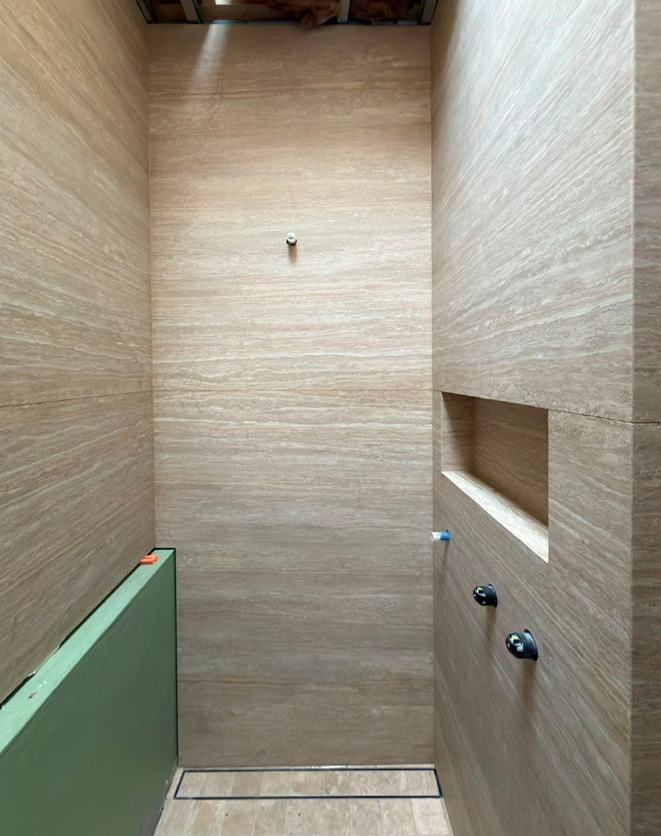
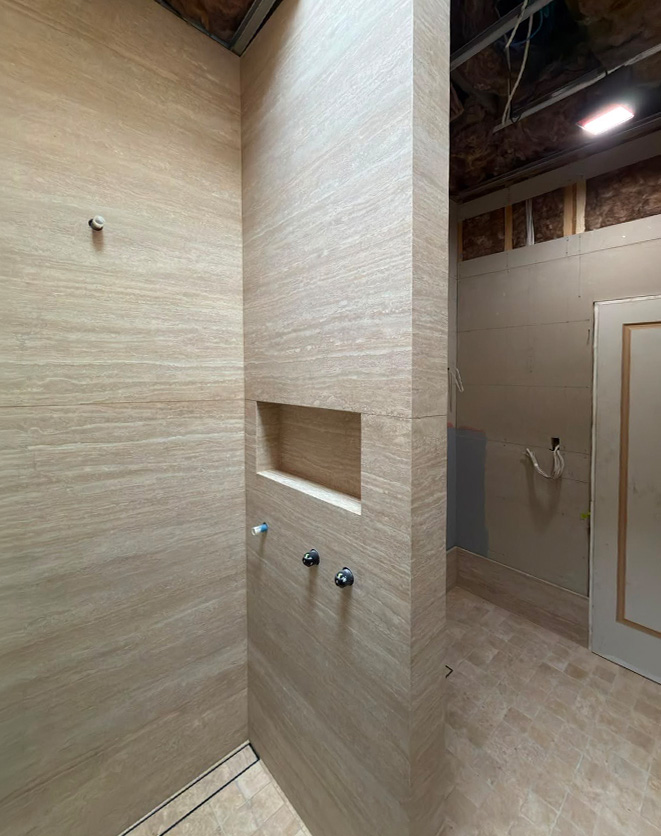
Joins matter more inside the shower than anywhere else in the room. They need to be fewer, tighter and well sealed. With natural stone, we plan the slab layout so joins fall where the veining hides them and away from the strongest spray. Large-format porcelain panels can reduce joins further, which is part of why they work so well in wet areas.
Ventilation does more for the long-term look of a shower than any product. A bathroom that stays humid will mark stone, tile and grout alike. A good exhaust fan and a quick squeegee are the routine. Our stone care page covers sealing and cleaning in more detail.
A common approach in the bathrooms we work on: natural stone on the vanity and feature walls, porcelain inside the shower.
Is stone waterproof in a bathroom?
No. This is the most important practical point in the whole guide. Stone, porcelain and tile are finishes. The waterproofing is the membrane installed behind them.
In Australia, waterproofing of domestic wet areas is covered by the National Construction Code and the standard AS 3740. Whatever you put on the walls, the membrane needs to be done properly, to that standard, by a licensed waterproofer. A beautiful stone wall on a poor membrane is still a leak.
How do you design a stone shower niche?
Stone niches are one of the most satisfying details in a bathroom. A niche lined in the same stone as the wall, with the veining carried through, looks carved rather than built.
Plan the niche size and position before framing. Place it where it won't break your strongest veining, and out of the direct spray so it drains and dries easily.
Honed or polished on bathroom walls and floors?
On the walls, it's a question of light. Polished stone reflects light and can make a small bathroom feel brighter. Honed stone feels softer and calmer, and it hides water marks better.
On the floor, it's a question of grip. Polished stone on a wet bathroom floor is slippery. Honed or textured finishes give better footing. Many bathrooms use polished or honed stone on the walls with a honed stone or textured porcelain floor.
Where should you start with stone in a bathroom?
Behind the vanity
The wall behind the vanity is the easiest place to start. A full slab splashback behind a stone vanity, running to the mirror or the ceiling, gives the room a focal point without the complexity of a shower.
Plan tapware first. Wall-mounted taps need plumbing in the wall and holes in the stone, positioned before templating. Mirror fixings and cabinet supports also need planning so they don't land on the best part of the slab.
The powder room
Powder rooms are the perfect place for bold stone on the walls. They're small, rarely used for showers and gentle on stone. A dramatic marble on every wall of a powder room is the design moment guests remember, and the care is minimal.
Tie the walls to the vanity
The walls work best when they relate to the vanity. Our stone vanity tops guide covers materials, and our pieces on marble vanities, the integrated stone sink and when the vanity becomes the feature cover the design side.
What drives the cost of stone bathroom walls?
Full slab walls cost more than tile, mostly because of slab count, the fabrication of large panels and niches, and the installation of heavy pieces. Large-format porcelain usually sits between the two.
As with any stone job, the main variables are the number of slabs, the number of cut-outs for taps, niches and fixtures, and how complex the shapes are. Our guide to what drives stone pricing walks through each one.
A simple decision framework
Choose full slab natural stone for feature walls, behind the vanity, around the bath, and in showers if you're comfortable with the care or you're using quartzite.
Choose large-format porcelain inside wet showers if you want minimal maintenance, especially with hard water.
Choose tile for complex shapes, many niches, tight budgets, or when you want texture against a stone vanity.
Many of the best bathrooms use all three, each where it works best: natural stone where you look, porcelain where the water falls, and tile where the shapes get complicated. Book a design consultation to plan yours with the slabs in front of you.
Frequently Asked Questions
Can you use marble on shower walls?
Yes, with care. Marble can etch from some soaps and cleaning products, and hard water can leave marks. Seal it regularly, use pH-neutral cleaners and squeegee after use. Quartzite and granite handle shower conditions with less care.
Is porcelain or natural stone better for a shower?
Inside a wet shower, large-format porcelain is often more practical. It's very hard to stain, needs no sealing, and handles soap and hard water well. Natural stone gives more depth and true veining, and suits feature walls and vanities beautifully.
Is stone waterproof in a bathroom?
No. Stone is a finish, not waterproofing. A properly installed membrane behind the stone does that job, done to AS 3740 by a licensed waterproofer. This applies to natural stone, porcelain and tile.
How heavy are full slab stone walls?
Natural stone is heavy, a little over 50kg per square metre at 20mm, so full slab walls need a sound structure and an appropriate fixing system. Plan this with your builder before the walls are closed. Large-format porcelain is much lighter.
Can you make a shower niche from stone?
Yes, and it's one of the best bathroom details. Lining a niche in the same stone as the wall, with the veining carried through, makes it look carved. Plan the size and position before framing, away from the strongest veining and the direct spray.
Is a full slab stone wall more expensive than tile?
Usually, yes. Full slab walls need more stone, fabrication of large panels and niches, and careful installation of heavy pieces. Large-format porcelain usually sits between natural stone and tile. The number of slabs and cut-outs drives the price most.
Do stone shower walls need sealing?
Natural stone in a shower should be sealed regularly, because water, soap and hard water are constant. Large-format porcelain doesn't need sealing. Either way, a squeegee after showering keeps the walls looking their best.
Should the vanity and walls be the same stone?
Using one stone for the vanity and walls makes the room read as a single idea and lets the veining carry between them. Pairing a bold vanity stone with a quieter wall stone or porcelain also works well.
How to Design a Calm Kitchen Around a Bold Stone
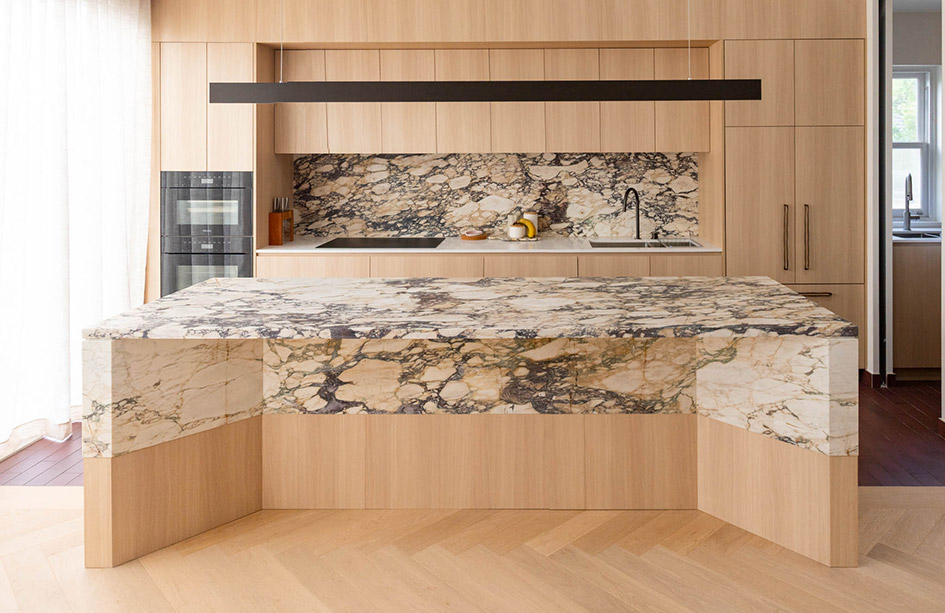
A bold stone like Calacatta Viola, Breccia, Patagonia or Negresco can carry a whole kitchen if everything else steps back. The rule is one hero: when the stone leads, the joinery, splashback, hardware and lighting support it. This guide covers where to put a bold stone, which joinery colours suit each of these four stones, how to manage visual weight, and why vein flow planning matters most with dramatic slabs.
How to Design a Calm Kitchen Around a Bold Stone

Granite Benchtops Are Back, and They Look Nothing Like the 90s
Granite sits mostly in darker and medium tones with a unique flowing pattern, and its dated reputation comes from what it was paired with in the 1990s, not the stone. With today's joinery, flooring and a honed finish, granite benchtops look timeless. It's hard, forgiving, resists etching and suits busy kitchens, outdoor areas and bathrooms. This guide covers pairing, finishes, real Marble Hub projects, granite vs quartzite, marble and dolomite, and how to choose a slab.
Granite Benchtops Are Back, and They Look Nothing Like the 90s

Waterfall Benchtops: Where They Add the Most to Your Kitchen
A waterfall benchtop takes the stone down the side of the island to the floor, so the island reads as a solid, sculptural piece of stone. This guide covers what a waterfall adds, how it compares with a standard island end, how many waterfalls to have, and the three corner finishes: mitred, shadowline and butt join. On timber floors we always suggest a shadowline. It also covers vein flow and what adds to the cost.
Waterfall Benchtops: Where They Add the Most to Your Kitchen

Outdoor Stone Benchtops That Survive a Sydney Summer
An outdoor benchtop in Sydney has to handle sun, heat, salt air, dust, rain and BBQ fat on the same surface. Porcelain and sintered stone are our first pick, granite is the best natural stone outdoors, and quartzite works with regular sealing. Light-coloured marble is best avoided outside, and engineered stone belongs indoors only, as UV affects it and outdoor use voids the manufacturer's warranty. This guide also covers joins, BBQ heat and why butt joins or shadowlines often outlast mitres outdoors.
Outdoor Stone Benchtops That Survive a Sydney Summer
Let’s Get Started on Your Dream Space
Whether it’s a kitchen, bathroom, or laundry, Kitchen Hub is here to bring your vision to life.
