
Add slabs to your wishlist so we can give you custom quote.
Add productions from our slab collection so we create a quote for your next project!
If you're unsure of what you're after please reach out via our contact page.

Granite Benchtops Are Back, and They Look Nothing Like the 90s
Granite Benchtops Are Back, and They Look Nothing Like the 90s

Granite is one of the hardest-working natural stones you can put in a kitchen. It's very hard, handles heat well, resists etching and is easy to live with once sealed. Its dated reputation has less to do with the stone and more to do with what it was paired with in the 1990s. With today's joinery, flooring and a honed finish, granite benchtops look timeless rather than like a time capsule.
Granite has a bit of an image problem. Mention it and many people picture a busy, salt-and-pepper benchtop with a high shine, sitting under oak cabinets in a 1998 kitchen. That kitchen existed. It just doesn't represent what granite looks like now.
Why did granite benchtops start to look dated?
The biggest reason granite looked dated was never the granite. It was everything around it: orange-toned timber, busy cabinet doors with heavy profiles, glossy tiles and patterned floors. The whole palette of that era moved on, and granite got blamed for the room.
Pair the same stone with today's materials and it reads completely differently. A timber veneer or laminate in a calm, current colour. A flat panel or slim shaker door. Flooring that stays in the background, like wide engineered timber boards or large-format tiles in a soft tone. Minimal hardware in a single finish.
The principle is balance. Granite carries a lot of visual texture, so the surfaces around it should be calm. Warm timber suits darker granites, creating contrast in both colour and texture. Soft white or pale grey joinery suits lighter granites with gentle movement. Avoid pairing a busy granite with a busy timber grain or a patterned tile. One textured surface leading the room is enough.
Our list of timeless natural stones explains why the materials that last are rarely the ones in fashion at the time.
What does granite do better than other benchtops?

It's very hard. Granite resists scratching better than marble and handles knives, pots and daily use well.
It handles heat. Granite tolerates heat better than most benchtop surfaces. We still suggest a trivet or board under really hot pans and dishes.
It resists etching. Lemon juice, wine and vinegar won't etch granite the way they etch marble. For a busy kitchen, that's the single biggest difference.
It's forgiving. Granite's colour and pattern hide everyday crumbs, water marks and small signs of use far better than a plain or bright white surface. It doesn't demand to be perfect.
It's low maintenance once sealed. Seal it regularly, wipe up oils promptly, especially on lighter granites, and use a pH-neutral cleaner. That's most of it. If a lighter granite does pick up an oil mark, a poultice usually draws it out, and resealing afterwards keeps it from returning. Our guide to living with natural stone covers the two habits that matter most for any stone.
Granite vs marble, quartzite and dolomite: how do they compare?
Start with colour and pattern. It narrows the choice to one or two stones before performance comes into it.
Colour and pattern
Granite sits mostly in darker and medium tones, with a unique flowing or crystalline pattern. It doesn't come in a light, marble-like look. Even the lighter granites read as speckled or textured rather than softly veined.
Marble is the light look: a white or pale background with soft veining. If a white background with gentle veins is the picture in your head, that's marble.
Quartzite gives you both. It can have stone-like veins and flowing movement in the same slab, and it comes in light and darker colours.
Dolomite has a mix of light and mid tones, often white and soft grey with gentle movement.
Pros and cons

Granite. Very hard, handles heat well, resists etching and is the most forgiving of the four. The trade-offs: some patterns are busy, and it won't give you a light, marble-like look.
Marble. Classic veining, a patina that develops over time, and it can be rehoned and restored. The trade-off: it's softer and etches with lemon, wine and vinegar.
Quartzite. A marble-like look with far more toughness, and much less prone to etching. The trade-off: it still needs sealing, and some stones sold as quartzite aren't, so ask what a stone really is.
Dolomite. Lighter colours with less care than marble, and harder than most marble. The trade-off: it can etch lightly with acids, more than granite does.
If you're weighing up quartzite and marble, our quartzite vs marble guide covers that decision. Granite sits at the most practical end of the natural stone range.
Why we mainly offer honed granite
Finish is the other big change in modern granite, and it's the reason we mainly offer granite honed.
Honed granite is smooth and matte. It reads calm and understated, and it suits the sleek joinery and calm palettes of today's kitchens.
Polished granite deepens colour, but on a dark stone it becomes extremely reflective. Every fingerprint, smear and crumb shows, and overhead lights bounce straight off it. It's also the finish most associated with the 90s look. That's why we steer most clients away from polished dark granite in a kitchen.
Leathered granite has a soft texture with a low sheen. It's the other good option if you want a more tactile surface that hides marks.
Changing the finish alone can take a granite from dated to architectural.
What does a modern granite kitchen look like?
A few recent Marble Hub projects show how far the look has moved.
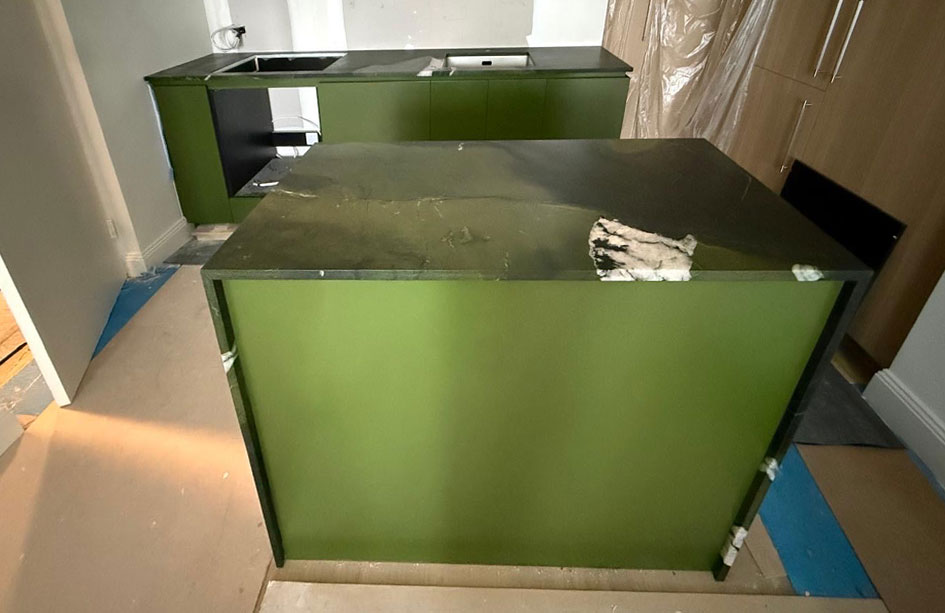
Deep green joinery and a moving stone. Flat-panel cabinetry in a deep green, curved island ends and an oak floor, with a granite full of sweeping grey, black and cream movement on the benchtops and a low splashback. The joinery is a single solid colour, so the stone's movement leads and nothing competes with it.
Black and gold, kept monochrome. A black granite with gold and white veining, set against matte black flat-panel joinery. The stone runs as a full slab splashback around a long window and down a waterfall island. With everything else in black, the gold veining becomes the only accent in the room.
Clean edges. Both kitchens use a thin square edge. Heavily profiled edges like bullnose and ogee push granite back toward a traditional look, so the edge is where a modern granite kitchen starts. Our edge profile guide shows how each profile changes the feel.
Where does granite work best?

Busy family kitchens. If you cook a lot, have kids, and don't want to think about lemon juice, granite is an excellent natural stone choice.
Outdoor kitchens and terraces. Granite handles sun, heat and weather well, and it's one of the strongest natural stones for an alfresco area. We've used black granite with white veining beside fluted timber battens on a BBQ kitchen, a white granite with black cabinetry and a full slab splashback on another, and a honed charcoal stone as a fire pit surround on a harbour-view terrace. Outdoors, we suggest butt joins or shadowlines over mitres, because decks and paving can move. Be mindful of dust, salt air and bird droppings, and talk through the pros and cons of your chosen stone with our team before you commit.
Laundries and butler's pantries. Hard-working rooms that need a durable surface without fuss.
Bathrooms. Granite handles water, cosmetics and cleaning products well. A honed or leathered granite vanity with timber joinery looks warm and contemporary, and it's one of the lowest-maintenance natural stone choices for a busy family bathroom.
The honest trade-offs
Granite's pattern is different from marble's. If your heart is set on long, soft veins across a white background, most granite won't give you that. Quartzite or marble will.
Some granite patterns are busy. A heavily speckled stone across a large island can feel restless. The fix is choosing a stone with calmer movement, or using granite where the pattern can breathe.
And a polished dark granite shows every fingerprint and crumb. A honed finish solves most of this, which is why it's the finish we mainly offer.
How do you choose a granite slab?
Look at full slabs, not small samples. Small samples of granite are particularly misleading, because the pattern changes across a slab. Slabs from the same block are usually very close, with slight variation, so what you see on one slab is typically on all of them.
Look for movement and scale. A granite with larger, flowing patterns reads very differently from a fine, even speckle. And look at the stone in the finish you'll actually use. Ask to see a honed sample next to a polished one.
Browse our granite range and the wider granite and dolomite range before you visit.
Dolomite: granite's lighter relative
If you like the practicality of granite but want a lighter, softer look, dolomite is worth a close look. We treat it as a close relative of granite in everyday use, and it sits alongside granite in our range.
Dolomite offers lighter options, often white and soft grey with gentle movement, while still being a hard-wearing stone. It's harder than most marble and much closer to granite day to day, which makes it a popular choice for a bright, calm kitchen without marble's level of care.
The honest caveat: dolomite can etch lightly with acids like lemon and vinegar, more than granite does. Seal it, wipe spills promptly, and it behaves well. Super White dolomite is a good example, and it's often marketed elsewhere as quartzite.
That last point is worth knowing generally. Stone names in showrooms aren't always geological, so ask what a stone actually is and how it behaves before you choose.
A simple decision framework

Choose granite if you want natural stone with minimal worry, you cook a lot, you have a busy household, or you're planning an outdoor kitchen.
Choose dolomite if you want granite's practicality in a lighter, softer colour.
Choose quartzite if you want similar toughness with a more veined look.
Choose marble if the veining and patina are what you love most, and you're happy with the care that comes with it.
The best way to see how far granite has come is in person. Visit the showroom and ask to see a honed granite next to a polished one. Most people are surprised. Bring a cabinet door sample or a timber offcut if you have one, because granite reads very differently beside the joinery it will actually live with.
Frequently Asked Questions
Is granite still a good choice for kitchen benchtops?
Yes. Granite is very hard, handles heat well, resists etching from acids, and is low maintenance once sealed. Its dated reputation comes from the glossy, speckled tops of the 1990s. With sleek joinery, current flooring and a honed finish, modern granite looks timeless.
Why does granite look dated in some kitchens?
Mostly because of what it was paired with. In the 1990s, granite sat beside orange-toned timber, heavy cabinet profiles and busy tiles. Pair it with a calm timber or laminate colour, a flat or slim shaker door and quiet flooring, and the same stone looks current.
What finish makes granite look modern?
Honed is the finish we mainly offer for granite. It's smooth and matte and suits today's sleek kitchens. Polished dark granite is extremely reflective and shows every fingerprint and crumb. Leathered is the other good option.
Granite or quartzite: which is better?
They're close in performance. Both are hard and practical. The difference is colour and pattern: granite sits mostly in darker and medium tones with a flowing or crystalline pattern, while quartzite can have both stone-like veins and flowing movement, in light and darker colours. Choose based on the look you prefer, then the specific slab. Some stones are sold under names that don't match their geology, so ask what a stone really is.
Does granite need sealing?
Yes, like most natural stone. Seal it regularly and wipe up oils promptly, especially on lighter granites. Day-to-day care is a wipe with a pH-neutral cleaner.
Can you put a hot pan on granite?
Granite tolerates heat better than most benchtop surfaces. We still suggest a trivet or board under really hot pans and dishes.
Can granite be used outdoors?
Yes. Granite handles sun, heat and weather well, which makes it one of the strongest natural stones for outdoor kitchens and fire pit surrounds. Outdoors, we suggest butt joins or shadowlines over mitres, because decks and paving can move.
What is the difference between granite and dolomite?
We treat dolomite as a close relative of granite in everyday use. Dolomite offers lighter options, often white and soft grey, while still being hard-wearing and much closer to granite than marble day to day. It can etch lightly with acids, so seal it and wipe spills promptly.

Waterfall Benchtops: Where They Add the Most to Your Kitchen
A waterfall benchtop takes the stone down the side of the island to the floor, so the island reads as a solid, sculptural piece of stone. This guide covers what a waterfall adds, how it compares with a standard island end, how many waterfalls to have, and the three corner finishes: mitred, shadowline and butt join. On timber floors we always suggest a shadowline. It also covers vein flow and what adds to the cost.
Waterfall Benchtops: Where They Add the Most to Your Kitchen

Outdoor Stone Benchtops That Survive a Sydney Summer
An outdoor benchtop in Sydney has to handle sun, heat, salt air, dust, rain and BBQ fat on the same surface. Porcelain and sintered stone are our first pick, granite is the best natural stone outdoors, and quartzite works with regular sealing. Light-coloured marble is best avoided outside, and engineered stone belongs indoors only, as UV affects it and outdoor use voids the manufacturer's warranty. This guide also covers joins, BBQ heat and why butt joins or shadowlines often outlast mitres outdoors.
Outdoor Stone Benchtops That Survive a Sydney Summer

Engineered Stone vs Natural Stone Benchtops: Honest Comparison | Marble Hub
Natural stone is one of a kind, handles heat well and can be restored for decades, but it needs sealing. Crystalline-silica-free engineered stone is consistent and needs no sealing, but it can scorch and can't be rehoned the same way. We cut both every week and compare them honestly on looks, care, heat, repair and price. We recommend natural stone first, and engineered stone where consistency or easy care matters most.
Engineered Stone vs Natural Stone Benchtops: Honest Comparison | Marble Hub

Pink Cristallo Quartzite for a Northmead Kitchen
A Federation home in Northmead with a new-wing kitchen by designer Vagn Madsen, built by Dan Kitchens Australia, with a Pink Cristallo Quartzite island benchtop and splashback from our Strathfield South showroom. This piece looks at why a pink stone works: subtle white shaker joinery that steps in and out around the rangehood, a soft stone that adds warmth without competing, a curved island with a softened, stepped double bullnose edge, and stone used in just two places. It also covers choosing slabs in person, living with pink quartzite in a family kitchen, and Pink versus White Cristallo.
Pink Cristallo Quartzite for a Northmead Kitchen
Let’s Get Started on Your Dream Space
Whether it’s a kitchen, bathroom, or laundry, Kitchen Hub is here to bring your vision to life.
