
Add slabs to your wishlist so we can give you custom quote.
Add productions from our slab collection so we create a quote for your next project!
If you're unsure of what you're after please reach out via our contact page.

Top 7 Natural Stones That Have Always Been Timeless and Never Just a Trend
Top 7 Natural Stones That Have Always Been Timeless and Never Just a Trend
TL;DR: Design shows and magazines love making a stone look like a new discovery. Esmerelda Quartzite, Breccia Rose, White Cristallo, Patagonia, Taj Mahal, Calacatta Viola and Athena Gold have been specified in homes and commercial buildings for over 50 years. They only look trendy because someone just noticed them. They were never chasing a moment.
A stone doesn't become popular because it's new. It becomes popular again because someone rediscovered something that was already good.
That distinction matters more than most homeowners realise when they're standing in a showroom. A trend is chosen because it photographs well right now. A timeless stone gets specified decade after decade, in kitchens and hotel lobbies and commercial foyers, because it solves a design problem that doesn't change with the season: how do you bring in colour, texture and depth without the room looking dated in ten years.
These seven stones have been doing that job for 50 years. Long before any design show discovered them.
Esmerelda (Emerald Green) Quartzite
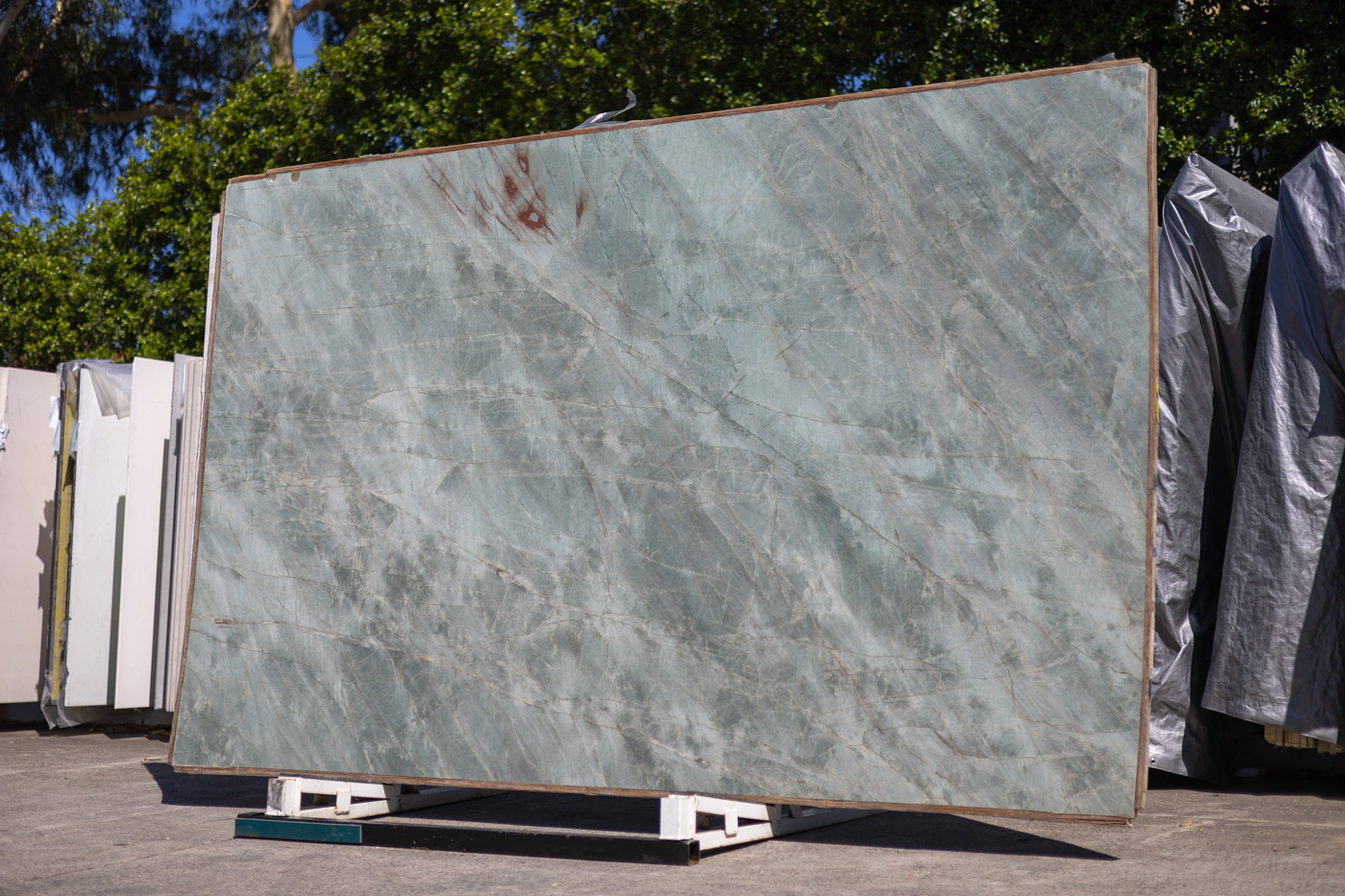
Esmerelda (Emerald Green) Quartzite
Esmerelda has a soft, sea-glass green with grey undertones and fine natural veining running through the slab. Green stone tends to get filed under “bold new choice,” but the reason it holds up has nothing to do with fashion. Quartzite is dense and hard-wearing, so a colour this rich doesn't rely on a polished finish to look considered. It reads the same way in a honed surface, which is why architects have trusted it in high-traffic commercial spaces for years.
Esmerelda's muted tone means it behaves like a neutral with personality. Pair it with warm oak joinery and it settles in. Push it against a black-framed window and it reads as dramatic, closer to a piece of art than a building material. That range comes from the stone's hardness and colour depth, not from being fashionable.
Breccia Rose (Botticelli) Marble
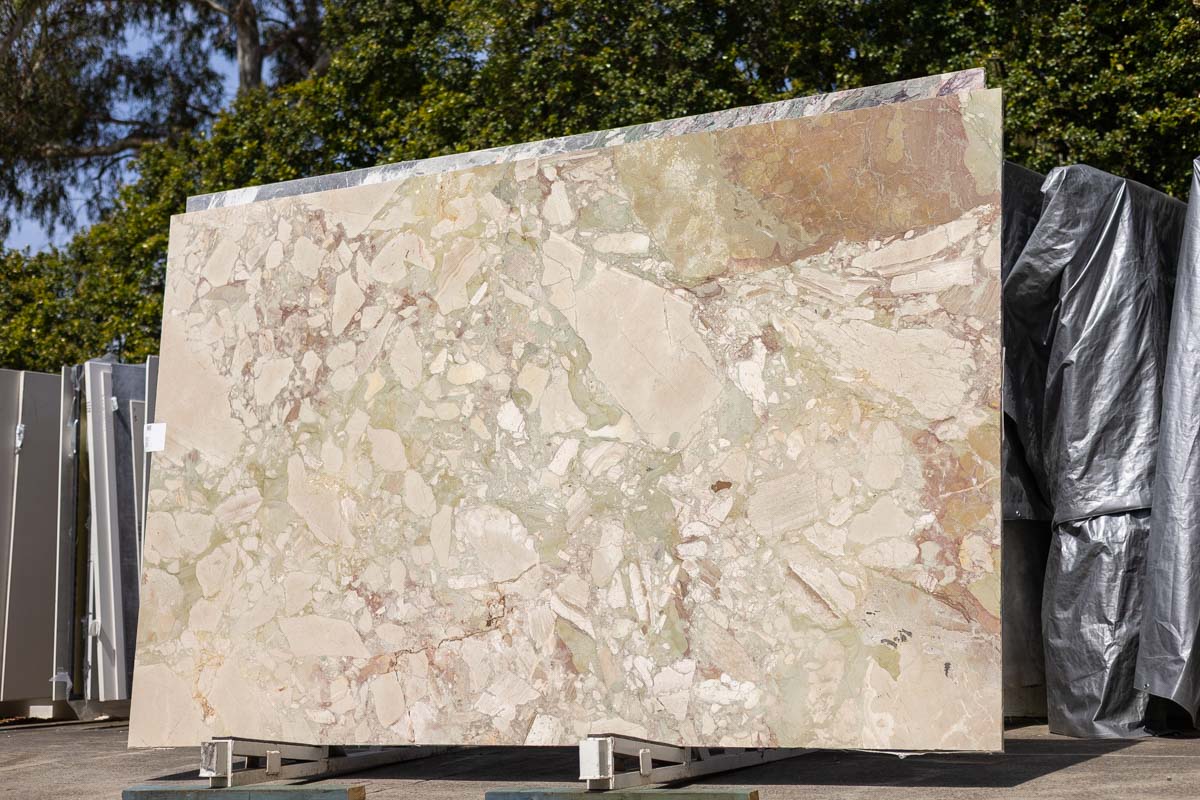
Breccia Rose (Botticelli) Marble
Breccia Rose is a warm, fragmented stone with soft blush and stone-coloured pieces set through a pale base. Brecciated marble in this style has been a fixture in European interiors for generations, well before it started showing up in Australian renovation feeds.
The reason it never dated is structural. The fragmented pattern creates texture and rhythm without one dominant vein pulling focus, so the eye never lands on a single point long enough to feel repetitive. Warm timber joinery picks up its honey and blush flecks. A pale, chalky painted cabinet lets the pattern carry the room. Either way, the pattern was doing this work in interiors long before anyone called it a trend.
White Cristallo Quartzite

White Cristallo is close to a pure white with a crystalline, frosted texture and faint natural fracturing. White stone gets treated like it goes in and out of fashion, but that's a misunderstanding of what white stone actually does in a room.
Architects specify quartzites like this because a stone this consistent gives them a considered canvas that doesn't compete with joinery, lighting or layout. In a honed finish it has a softness polished white marble doesn't, which is why it reads as calm rather than clinical. That's a material property, not a style choice, and material properties don't go out of fashion.
Patagonia White Quartzite
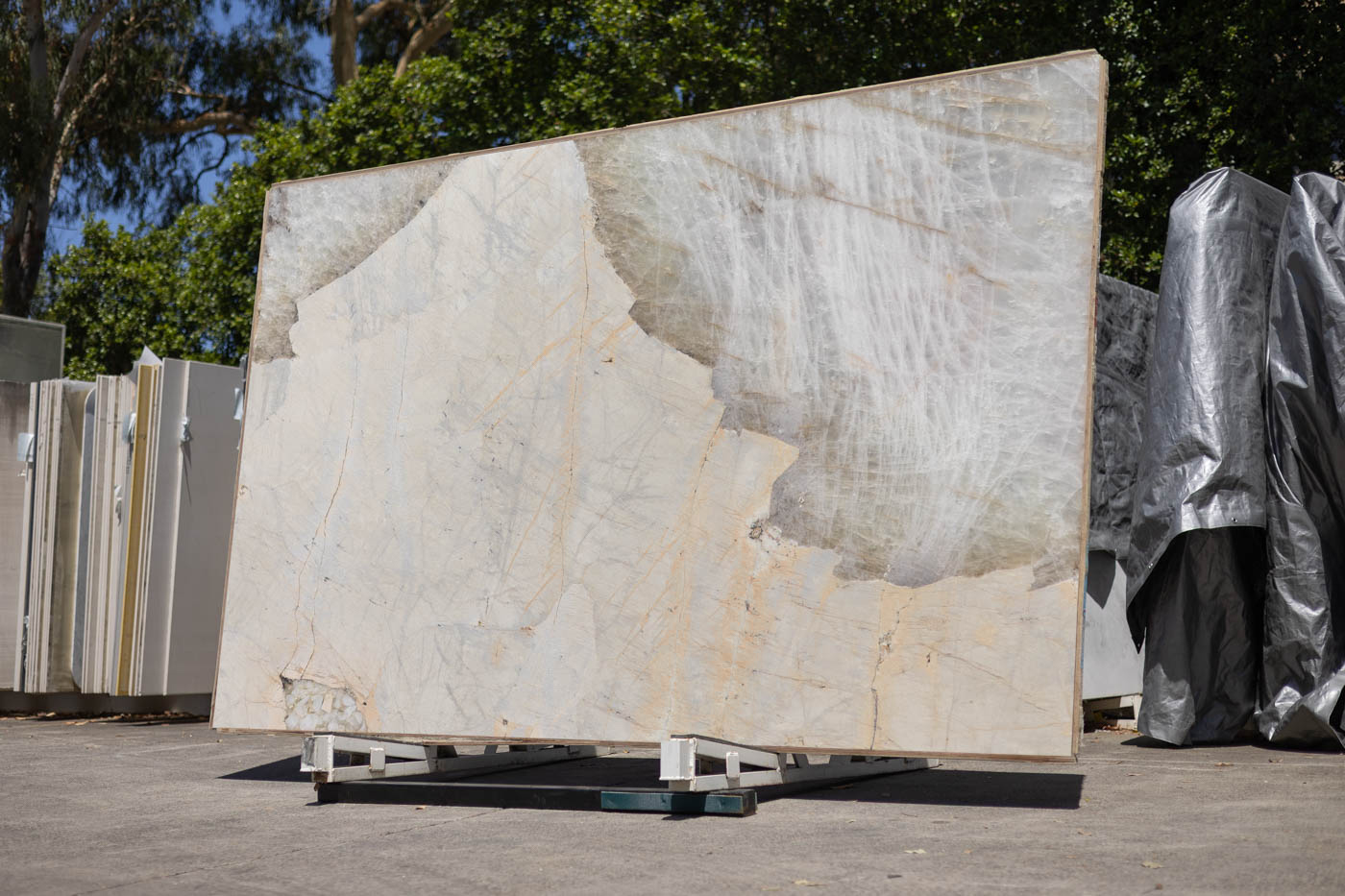
Expect a soft, warm white and cream base with a translucent quality running through the slab, contrasted against bold, striking black clusters and veining. That translucency is part of what makes Patagonia so sought after. Lit from behind, the stone glows in a way few others can manage. But the backlighting is really just a party trick that reveals what's already there. The real reason designers keep coming back to it is the depth the translucency gives the stone even in ordinary daylight.
Patagonia has been a mainstay in high-end residential and commercial projects for a long time because it combines the durability of quartzite with a depth and movement usually only found in the finest marble. It's less a benchtop material and more a slab of art that happens to be food-safe.
Taj Mahal Quartzite
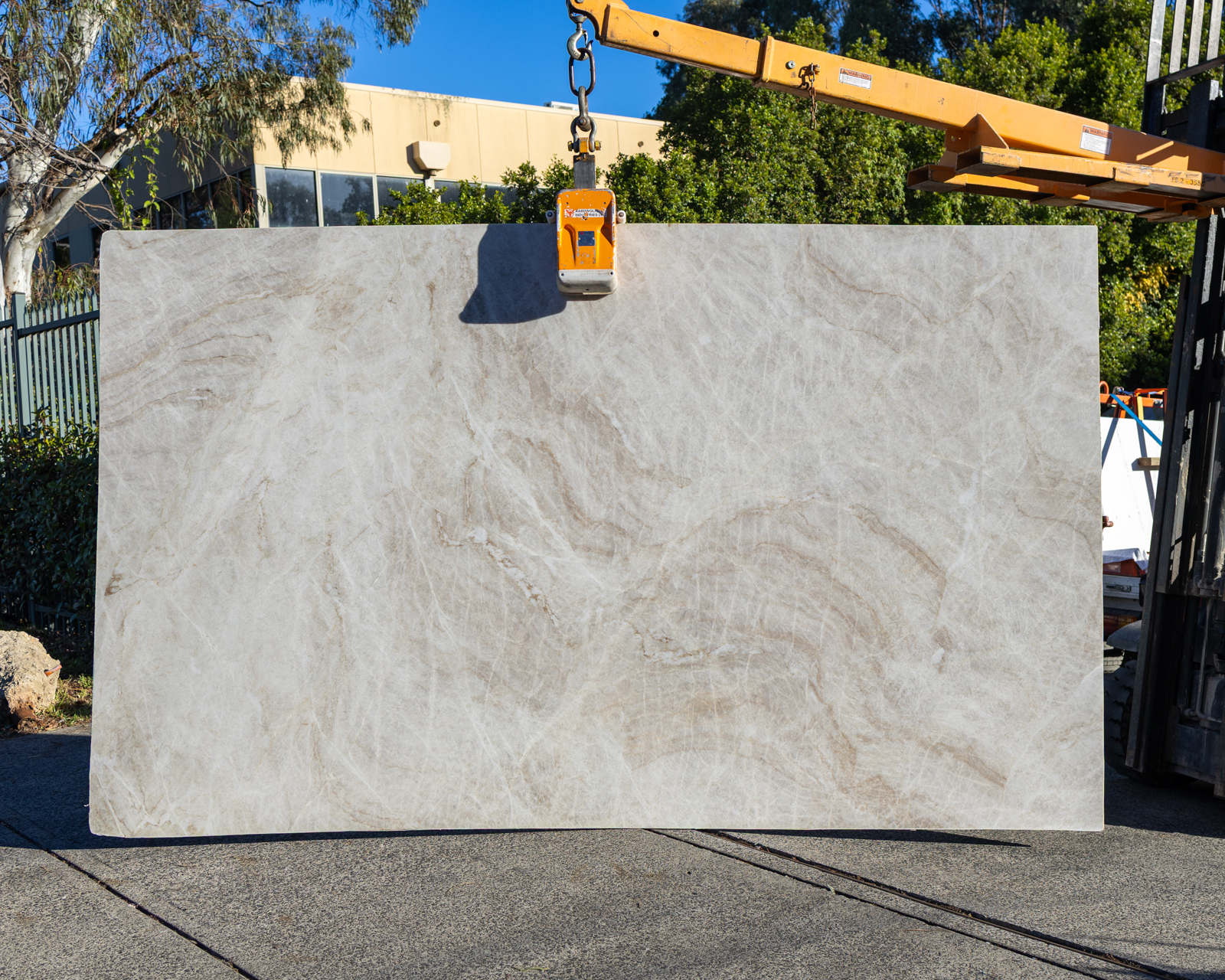
Taj Mahal has a soft beige-cream background with linear, sandy veining running in one direction across the slab. It's understated compared to the more dramatic stones on this list, and understatement ages better than drama in a kitchen used every day.
Because the veining is restrained and directional, Taj Mahal lets joinery do the visual work; two-tone cabinetry, a strong handleless profile, warm timber underneath. A stone that supports rather than competes doesn't need to be reinvented every few years. It just needs to keep doing what it's always done.
Calacatta Viola Extra Marble

Calacatta Viola Extra is the boldest stone on this list. A bright white base is broken up by thick, dark violet-black veining moving across the slab in dramatic, sculptural lines. Calacatta marble in general has been the benchmark for luxury stone for decades, and the violet variation is a variation on a pattern that's been photographed in serious interiors since long before design shows existed in their current form.
Homeowners sometimes worry a stone this dramatic will date quickly, assuming boldness equals trend. Think of it the way you'd think about buying a striking piece of art. Nobody chooses a bold painting because it's safe. They choose it because it does something to the room, then they build everything else around letting it. Calacatta Viola works the same way. It's the art. Your joinery is the wall it hangs on. Pair it with simple, dark timber or matte black joinery and let the veining carry the room.
Athena Gold Marble

Athena Gold has a soft white and cream base with warm, honey-gold striations moving through it in long, linear sweeps. It sits between Taj Mahal's calm and Calacatta Viola's drama, offering warmth and movement without a high-contrast statement.
This is a stone for homeowners who want marble's depth without a stark black-and-white statement. The gold tones pair naturally with warm timber and brass fittings. The veining moves in one clear direction, which is what makes it read as intentional on a large island benchtop rather than busy.
Why “Bold” Isn't the Same Question as “On Trend”
Homeowners second-guess a dramatic stone in a way they'd never second-guess a dramatic piece of art. Nobody stands in front of a gallery wondering if the painting will date. They ask if it moves them, then figure out where it goes and what supports it.
A benchtop deserves the same thinking, and it points to the real question underneath all of this. It was never whether a stone is popular right now. It's whether the reason it's popular has anything to do with lasting design principles, hardness, proportion, contrast, restraint, or whether it just looked good in one kitchen on one feed. These seven stones pass that test because they were being specified in serious architecture decades before anyone needed to post about it.
That's true whether the stone in question is quiet, like Taj Mahal, or the feature of the whole room, like Calacatta Viola. The job with a bold stone isn't to pick something safe. It's to pick something you love and then build the room around letting it work, restrained joinery, quieter paint, simpler hardware, the same way you'd hang a bold artwork on a plain wall instead of a busy one.
Choosing Between Them: A Simple Framework
Choose Esmerelda or Calacatta Viola if you want the stone to carry the room and you're comfortable keeping everything else restrained around it, the way you would with a statement artwork.
Choose Taj Mahal or White Cristallo if your joinery, lighting or layout is already doing the design work and the stone needs to support rather than compete.
Choose Breccia Rose or Athena Gold if you want warmth and movement without the high-contrast drama of Calacatta or the coolness of a pure white.
Choose Patagonia if you want a stone flexible enough to sit with almost any timber tone in the house, not just the kitchen.
None of these are trend calls. They're decisions based on how the stone behaves in a room, which is the same basis architects have used to specify them for 50 years.
The Honest Trade-Off
Timeless doesn't mean maintenance-free. Quartzites like Patagonia, Taj Mahal, White Cristallo and Esmerelda are naturally more resistant to etching than marble, but no natural stone is completely etch-proof. Marbles like Calacatta Viola, Breccia Rose and Athena Gold will develop patina, and for many homeowners that's the appeal, not the drawback.
That's worth an honest conversation before you commit to a slab, regardless of how long the stone has been in circulation. It's also worth seeing the actual slab in person. Photos flatten veining and can shift colour depth, and a stone like Patagonia or Calacatta Viola moves differently under natural light than it does on a screen. Our showroom in Strathfield South has current slabs from all seven of these stones if you want to see how they actually read before making the call.
Frequently Asked Questions
If a stone is trending right now, does that mean it's not actually timeless?
Not necessarily. Trending and timeless aren't opposites, they're just measuring different things. A stone trends when a magazine or design show features it. It's timeless when it's been specified consistently for decades regardless of media coverage. All seven stones here happen to be both right now, which is why they can feel new even though they've been used in serious architecture for 50 years.
I love a bold stone but I'm worried it's too much. How do I know if it's the right call?
Ask the same question you'd ask about a piece of art. Does it move you, and are you willing to build the room around it rather than expecting it to blend in? A bold stone like Calacatta Viola or Esmerelda isn't meant to disappear into the background. It's meant to be the feature, with everything else, joinery, paint, hardware, kept quieter so it can do its job.
How do I know if I'm choosing a stone because it's genuinely right for my home, or because it's popular right now?
Ask whether the reason you like it is about how it behaves in a room, its colour range, how it pairs with your joinery, how it reads in your light, rather than because you saw it in one specific kitchen online. Stones with 50 years of use across different design eras tend to hold up regardless of the reason someone first noticed them.
Are quartzite and marble the same thing?
No. Quartzite is a metamorphic stone formed from sandstone, which makes it harder and more resistant to etching than marble. Marble forms from limestone and etches more easily, though many homeowners consider the patina part of the appeal. Patagonia, Taj Mahal, White Cristallo and Esmerelda are quartzites. Breccia Rose, Calacatta Viola and Athena Gold are marbles.
Will a bold stone like Calacatta Viola date faster than a subtle one like Taj Mahal?
No. High-contrast marble has appeared in interiors for over 40 years without going out of style. What dates a kitchen is usually the joinery, hardware and layout around the stone, not the stone itself.

Outdoor Stone Benchtops That Survive a Sydney Summer
An outdoor benchtop in Sydney has to handle sun, heat, salt air, dust, rain and BBQ fat on the same surface. Porcelain and sintered stone are our first pick, granite is the best natural stone outdoors, and quartzite works with regular sealing. Light-coloured marble is best avoided outside, and engineered stone belongs indoors only, as UV affects it and outdoor use voids the manufacturer's warranty. This guide also covers joins, BBQ heat and why butt joins or shadowlines often outlast mitres outdoors.
Outdoor Stone Benchtops That Survive a Sydney Summer

Engineered Stone vs Natural Stone Benchtops: Honest Comparison | Marble Hub
Natural stone is one of a kind, handles heat well and can be restored for decades, but it needs sealing. Crystalline-silica-free engineered stone is consistent and needs no sealing, but it can scorch and can't be rehoned the same way. We cut both every week and compare them honestly on looks, care, heat, repair and price. We recommend natural stone first, and engineered stone where consistency or easy care matters most.
Engineered Stone vs Natural Stone Benchtops: Honest Comparison | Marble Hub

Pink Cristallo Quartzite for a Northmead Kitchen
A Federation home in Northmead with a new-wing kitchen by designer Vagn Madsen, built by Dan Kitchens Australia, with a Pink Cristallo Quartzite island benchtop and splashback from our Strathfield South showroom. This piece looks at why a pink stone works: subtle white shaker joinery that steps in and out around the rangehood, a soft stone that adds warmth without competing, a curved island with a softened, stepped double bullnose edge, and stone used in just two places. It also covers choosing slabs in person, living with pink quartzite in a family kitchen, and Pink versus White Cristallo.
Pink Cristallo Quartzite for a Northmead Kitchen
Undermount vs Flush Mount vs Drop-In Sink for Stone Benchtops | Marble Hub
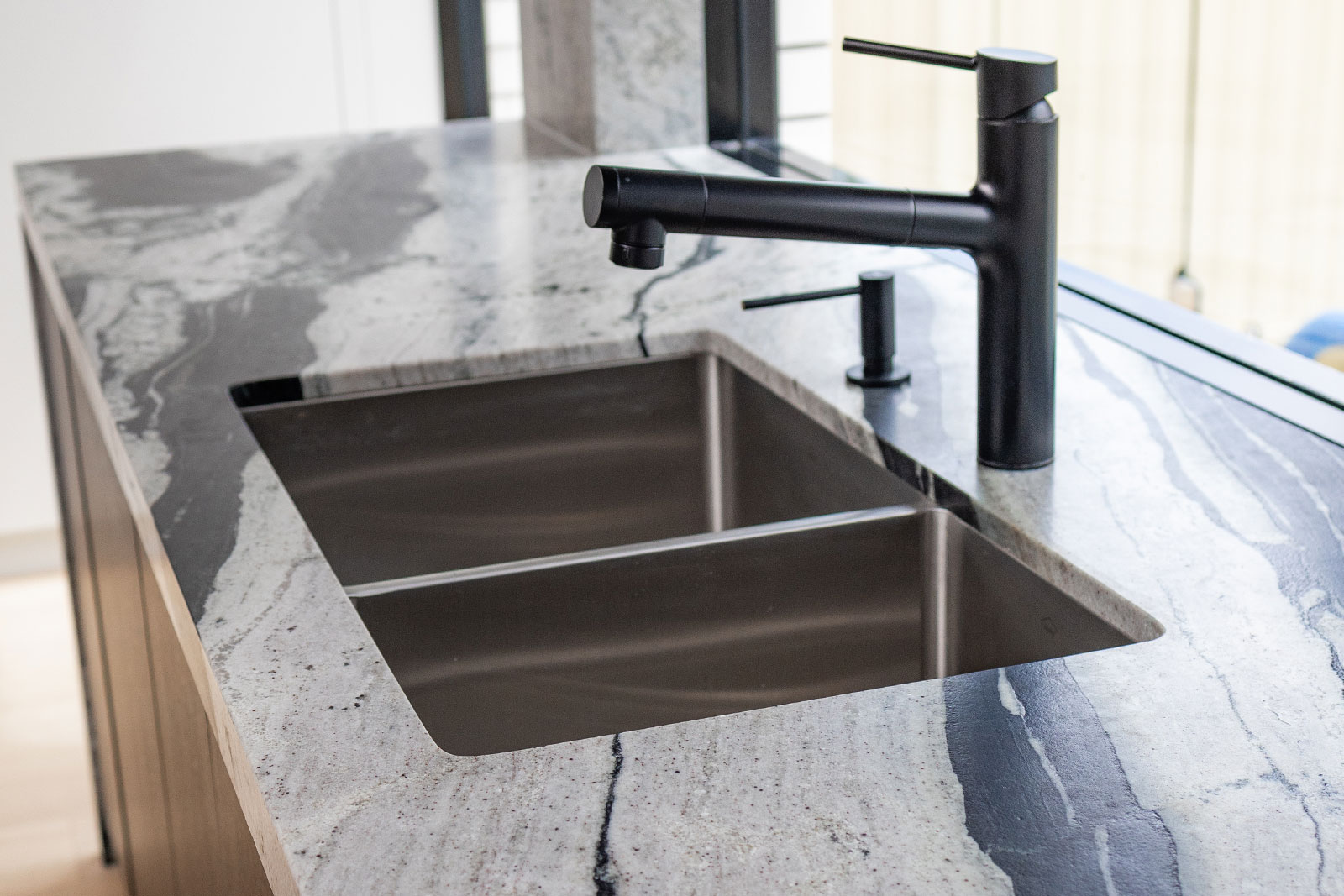
There's no wrong sink style for a stone benchtop, only the right one for how you'll use it. This guide explains the look, cost and maintenance of undermount, flush mount, drop-in and integrated stone sinks from a fabricator's point of view. Drop-in sinks work hard in busy kitchens, butler's pantries and utility laundries, while flush mount gives the sharpest look and needs the most planning. It also explains how Marble Hub reviews and supports every flush mount sink at the factory. Tags: undermount sink, flush mount sink, drop in sink, top mount sink, integrated stone sink, butler's pantry sink, laundry sink, sink cut-out, stone benchtop sink, kitchen sink styles, Sydney stone fabricator, Marble Hub
Undermount vs Flush Mount vs Drop-In Sink for Stone Benchtops | Marble Hub
Let’s Get Started on Your Dream Space
Whether it’s a kitchen, bathroom, or laundry, Kitchen Hub is here to bring your vision to life.
