
Add slabs to your wishlist so we can give you custom quote.
Add productions from our slab collection so we create a quote for your next project!
If you're unsure of what you're after please reach out via our contact page.
Patagonia Quartzite: Is It Worth It? The Honest Answer
Patagonia Quartzite: Is It Worth It? The Honest Answer
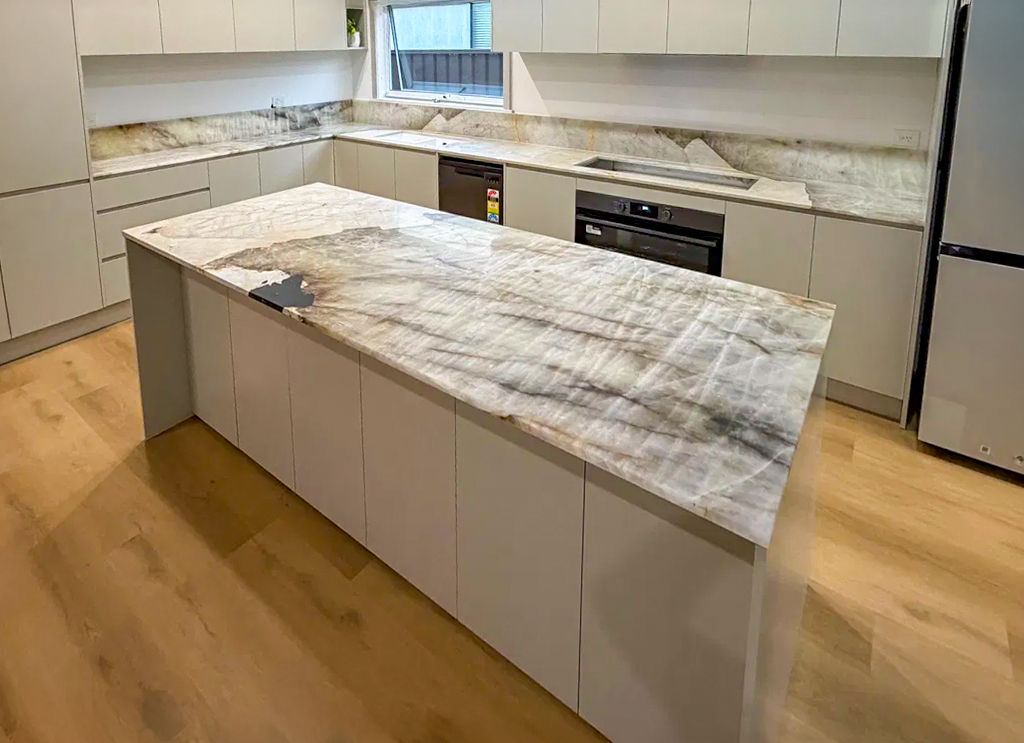
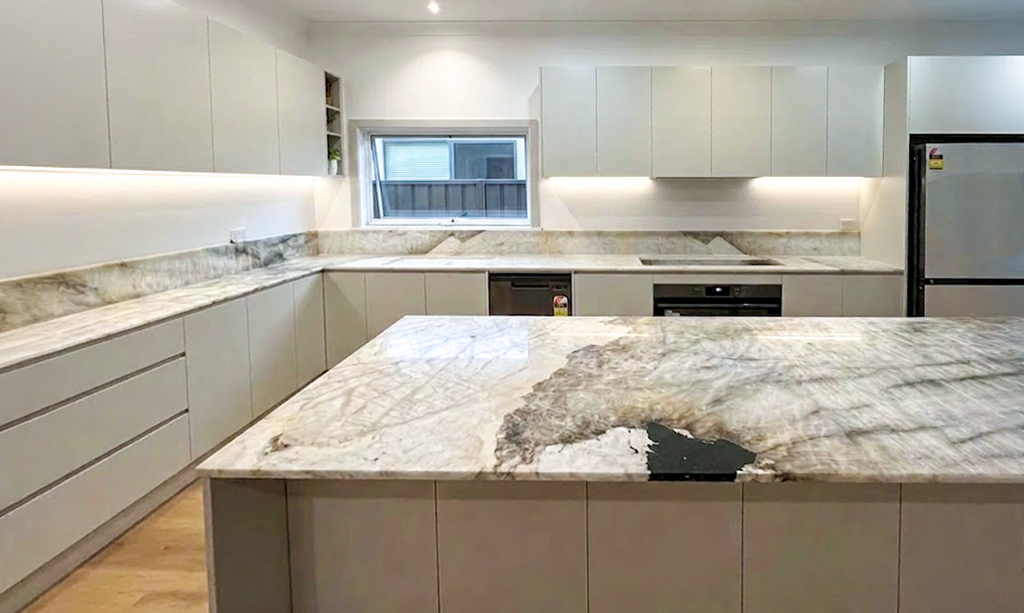
Patagonia quartzite is a hard, durable natural stone with a creamy base, dark charcoal and rusty brown veining, and patches of translucent quartz that catch the light. It suits people who want the benchtop to be the most interesting thing in the room. The owners of this Sydney kitchen made a run of smart calls around it: a 20mm top, a pencil round edge, one mitred waterfall, and a splashback stopped short of the cabinets. Here's why each choice worked.
What is Patagonia quartzite, and is it really quartzite?
Short answer: Patagonia is a genuine quartzite, not a marble and not engineered stone. That matters, because quartzite is harder than marble and much more resistant to acid etching. Lemon or wine is far less likely to leave a mark than it would on marble, though no natural stone is completely etch-proof.
The name gets used loosely, so it's worth being precise. True Patagonia quartzite is quarried in Brazil. It rates around 7 on the Mohs hardness scale, similar to granite, and well above marble at 3 to 4.
The look is what people fall for. A creamy, ivory base, warm beige in places, threaded with light brown. Bold, contrasting veins of charcoal, deep black and rusty brown swept across the top. And patches of transparent quartz set into the surface that catch the light like gemstones. The mix of a light, creamy background against dark, opaque black and brown veins is what gives Patagonia its high drama.
It's still natural stone, so it's porous and needs sealing. It stands up to acids far better than marble, but it isn't bulletproof. More on the trade-offs below.
For the full comparison, see our guide on quartzite vs marble
The project: one stone, throughout
This was a renovation in Sydney's inner west. The owners wanted a statement stone and a calm, handleless kitchen around it. Light timber floors. Light soft grey matte joinery. Clean and simple.
The brief was easy: let the stone lead, and let nothing else compete with it.
The owners came in with clear ideas about the edge, the waterfall and the splashback height. Our job was to advise where it helped, quote it, and fabricate it cleanly. They made good calls. We ran Patagonia quartzite across the perimeter bench, the island and the splashback, then through to the laundry. Their decisions shaped how it reads. Here's why each one worked.
Why a 20mm pencil round edge suits this kitchen
Short answer: A 20mm benchtop with a pencil round edge keeps the profile thin and modern, so the stone reads as a clean plane of movement instead of a heavy slab. The owners chose it, and with a busy stone like Patagonia it's the right instinct. Restraint at the edge stops the kitchen feeling overdone.
The owners asked for a 20mm top with a pencil round edge. With a stone this active, it's a smart call.
People assume thicker means better. With a stone this active, the opposite is true.
A chunky 40mm or 60mm edge adds visual weight. Pile that on top of heavy veining and it starts to feel like too much of a good thing.
The pencil round softens the top corner just enough to feel finished, without asking for attention. It's the most understated edge we make, and that's the strength of it here. The edge should disappear so the surface can do the talking.
This is restraint as a design principle. When one element is doing a lot of work, everything around it should step back. A 20mm pencil round bench is a deliberate choice for sleek, minimal kitchens, not a budget compromise. When clients ask us for it, we rarely talk them out of it.
Weighing up thicknesses? Our piece on edge profiles and benchtop thickness covers when chunky earns its place.
Why a single mitred waterfall suits the island
Short answer: The island has one mitred waterfall. Mitring the corner lets the veining flow down the side with no break, so the stone looks like it folds over the edge in one piece. Choosing one waterfall instead of two keeps the island grounded and avoids a boxed-in look.
The owners wanted a single mitred waterfall on the island. It's the choice we'd have suggested too.
A waterfall end is where the benchtop turns 90 degrees and runs to the floor. Mitred means the two pieces meet at a 45-degree cut, so the pattern carries over the corner with no seam across the top.
With Patagonia, that vein flow over the corner is the whole reward. The charcoal and rusty brown veining keeps running down the side of the island, set against the creamy base. It's a quieter kind of drama than a high-gloss statement.
One waterfall, not two, is the smarter move for balance. Two can make an island feel like a sealed block. One open end keeps the joinery visible and gives the eye somewhere to rest. The result reads as intentional, which is exactly what you want.
See how this plays out across layouts in our kitchen island design guide.
Why a shorter splashback
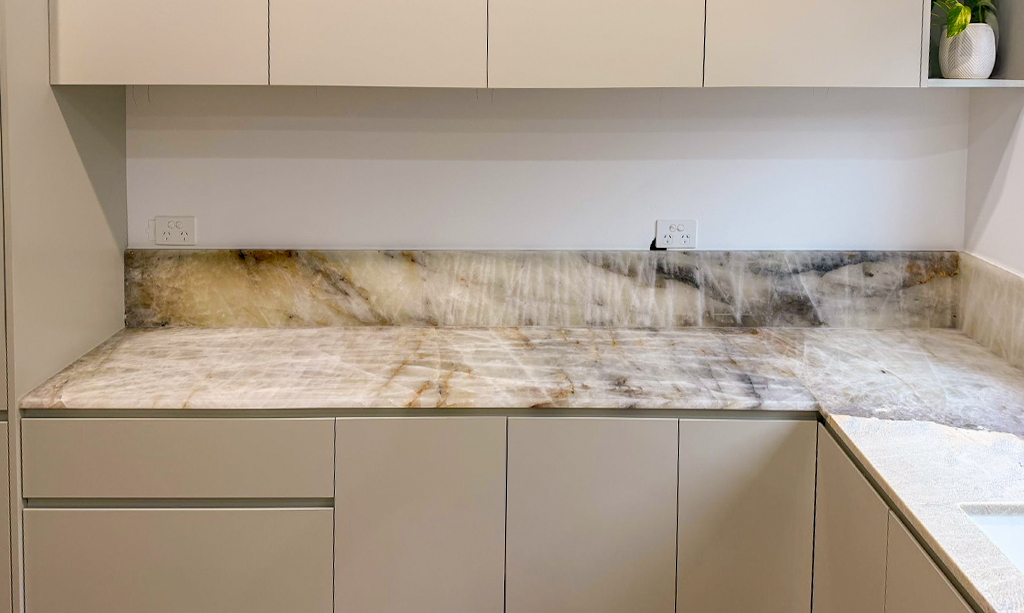
Short answer: Rather than running the splashback full height to the cabinets, this one stops at a lower height. With a stone this active, the lower line keeps the look clean. The stone reads as a defined band of movement instead of a wall of it, and the painted wall above gives the eye room to rest.
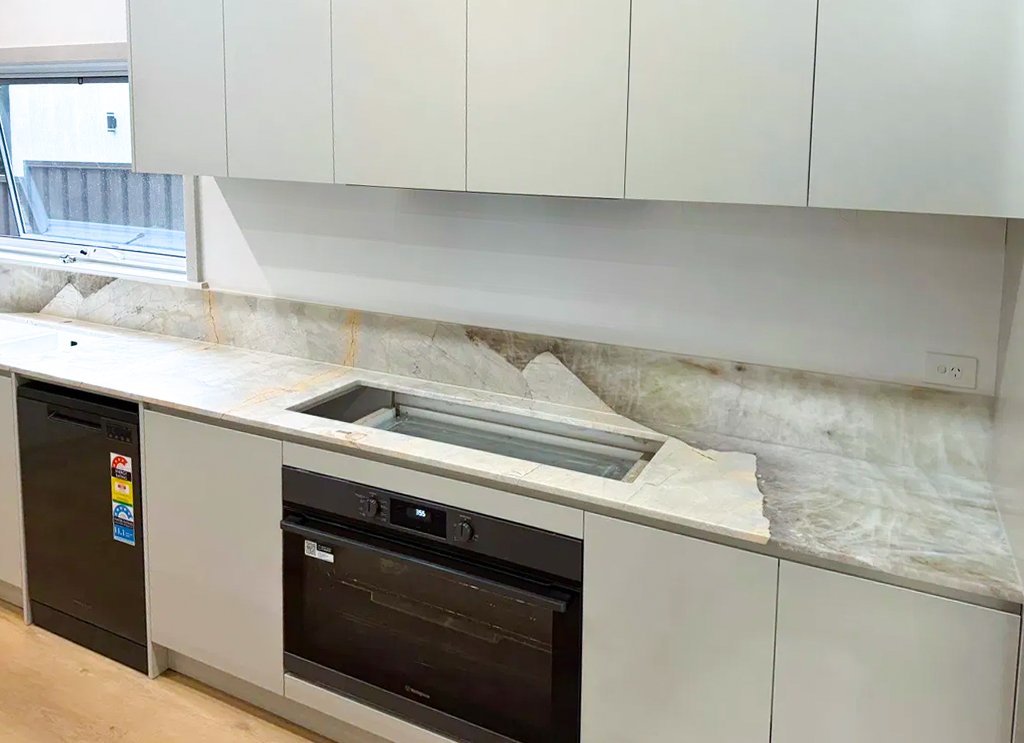
Stopping the splashback short was the owners' idea. It's a good one.
A full-height stone splashback is a beautiful thing, and sometimes it's the right call. Here it would have been too much. Floor to cabinets in a stone this active tips a kitchen from considered into chaotic.
The lower height does two things. It lets the wall above breathe in plain paint, which gives your eye relief. And it turns the stone into a clean horizontal band across the room. That band hits harder because it has space around it.
It keeps the detailing clean too. Power points sit in the painted wall above, not cut into the stone, so nothing interrupts the run of the slab.
This is contrast and proportion working together. Dense stone against a calm wall is what makes the whole thing feel intentional.
Why the stone continues into the laundry
Short answer: The same Patagonia quartzite runs across the laundry bench. Material continuity between rooms makes a home feel designed, not decorated. And a hardwearing quartzite is a sensible surface for a room that takes water, detergent and daily use.
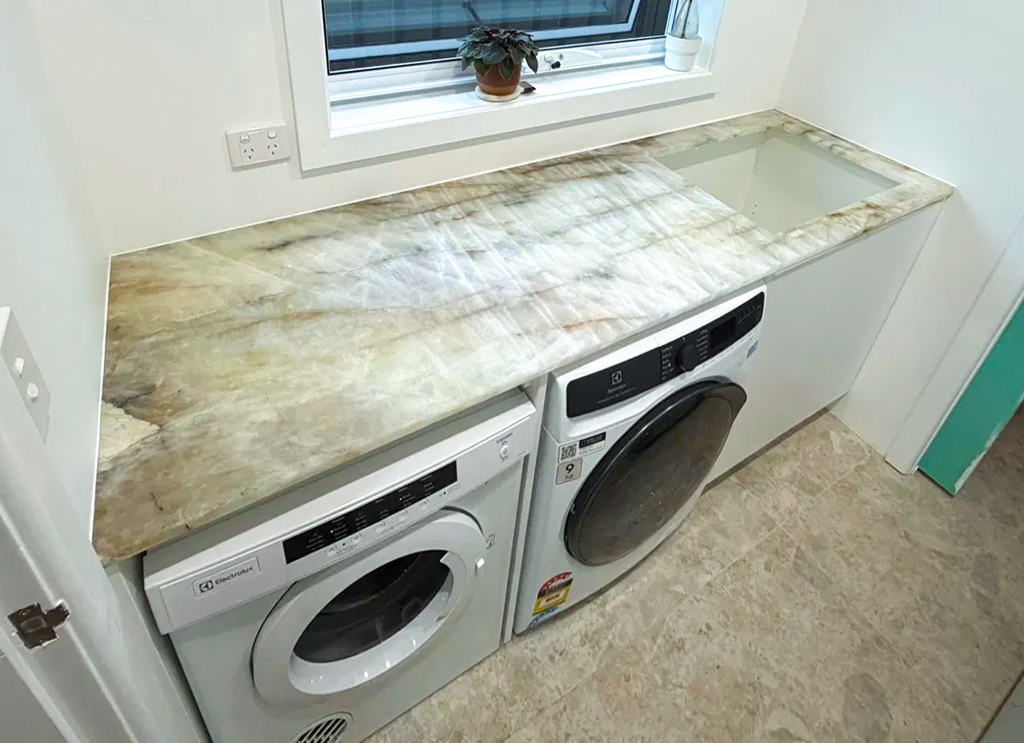
Matching the laundry to the kitchen was the owners' call, and it's one more homes should make.
Laundries are where good material logic usually stops. People spend on the kitchen, then default to plain laminate next door.
Carrying the stone through is one of the cleaner ways to make a home feel cohesive, without paying for a second statement. There's a practical case too. The bench bridges the washer and dryer and gives a folding surface that takes a knock and a wipe. Sealed quartzite handles that better than most softer stones.
The top sits at a comfortable working height under the window, with the same soft grey joinery below. You read the two rooms as one home.
Our guide on stone beyond the benchtop covers more rooms where this pays off.
Why Patagonia is worth the price
Short answer: A stone like Patagonia earns its price because you never stop seeing it. Look at it on a Tuesday morning and you'll catch a vein you'd never noticed. The base shifts with the light through the day, and under dim or evening lighting the translucent quartz comes alive. It has real depth, closer to a piece of art than a benchtop.
Most benchtops you stop noticing within a week. Patagonia isn't one of them.
The depth is the reason. The layers in the stone, the way the dark veins sit over the creamy base, the translucent quartz catching the light, give it a complexity you keep finding new things in. A new vein. A patch you hadn't clocked. A moment where it's hard to believe something this considered was formed underground over millions of years and not drawn by a designer.
It reads differently through the day. Morning light catches it one way, afternoon another. Under dim or evening light, the quartz takes on a glow a printed engineered surface can't reproduce, because there's nothing real underneath to catch the light.
That's where the price makes sense. You're not paying for a work surface. You're paying for something you'll look at every day for years and still find interesting. For the right person, that's worth it. For someone who wants a bench they never think about, it isn't, and that's a fair call too.
The honest trade-offs with Patagonia
No stone is right for everyone. A real recommendation means being straight about the downsides.
It's a statement, not a backdrop. Patagonia has a lot to say. In a small or already-busy room, that movement overwhelms. It works best when the rest of the space is calm: plain joinery, simple floors, restrained edges. If you want a quiet kitchen, this isn't your stone, and that's fine.
It needs sealing. Quartzite is porous. It stands up to acids far better than marble, so lemon, vinegar and wine are much less of a worry than they'd be on marble. It isn't etch-proof though. Some quartzites can still mark, usually far more slowly than marble would, and it can stain if a spill sits long enough on an under-sealed surface. A good seal and normal habits keep it easy to live with.
Every slab is different. Patagonia varies a lot block to block. The creamy base, the black and brown veining, the patches of translucent quartz: no two slabs match. You choose your own slab, you don't order a colour. We bring clients in to see the actual slab first, because a photo never tells you what you're getting.
It sits at the premium end. Patagonia is a high-movement quartzite and it's priced that way. The section above covers why that price earns its place. If that payoff doesn't land for you, it's a fair sign a more affordable surface is the smarter fit.
---
Should you choose Patagonia quartzite?
Choose it if:
- You want the benchtop to be the most interesting surface in the room.
- The rest of your kitchen is calm and ready to let the stone lead.
- You want the durability and stronger acid resistance of a true quartzite, not the softness of marble.
- You're happy to seal it and treat it with normal care.
Reconsider if:
- Your kitchen already has a lot going on with colour, pattern or texture.
- You want a surface you never think about. Sintered stone or porcelain is the more honest fit.
- You want every slab to match the sample, because natural stone won't.
FAQ
Is Patagonia a quartzite or a marble?
Patagonia is a genuine quartzite. It's harder than marble and much more resistant to acid etching, so it's far less likely to dull from lemon or wine. No natural stone is fully etch-proof, but it's more forgiving than marble in a working kitchen. It's still porous and needs sealing.
Does Patagonia quartzite stain?
It can, if a spill sits on an under-sealed surface long enough. Sealed properly and wiped within a reasonable time, it handles everyday kitchen life well. It stands up to acids far better than marble, so acidic spills are much less of a worry, though no stone is completely etch-proof.
Why use a 20mm benchtop instead of a thicker one?
A 20mm top with a pencil round edge keeps the profile thin and modern, which suits a high-movement stone like Patagonia. A chunkier edge adds visual weight, and on top of heavy veining that can feel like too much. Thin is a design choice here, not a saving.
What is a mitred waterfall end?
It's where the benchtop turns down to the floor and the two pieces meet at a 45-degree cut, so the veining flows over the corner with no break across the top. With Patagonia, that continuous vein flow down the side of the island is the main reward.
Can you run quartzite into a laundry?
Yes. Sealed quartzite is hardwearing and handles water, detergent and daily use well. Carrying the same stone from kitchen to laundry also makes a home feel designed as one space rather than room by room.
Is Patagonia quartzite expensive?
It sits at the premium end of natural stone, because it's a high-movement true quartzite and every slab is unique. For a kitchen built to lead with the stone, it does something engineered surfaces can't, since the movement is real geology rather than a printed pattern.
See it in person
Patagonia is a stone you have to stand in front of. Photos flatten the translucency and never show how a slab moves in real light. If you're weighing it up, come and choose your slab at our Strathfield South showroom. We'll talk through the edge, the waterfall and how it sits with your joinery.
Book a slab consult | View the Patagonia quartzite

Outdoor Stone Benchtops That Survive a Sydney Summer
An outdoor benchtop in Sydney has to handle sun, heat, salt air, dust, rain and BBQ fat on the same surface. Porcelain and sintered stone are our first pick, granite is the best natural stone outdoors, and quartzite works with regular sealing. Light-coloured marble is best avoided outside, and engineered stone belongs indoors only, as UV affects it and outdoor use voids the manufacturer's warranty. This guide also covers joins, BBQ heat and why butt joins or shadowlines often outlast mitres outdoors.
Outdoor Stone Benchtops That Survive a Sydney Summer

Engineered Stone vs Natural Stone Benchtops: Honest Comparison | Marble Hub
Natural stone is one of a kind, handles heat well and can be restored for decades, but it needs sealing. Crystalline-silica-free engineered stone is consistent and needs no sealing, but it can scorch and can't be rehoned the same way. We cut both every week and compare them honestly on looks, care, heat, repair and price. We recommend natural stone first, and engineered stone where consistency or easy care matters most.
Engineered Stone vs Natural Stone Benchtops: Honest Comparison | Marble Hub

Pink Cristallo Quartzite for a Northmead Kitchen
A Federation home in Northmead with a new-wing kitchen by designer Vagn Madsen, built by Dan Kitchens Australia, with a Pink Cristallo Quartzite island benchtop and splashback from our Strathfield South showroom. This piece looks at why a pink stone works: subtle white shaker joinery that steps in and out around the rangehood, a soft stone that adds warmth without competing, a curved island with a softened, stepped double bullnose edge, and stone used in just two places. It also covers choosing slabs in person, living with pink quartzite in a family kitchen, and Pink versus White Cristallo.
Pink Cristallo Quartzite for a Northmead Kitchen
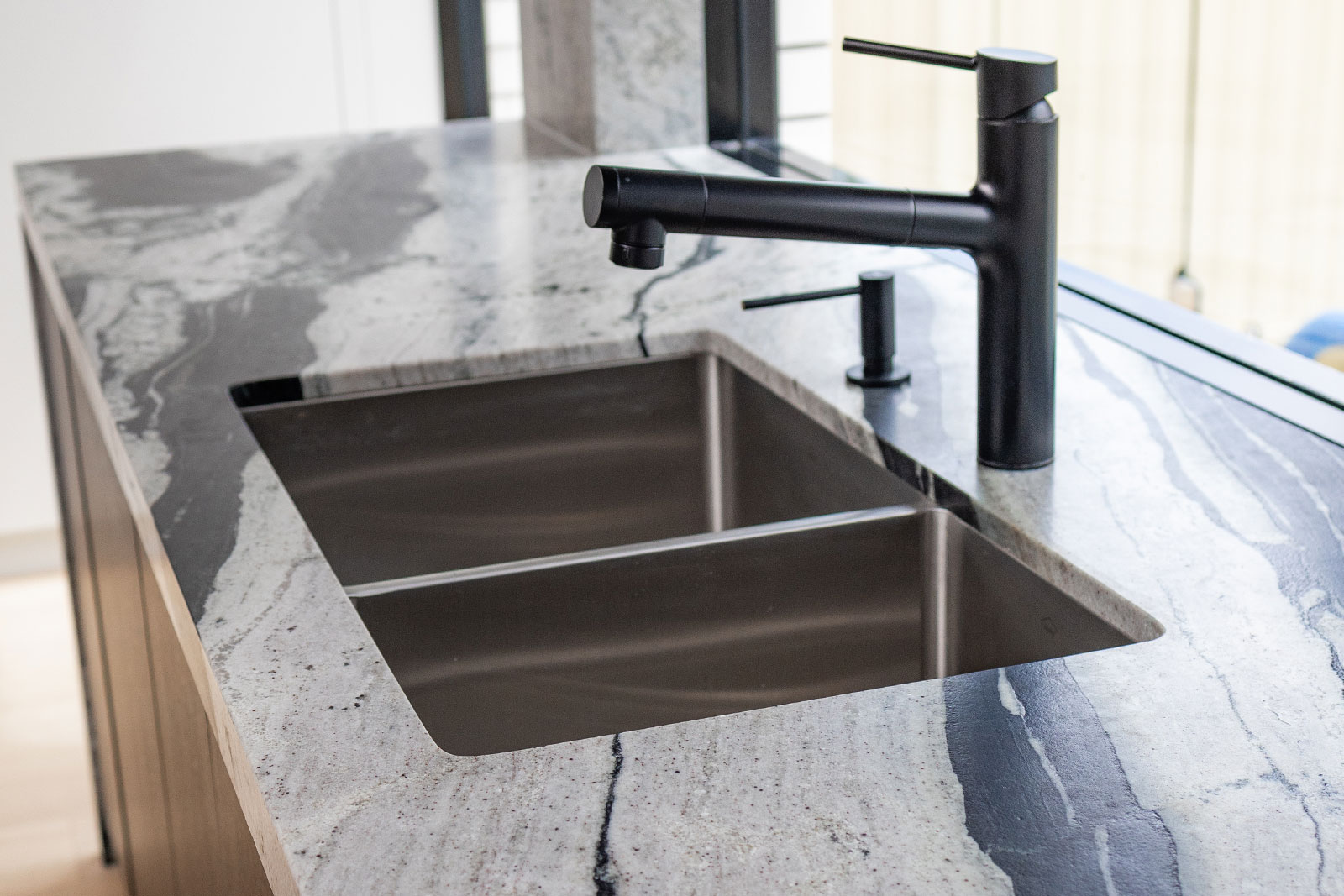
Undermount vs Flush Mount vs Drop-In Sink for Stone Benchtops | Marble Hub
There's no wrong sink style for a stone benchtop, only the right one for how you'll use it. This guide explains the look, cost and maintenance of undermount, flush mount, drop-in and integrated stone sinks from a fabricator's point of view. Drop-in sinks work hard in busy kitchens, butler's pantries and utility laundries, while flush mount gives the sharpest look and needs the most planning. It also explains how Marble Hub reviews and supports every flush mount sink at the factory. Tags: undermount sink, flush mount sink, drop in sink, top mount sink, integrated stone sink, butler's pantry sink, laundry sink, sink cut-out, stone benchtop sink, kitchen sink styles, Sydney stone fabricator, Marble Hub
Undermount vs Flush Mount vs Drop-In Sink for Stone Benchtops | Marble Hub
Let’s Get Started on Your Dream Space
Whether it’s a kitchen, bathroom, or laundry, Kitchen Hub is here to bring your vision to life.
